A cooled-versus-uncooled decision should not begin with the detector label. It should begin with the operational decision the image must support: early detection, class recognition, subtype identification, tracking, evidence collection or temperature measurement. The same camera architecture can be appropriate in one project and unnecessarily complex—or insufficient—in another.
Cooled thermal cameras can reduce detector noise and support demanding sensitivity, spectral and long-range imaging requirements. Uncooled thermal cameras avoid a cryogenic cooler and normally offer lower size, weight, power, cost and maintenance burden. Neither description is a project answer. The correct choice is the lowest-complexity architecture that passes a target-specific, environment-specific and system-level acceptance test with adequate margin.
This guide gives system integrators and buyers a defensible method for comparing the two architectures without relying on one headline range, one NETD number or one product demonstration.
Jump to the mission-based selection matrix →
AI Summary — Key Points at a Glance
- Start with the task, not the technology: use uncooled when it passes the defined target test; add a cooled architecture only when the operational gap is documented and the lifecycle burden is justified.
- Uncooled cameras are often the practical choice for persistent, distributed and quantity-sensitive surveillance when they meet the required task.
- Cooling state, detector material and spectral band are related design choices but are not interchangeable labels.
- Operational range depends on the entire imaging chain: target, atmosphere, detector, optics, stabilization, processing, compression, display and scoring rule.
- Radar cueing requires more than a video stream; coordinate conversion, timestamps, PTU performance, calibration, metadata and failover must be specified.
The purchase decision should be made from a common RFI/RFQ basis and verified through FAT and SAT—not from different suppliers’ catalogue ranges.
Cooled vs Uncooled Thermal Cameras for Long-Range Surveillance: How to Choose
1. Define the Operational Task Before the Detector
Thermal surveillance requirements often use broad phrases such as “detect a person at 10 km” or “identify a vessel at long range.” These are incomplete because detection, recognition, identification and evidence capture are different tasks. A warm spot may support early warning while still being unsuitable for class recognition. A clear target silhouette may support class recognition without allowing subtype identification or evidential detail.
The requirement should define the target class, critical dimension, aspect, background, range bands, warning time, decision to be made and the probability or repeated-trial rule. It should also state whether the human operator, an analytics model or both will perform the task.
| Requirement input |
Minimum definition |
| Operational task |
Detection, class recognition, subtype identification, tracking, evidence, radiometry or a combination. |
| Target |
Dimensions, material/emissivity where relevant, orientation, speed, route and expected concealment. |
| Scene |
Background type, clutter, thermal contrast, skyline/ground viewing and day/night periods. |
| Range and time |
Required range bands, warning time, dwell time and revisit or track-update needs. |
| Decision rule |
Probability, repeated successes, blind scoring or analytics threshold; exclusions and degraded modes. |
| Evidence |
Original video, metadata, environmental records, logs, operator scoring and retention requirements. |
2. What Cooling Changes Inside a Thermal Camera
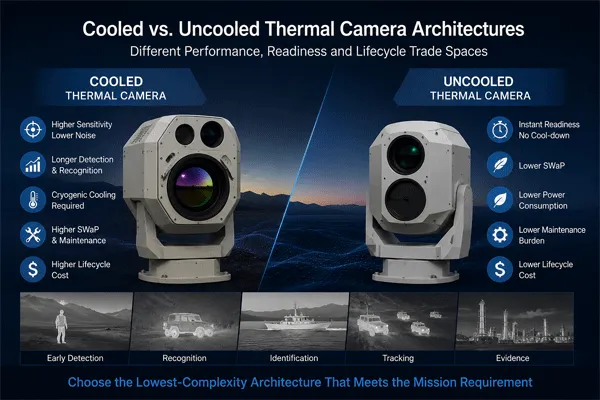
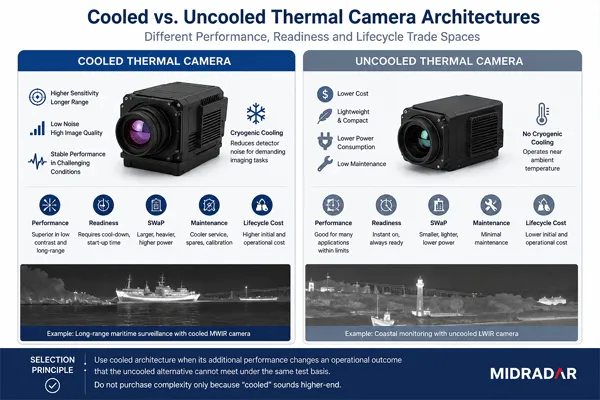
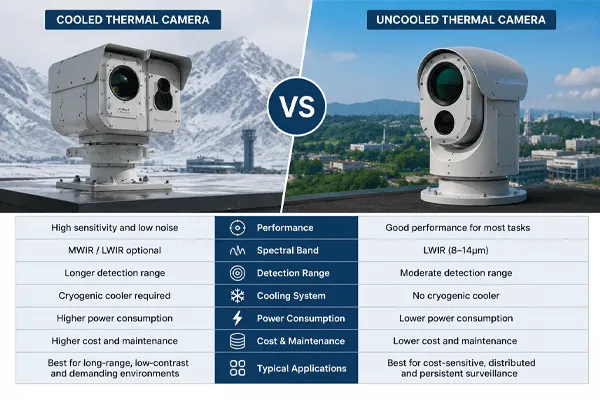
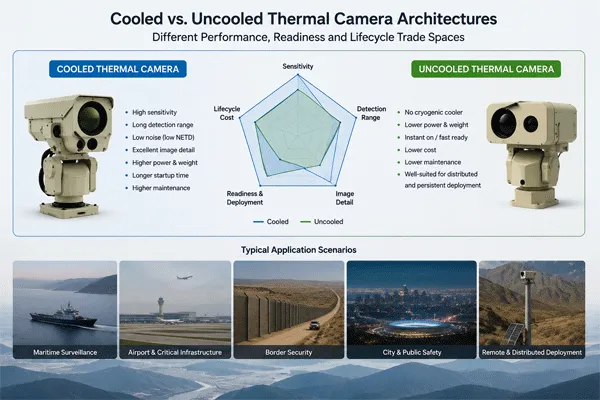
A cooled camera uses a cryogenic cooler to lower the detector temperature. Reducing detector-generated thermal noise can improve sensitivity and support demanding imaging tasks. The cooler and its associated control hardware also introduce a start-up cycle, additional power, mass, mechanical complexity and an eventual service requirement.
An uncooled detector operates near ambient temperature and does not require a cryogenic cool-down cycle. This normally simplifies the payload, reduces the readiness and sustainment burden and makes the architecture attractive for persistent fixed-site coverage, mobile platforms with limited power and deployments that require many sensor nodes.
3. Separate Cooling Architecture From Spectral Band
Cooled and uncooled describe detector temperature control; MWIR and LWIR describe spectral channels. They are related implementation choices, not interchangeable labels. Specify both, then use the dedicated MWIR-versus-LWIR guide for wavelength-dependent atmosphere, contrast and optical-material decisions.
Use the dedicated MWIR-versus-LWIR guide for wavelength-dependent atmosphere, target-background contrast and optical-material decisions. This page should remain focused on whether the mission justifies a cooled or uncooled architecture.
Cooled vs Uncooled Thermal Cameras for Long-Range Surveillance: How to Choose
4. Compare the Complete Imaging Chain
Operational image quality is created by the complete chain: target contrast, atmosphere, detector, optics, stabilization, processing, compression, display and scoring rule. Compare complete proposed systems on the same target and scene rather than comparing detector labels in isolation.
For product-family context, review Midradar’s thermal imaging cameras and broader optoelectronic systems. These pages are discovery and capability entry points; the project decision still requires the common evaluation basis in this guide.
5. NETD and Sensitivity: Useful, but Not a Range Guarantee
NETD is a useful sensitivity indicator under stated detector, optics and processing conditions, but it is not a range claim. Ask whether the value applies to the detector core or complete camera and require representative low-contrast imagery with the processing state disclosed.
A valid comparison should identify the test condition, lens f-number, detector temperature, integration time, image processing state and whether the number refers to a detector core or complete camera. The buyer should also inspect imagery in low-contrast scenes rather than only high-contrast demonstrations.
| Evidence item |
Architecture-selection purpose |
| Complete-camera sensitivity basis |
Confirms whether performance is measured through the delivered optics and processing chain. |
| Representative low-contrast imagery |
Shows whether added cooling changes the required operational decision. |
| Readiness and restart evidence |
Quantifies cool-down, standby, recovery and degraded-mode behavior. |
| Service and lifetime evidence |
Defines cooler health, replacement, spares, turnaround and downtime risk. |
6. Calculate and Test Range by Operational Task
Cooling architecture alone does not define detection, recognition or identification range. Use the separate DRI methodology to calculate pixels on target and atmospheric effects, then verify the proposed camera against representative targets, range bands, backgrounds, stabilization and a defined scoring rule. Digital zoom must not be counted as additional optical sampling.
7. Account for Atmosphere and Background
Humidity, aerosols, sea spray, dust, fog, rain, thermal turbulence and hot terrain can reduce contrast or change the relative value of detector sensitivity and waveband. Require the atmospheric model or field condition behind every long-range prediction and test the operational windows that matter to the project, not only a favourable demonstration period.
Cooled vs Uncooled Thermal Cameras for Long-Range Surveillance: How to Choose
8. Optics, Field of View and Search Efficiency
Optics must support both search and verification. Specify field of view at operational focal lengths, aperture, focus and zoom repeatability, boresight stability and stabilization. Detailed waveband-specific optical material and transmission controls belong in the MWIR-versus-LWIR article.
Specify horizontal and vertical field of view at each operational focal length, clear aperture or f-number, focus method, focus repeatability, minimum focus distance, transmission, boresight stability and the time needed to change fields of view. If the camera is radar-cued, verify that the target remains inside the narrow field after coordinate conversion, PTU motion and settling.
| System factor |
Architecture-selection check |
| Search and verification fields of view |
Confirm that the proposed architecture supports the required acquisition and identification workflow. |
| Stabilization and boresight |
Verify that added sensitivity is not lost through motion, pointing error or zoom-dependent shift. |
| Payload and platform burden |
Check lens aperture, housing, PTU torque, power and environmental-control effects. |
| End-to-end acceptance |
Test the delivered camera, optics, platform, video path and scoring rule together. |
9. Readiness, SWaP and Deployment Architecture
Persistent surveillance may value immediate availability more than peak laboratory sensitivity. A cooled payload must reach operating condition before it can deliver its specified performance, so start-up, restart after power loss, standby mode and failover should be contractual parameters. Power and heat rejection also affect cabinets, vehicles, masts and backup-energy design.
Uncooled cameras can simplify distributed deployments and reduce the burden on solar, battery or vehicle power. Cooled systems may be justified at a smaller number of priority observation posts while uncooled cameras cover secondary sectors. Mixed architectures are often more defensible than forcing one detector type across every zone.
| Deployment concern |
Uncooled architecture |
Cooled architecture |
| Readiness |
Normally no cryogenic cool-down cycle; verify boot and image-ready time. |
Define cool-down, restart, standby and degraded-mode behavior. |
| Size/weight/power |
Usually lower, supporting distributed or mobile installations. |
Higher burden may affect PTU, mast, vehicle, UPS and thermal management. |
| Quantity scaling |
Often practical for many persistent nodes. |
Often reserved for priority sectors where performance benefit is operationally material. |
| Maintenance logistics |
Lower cooler-specific burden; still requires optics, sealing, calibration and software support. |
Requires cryocooler health, service interval, spares, replacement process and downtime plan. |
| Failover |
Can use overlapping nodes or spare units. |
May require warm standby, overlapping uncooled coverage or a service-replacement strategy. |
10. Reliability, Maintainability and Total Cost of Ownership
Acquisition price is only one cost layer. A ten-year comparison should include power, environmental control, cooler service or replacement, calibration, spares, software licences, cybersecurity updates, training, shipping, customs handling, field labor and the operational cost of downtime.
Ask the supplier to state the cryocooler design life basis, health indicators, rebuild or replacement method, expected turnaround, field-replaceable-unit boundary and warranty treatment. For uncooled systems, verify shutter/NUC behavior, detector stability, lens and housing maintenance, calibration needs and long-term availability of the core and interfaces.
| TCO element |
Evidence to obtain |
| Acquisition scope |
Camera, lens, housing, PTU/stabilization, server, software, interfaces, accessories and commissioning. |
| Energy and infrastructure |
Normal/peak power, heaters/cooling, UPS, cable, cabinet, network and mounting requirements. |
| Scheduled maintenance |
Inspection, cleaning, calibration, cooler service, seals, desiccant, fans and software maintenance. |
| Spares and repair |
Recommended spares, repair level, field replacement time, turnaround, obsolescence and escalation route. |
| Downtime risk |
Warm-up/restart, single points of failure, overlapping coverage, loan units and degraded operation. |
| Lifecycle software |
Firmware, security patches, analytics models, API compatibility and configuration backup/restore. |
11. Treat Radar Cueing, Video and Cybersecurity as System Requirements
A radar-cued cameramust receive a usable target state, convert coordinates, move and settle, place the target inside the selected field of view and maintain track through the operator or automatic workflow. Freeze timestamps, coordinate frames, PTU performance, boresight calibration, metadata, event mapping and failure handling before award.
Define codecs, frame rate, latency, authentication, encryption, roles, logging, patching and configuration backup. Treat “ONVIF Profile T supported” as an interface claim until the required video, metadata and PTZ functions are tested with the proposed device-client combination.
12. Mission-Based Selection Matrix
| Mission pattern |
Likely starting architecture |
Why |
Buyer must prove |
| Distributed perimeter nodes |
Uncooled |
Lower SWaP and lifecycle burden can support many always-on sectors. |
Target task, clutter, coverage overlap, analytics and maintainability. |
| Priority ultra-long-range sector |
Cooled candidate |
Added sensitivity/optics may extend usable decision range when atmosphere and platform support it. |
Common target test, atmosphere, cool-down, stabilization and lifecycle support. |
| Harbor or coastal early warning |
Evaluate both / mixed |
Long path, haze, sea background, corrosion and vessel motion can change the trade. |
Seasonal visibility, small-vessel task, platform motion, lens and field test. |
| Border watchtower network |
Mixed architecture |
Cooled sensors may serve priority posts; uncooled sensors may scale secondary coverage. |
Sector-specific target routes, power, maintenance logistics and failover. |
| Radar-cued UAV verification |
Evaluate by target and FOV |
Fast cueing, narrow target size and track dynamics may dominate the detector label. |
End-to-end target-in-frame probability, latency, optics and PTU performance. |
| Industrial thermography |
Usually radiometric architecture selected by measurement task |
Temperature measurement needs calibration, emissivity and accuracy controls beyond surveillance imaging. |
Measurement range/accuracy, emissivity, reflected temperature, windows and calibration. |
13. Use a Structured Selection Workflow
Figure 3. A mission-driven workflow prevents the detector label from replacing project engineering.
- Define the target, operational decision, range bands, warning time and evidence requirement.
- Document the site geometry, backgrounds, seasonal atmosphere, installation positions, power and maintenance access.
- Ask suppliers to screen cooled and uncooled candidates against the same target and scoring basis.
- Freeze optics, PTU/stabilization, radar cueing, video, metadata, cybersecurity and software responsibilities.
- Compare lifecycle cost, spares, cryocooler service, calibration, updates and downtime—not only purchase price.
- Run FAT and SAT with representative targets, environmental records, original video and agreed pass/fail rules.
14. Move the Detailed RFQ and FAT/SAT Records Into Downloadable Assets
Use the editable Thermal Camera RFI/RFQ Data Sheet to capture targets, range bands, atmosphere, detector and optics data, platform interfaces, video, cybersecurity, maintenance and acceptance requirements. Use a separate FAT/SAT record to document configuration, original video, target geometry, environmental conditions, radar cueing and pass/fail evidence. The public page should explain the decision method rather than reproduce every project field.
15. Apply the Method to Product Families
Use Midradar’s uncooled thermal camera, cooled thermal camera and electro-optical product families as candidate starting points only after the mission screen is complete. Final selection requires the exact detector and waveband, optics, platform, environment, interface, service model and acceptance basis. Published range examples must not be converted into universal project guarantees.
Conclusion
The cooled-versus-uncooled decision is not a technology ranking. It is a mission, system and lifecycle trade. Cooled cameras may be justified when reduced detector noise, specialized spectral performance and long-range optics create a measurable operational advantage. Uncooled cameras may provide the more robust and scalable architecture when they meet the required task without cryocooler burden.
A defensible procurement decision defines the target and task, models the atmosphere, compares the complete imaging chain, freezes integration responsibilities, calculates lifecycle cost and verifies the selected system through FAT and SAT. The lowest-complexity configuration that passes that process with margin is usually the correct starting point.
Request a Target-Specific Thermal Camera Architecture Review
Midradar can prepare a preliminary cooled-versus-uncooled configuration basis for border, port, airport, perimeter, coastal, industrial and radar-cued surveillance projects. Provide:
| Site & Sectors Site map, coordinates, installation points and protected sectors. |
Targets & Routes Target types, dimensions, routes and required operational decisions. |
| Range & Task Detection, recognition, identification or evidence range bands. |
Environment Visibility, humidity, dust, sea spray, temperature and seasonal conditions. |
| Infrastructure Power, network, PTU/stabilization and maintenance constraints. |
Existing Interfaces Radar, VMS, PSIM, C2 or video-platform interfaces. |
| Acceptance Evidence Acceptance-test expectations, required records and pass/fail basis. |
Project Context Destination country, delivery schedule, local approvals and support model. |
| Request Architecture Review |
Download the Fillable RFI/RFQ Data Sheet (PDF) |
The output can be used to compare detector architecture, optics, integration scope, lifecycle responsibilities and acceptance evidence on consistent terms.
FAQ
Is a cooled thermal camera always better than an uncooled camera?
No. A cooled camera may offer stronger sensitivity and demanding long-range performance, but it also adds cool-down time, power, mass, cost and cryocooler maintenance. The correct choice is the architecture that passes the defined project task and lifecycle requirements.
Why are uncooled thermal cameras widely used for security surveillance?
Uncooled cameras normally avoid cryogenic cool-down and offer lower size, weight, power, cost and maintenance complexity. They can be well suited to persistent, distributed and quantity-sensitive monitoring when their target performance is adequate.
Does a lower NETD guarantee a longer detection range?
No. NETD is a sensitivity metric under stated conditions. Operational range also depends on target size and contrast, optics, atmosphere, stabilization, image processing, compression, display and the detection or identification criterion.
How should cooled and uncooled camera ranges be compared?
Use the same target, aspect, atmosphere, range, optics basis, processing state and probability or repeated-trial rule. Compare recorded system-level evidence rather than unrelated catalogue figures.



 10:41
10:41