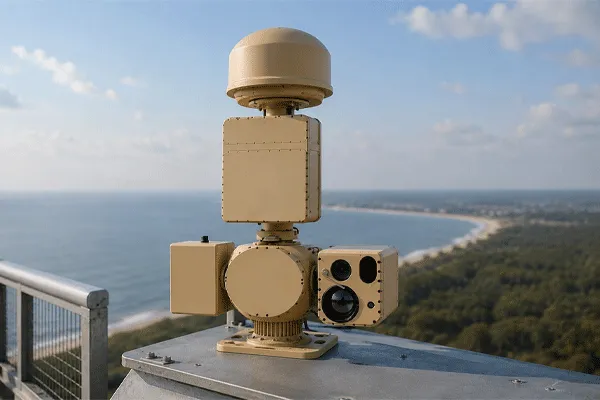
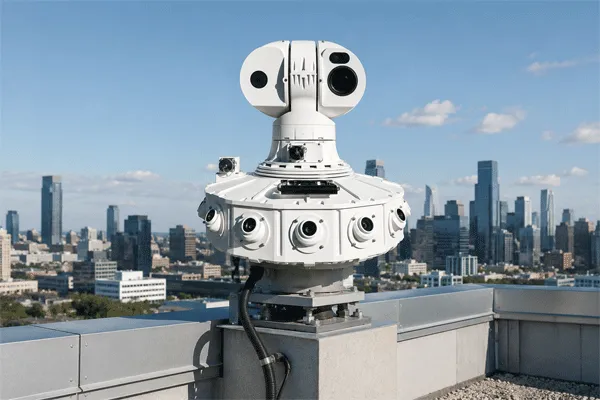
MWIR and LWIR should be compared as wavelength-dependent imaging channels, not as shorthand for cooled and uncooled cameras. The correct waveband depends on the target’s apparent temperature and emissivity, the background, atmospheric path, solar effects, optical design, detector technology and the operational decision the image must support.
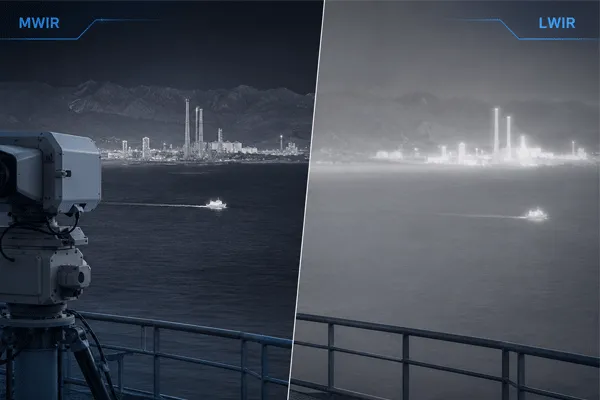
MWIR vs. LWIR Thermal Cameras for Long-Range Surveillance
1. Cooling State and Spectral Band Are Different Decisions
Long-range cooled surveillance systems commonly use mid-wave infrared detectors, while many uncooled security cameras use long-wave infrared microbolometers. These are common implementation patterns, not universal definitions. A specification should separately identify detector material, spectral response, cooling method, array format, pixel pitch, frame rate and calibration mode.
This distinction matters because atmospheric transmission, target emission, solar reflections, optics materials, thermal background and available detector technologies vary by wavelength. A buyer who writes only “cooled thermal camera” has not yet specified the channel that must be tested.
| Specification field |
Why it must be explicit |
| Detector material and architecture |
Clarifies whether the proposal uses a photon detector, microbolometer or another architecture. |
| Spectral band |
Defines the wavelength region used by the complete detector-and-optics channel. |
| Cooling method and cool-down time |
Affects readiness, power, duty cycle, maintenance and failover planning. |
| Array format and pixel pitch |
Influence sampling, field of view, optics size and DRI calculations. |
| Frame rate and latency |
Affect tracking, analytics, operator response and export/compliance review where applicable. |
| Radiometric or imaging-only mode |
Temperature measurement and security imaging have different calibration and acceptance needs. |
Common Selection Mistakes to Avoid Before Comparing Cameras
Before comparing sensitivity, range or spectral-band claims, eliminate these eight specification errors from the RFI/RFQ basis.
| Mistake |
Better waveband decision |
| Treating cooled/uncooled as spectral bands |
Specify cooling method and exact detector spectral response separately. |
| Using one favorable daytime scene |
Compare the same target across critical day/night, background and weather windows. |
| Comparing unrelated catalogue ranges |
Use the same target, atmosphere, field of view, processing and scoring rule. |
| Selecting from NETD alone |
Align the measurement basis and review common-scene low-contrast evidence. |
| Ignoring sub-band and lens transmission |
Require complete detector-plus-optics spectral response and aperture data. |
| Using focal length as optical equivalence |
Compare field of view, target sampling, aperture, MTF evidence and stabilization. |
| Assuming one band for every sector |
Allow sector-based or mixed architectures where the evidence supports them. |
2. What MWIR and LWIR Change in the Imaging Problem
| Decision factor |
MWIR consideration |
LWIR consideration |
| Typical spectral region |
Approximately 3-5 µm, subject to exact detector response |
Approximately 8-12 µm, subject to exact detector response |
| Detector implementation |
Commonly cooled for demanding long-range surveillance |
Commonly uncooled in security systems; cooled LWIR also exists |
| Solar and reflected components |
Can be more sensitive to reflected energy in some daytime scenes |
Often dominated by emitted thermal contrast, but scene dependent |
| Atmospheric path |
Transmission varies with humidity, aerosols and selected sub-band |
Transmission also varies with humidity, aerosols and weather |
| Optics |
Requires materials and coatings suitable for the selected MWIR band |
Requires materials and coatings suitable for the selected LWIR band |
| Best choice |
Must be established by target, background, path and acceptance test |
Must be established by target, background, path and acceptance test |
3. Compare the Complete Imaging Chain
The waveband decision must preserve spectral information through the full channel. Compare detector response, lens transmission, aperture, calibration, processing and display together; a strong detector cannot recover contrast lost through unsuitable waveband optics or a path with poor transmission.
Figure 2. The useful waveband is determined by the detector-plus-optics spectral channel, atmospheric path and target-background contrast.
Use the Midradar category pages only to identify candidate hardware. Before comparison, record each candidate’s exact detector response, operating sub-band, lens transmission and aperture across the required field-of-view range.
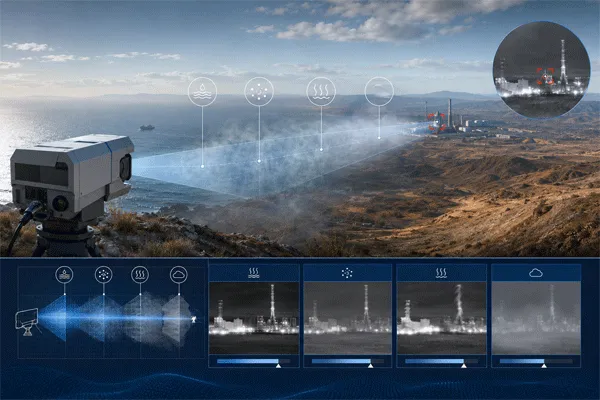
MWIR vs. LWIR Thermal Cameras for Long-Range Surveillance
4. Do Not Select a Waveband From NETD Alone
NETD values are not directly comparable unless detector temperature, selected sub-band, lens f-number, integration time and processing state are aligned. Use NETD only as one input, then inspect common-scene recordings during low target-background contrast and thermal crossover.
For a waveband comparison, align detector temperature, selected sub-band, lens f-number, integration time and processing state. Review synchronized recordings of the same low-contrast scene so that spectral-channel differences are not confused with unequal optics or enhancement settings.
| Waveband comparison input |
Why it matters |
| Exact detector spectral response and selected sub-band |
Atmospheric and target contrast can vary within the broad MWIR or LWIR label. |
| Complete lens transmission and f-number across zoom |
Delivered signal depends on optics, not detector response alone. |
| Common target/background radiance or temperature contrast |
Prevents different scenes from being presented as waveband superiority. |
| Path model and measured weather variables |
Makes range prediction traceable to humidity, aerosols, visibility and geometry. |
| Original synchronized recordings and metadata |
Allows side-by-side scoring without selected screenshots or unequal processing. |
5. Atmosphere and Background Can Reverse the Ranking
Environmental Scenarios That Can Change the Waveband Decision
Water vapor, aerosols, sea spray, dust, fog, rain and turbulence affect MWIR and LWIR differently across specific sub-bands and paths. Background can reverse the apparent advantage: solar reflection, sky radiance, warm terrain, water and industrial exhaust may change target contrast by time and viewing geometry. Model the critical site windows rather than declaring one band universally superior.
The supplier should state the atmospheric model or field condition behind every long-range prediction. For high-value projects, evaluate seasonal and daily windows rather than one favorable demonstration. The site model should include installation height, slant path, horizon geometry, expected background and the periods in which the decision is most critical.
| Environment |
What to model or test |
| Humid coastal/harbor |
Water vapor, sea spray, haze, sun glint, warm water/sky backgrounds, corrosion and platform motion. |
| Hot desert |
Dust/aerosols, solar heating, thermal turbulence, low target contrast near crossover and cooling/airflow burden. |
| Cold or high-altitude |
Low ambient temperature, icing, focus shift, heater demand, snow background and cold-start behavior. |
| Industrial site |
Hot equipment, steam, exhaust plumes, reflective surfaces, vibration, electromagnetic environment and maintenance access. |
| Urban/perimeter |
Dense backgrounds, traffic, heat sources, occlusion, lighting transitions and privacy/data-retention constraints. |
6. Optics and Field of View Must Match the Waveband
Waveband-specific optics control transmission, aperture, focus behavior and boresight stability. Require the supplier to disclose lens material/coatings, clear aperture or f-number across zoom, transmission over the claimed band, focus shift with temperature, zoom-dependent boresight and calibration method. Compare equivalent fields of view and target sampling, not focal length alone.
Specify horizontal and vertical field of view, target sampling and aperture at each operational focal length. Require waveband-specific transmission, temperature-dependent focus behavior and zoom boresight data. For radar-cued tests, hold coordinate conversion, PTU motion and settling constant so the comparison isolates the imaging channel.
| Waveband optical control |
Buyer should request |
| Spectral transmission |
Lens material, coatings and measured/declared transmission across the operating sub-band. |
| Aperture across zoom |
Clear aperture or f-number at each operational focal length, including any closing aperture. |
| Focus stability |
Focus method, repeatability and temperature-dependent shift for the selected band. |
| Boresight stability |
Thermal-to-visible alignment and boresight change with zoom and temperature. |
| Equivalent image scale |
Horizontal/vertical field of view, target pixels and stabilization on a common scene. |
7. Use Mission Scenarios Instead of Universal Rules
| Mission scenario |
Questions to resolve before choosing |
| Border and desert surveillance |
Day/night background temperature, dust and aerosol path, hot-terrain crossover, warning time and maintenance access |
| Coastal and port surveillance |
Humidity, sea spray, haze, horizon background, platform vibration and corrosion protection |
| Airport and critical infrastructure |
Target classes, false-alarm environment, integration latency, field of view and operator recognition task |
| Industrial monitoring plus security |
Whether radiometric measurement is required, target temperature range and calibration traceability |
| Radar-cued long-range tracking |
Target-in-frame probability after coordinate conversion, PTU settling, narrow-field selection and atmospheric loss |
No row in this table automatically selects MWIR or LWIR. It identifies the evidence needed for a project-specific comparison.
MWIR vs. LWIR Thermal Cameras for Long-Range Surveillance
8. Define a Common Supplier Comparison Basis
- Exact spectral response, detector material, cooling method, array format and pixel pitch.
- Lens focal lengths, clear aperture or f-number, transmission and field of view.
- Target dimensions, apparent temperature or contrast assumption and background condition.
- Atmospheric model, path length, weather variables and transmittance assumption.
- Image processing, integration time, calibration mode, compression and display path.
- Detection, recognition or identification scoring rule and probability requirement.
- Power, readiness time, service model, spares and lifecycle obligations.
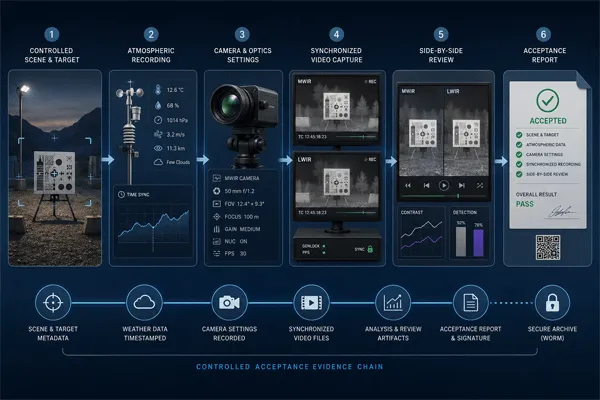
9. Test MWIR and LWIR With the Same Evidence Chain
A fair field comparison uses the same target, route or position, range, time window, atmospheric record, mounting stability, display and scoring method. Preserve original video and metadata rather than relying on selected screenshots. Record focus state, focal length, processing mode, detector temperature, calibration events and operator decisions.
| Test element |
Minimum evidence |
| Scene and target |
Dimensions, range, background and time |
| Atmosphere |
Temperature, humidity, visibility or aerosol observation and weather |
| Camera state |
Detector, waveband, optics, focus, processing and calibration |
| Image chain |
Original stream, compression, display and recording configuration |
| Scoring |
Defined detection/recognition/identification rule and reviewer method |
| Result |
Probability, limitations, exceptions and retained sample set |
10. Relationship to Cooled vs. Uncooled Selection
Waveband selection and cooling architecture influence each other, but they answer different questions. Use this page to decide which spectral channel deserves project testing. Then use the cooled-versus-uncooled guide to compare readiness, SWaP, sensitivity, maintenance and lifecycle cost for candidate architectures in that channel.
Conclusion
MWIR is not universally superior to LWIR, and LWIR is not automatically the lower-performance option. The defensible choice is the waveband whose complete imaging chain passes the target-specific, atmosphere-specific and task-specific acceptance test with adequate margin and an acceptable lifecycle burden. Review the thermal imaging camera portfolio for current product classes and the radar-vision fusion architecture for end-to-end cueing context.
FAQ
Is MWIR always cooled?
No. Cooled MWIR is common in long-range surveillance, but cooling state and spectral response must be specified independently.
Is LWIR always uncooled?
No. Uncooled LWIR microbolometers are common, but cooled LWIR architectures also exist.
Which waveband performs better in fog or humidity?
There is no universal answer. Performance depends on the exact sub-band, atmospheric path, aerosol and water content, target-background contrast, optics and processing.
Can catalogue range be used to compare MWIR and LWIR?
Only when the target, atmosphere, optics, stabilization, processing and scoring basis are equivalent. Otherwise the comparison is not controlled.



 11:05
11:05