Radar-Vision Fusion Systems: Achieving ‘Instant’ Rapid Response from PTZ Cameras

14:41
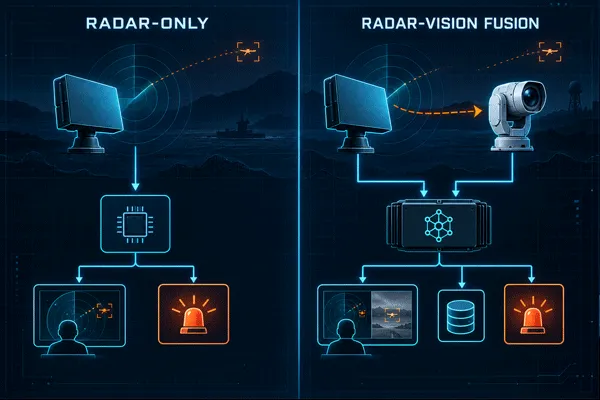
In radar-vision fusion systems, radar is responsible for “detecting” targets (providing coordinate information), while PTZ (Pan-Tilt-Zoom) cameras are responsible for “identifying” targets (visual confirmation). The lower the latency between radar detecting target coordinates and the PTZ camera aligning to the target, the higher the system’s practical value.
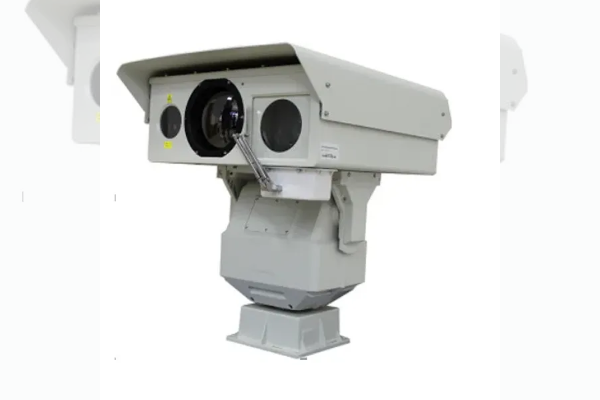
Beyond fundamental hardware link selection, the core of achieving rapid response lies in the following four key technologies:
1. “Extreme Speed” Optimization of Communication Links
The basic physical connection determines the upper limit of data transmission.
- Interface Protocol Selection: Compared to RS232, RS422 or RS485 offers superior long-distance transmission and anti-interference capabilities. Within an integrated radar-vision unit, full-duplex RS422 is recommended to enable simultaneous command issuance and status feedback without bandwidth contention.
- Baud Rate Optimization: Common 9600bps can introduce noticeable delays with complex commands. Professional solutions typically increase the baud rate to 115200bps or higher, ensuring hundreds of coordinate updates can be processed per second.
- Networked Control: For high-end systems, using the UDP protocol (instead of TCP) for control command transmission over Ethernet can further reduce latency caused by communication handshakes.
2. Streamlined and Efficient “Private Protocols”
Generic standard protocols like Pelco-D offer good compatibility but often have significant command redundancy.
- Variable-Length Command Optimization: Employing more concise binary private protocols to compress the byte count of individual commands.
- Absolute Positioning Control: Traditional control involves sending “turn left” rate commands, which can lead to “stop-and-go” movements. A rapid response system must support direct transmission of absolute PTZ coordinates. After the radar calculates latitude/longitude or relative position, it directly maps these to the PTZ’s Pan and Tilt angles, achieving one-step precise positioning.
3. PTZ Internal “Servo Control” Algorithms
Fast hardware rotation does not guarantee accuracy. Without robust algorithms, Pan-Tilt units can experience oscillation or overshoot.
- Feed-forward Control: The PTZ control unit anticipates the target’s next second position based on the target velocity provided by the radar, initiating motor movement in advance to eliminate startup inertia.
- PID Dynamic Tuning: Utilizing optimized PID (Proportional-Integral-Derivative) algorithms ensures smooth acceleration to maximum speed and deceleration to a stop, preventing jitter when reaching the target position.
- High-Precision Encoders: Coupled with high-line count encoders, these ensure the PTZ unit provides real-time, accurate position feedback (feedback frequency recommended at 50Hz or higher).
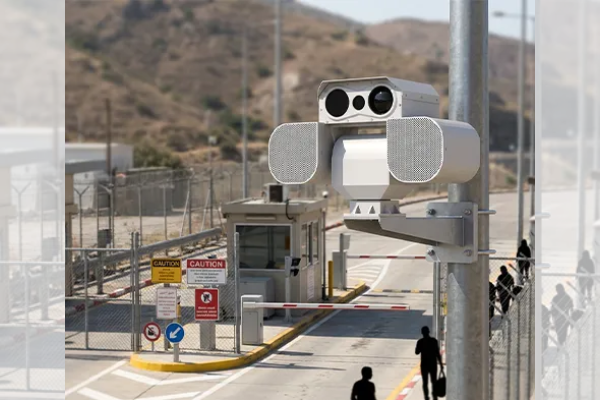
4. “Edge-Side” Fusion in System Architecture
The biggest enemy of response speed is an “overly long loop.”
- Localized Decision-Making: Avoid transmitting radar data back to a backend server for processing before issuing commands to the PTZ. Instead, perform coordinate conversion (GCS to PTZ coordinate system) and command issuance directly at the edge of the radar-vision integrated unit.
- Frequency Synchronization: The radar’s refresh rate (typically 10Hz-20Hz) and the PTZ control frequency require interpolation compensation. Smoothing radar signals through algorithms prevents the PTZ from stuttering due to radar data fluctuations.
Conclusion: Radar-Vision Fusion PTZ Selection Checklist
If you are developing or selecting a radar-vision fusion system, it is recommended to focus on the following parameters:
| Dimension |
Professional Requirement |
Core Value |
| Physical Interface |
Full-duplex RS422 or Gigabit Ethernet |
Ensures bidirectional, collision-free data transmission |
| Communication Frequency |
Command update frequency ? 25Hz |
Guarantees smooth visual tracking |
| Control Method |
Supports Absolute Angle Positioning (Absolute P/T) |
Eliminates aimless rotation, achieves precise targeting |
| Feedback Mechanism |
High-speed real-time position feedback |
Provides data support for closed-loop control |
Final Thoughts:
Rapid response is not merely about “fast motor rotation”; it is a precise synergy of communication bandwidth, protocol efficiency, and motion control algorithms. By optimizing physical links and integrating edge-side coordinate conversion algorithms, radar-vision fusion systems can truly achieve “point-and-shoot” capabilities, enabling sub-second target locking.
Ready to Enhance Your Surveillance Capabilities?
Contact MidRadar for a customized radar-vision fusion solution.