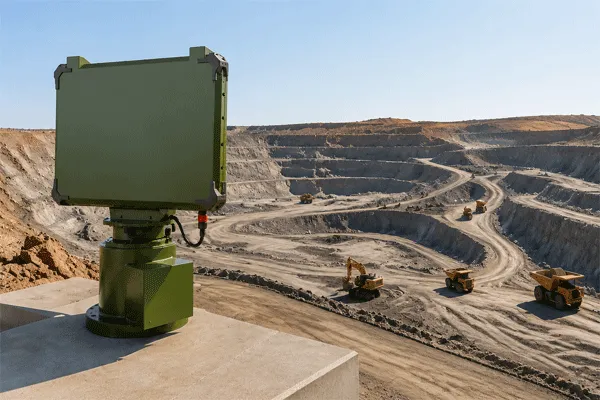
“Outdoor rated” is not an engineering specification.
Environmental claims are common on surveillance-radar datasheets: Outdoor use. IP66. Coastal suitable. Desert suitable. Operates at 50°C.
These claims may all be valid and still be insufficient for project procurement. A buyer needs to understand: “What exactly was tested, under which conditions, and what does the claim prove?”
That distinction is especially important for coastal Brazil, North Africa, southern African mines e ports, where equipment may face combinations of heat, dust, humidity, salt and strong wind.
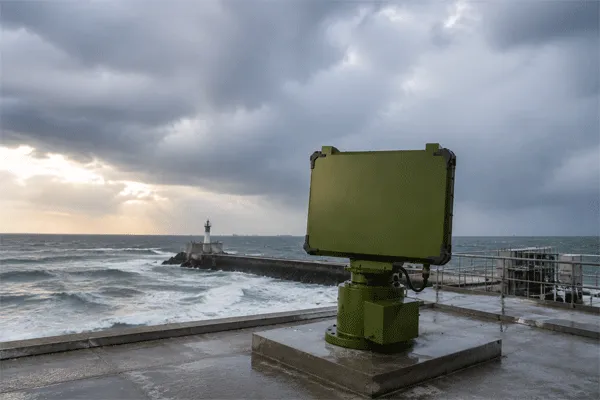
Radar for Dust, Salt Fog and Coastal Environments: What Buyers Should Verify Before Procurement
Supplier Evidence Matrix
The strongest environmental specification is one that is connected to evidence. Buyers can use the Radar Environmental Configuration Review Checklist to structure the evidence request.
| Supplier Claim |
What the Buyer Should Request |
| IP66 |
Applicable IEC 60529 test evidence |
| Salt-fog resistant |
Test method, duration and tested configuration |
| Coastal suitable |
Material/coating specification |
| 50°C operation |
Test condition and derating statement |
| High humidity |
Test condition and acceptance criteria |
| Strong wind |
Structural/wind-load calculation |
| Lightning protection |
Grounding/SPD architecture |
| Outdoor connectors |
Connector and cable-gland specification |
| Corrosion protection |
Fastener/material/coating details |
| 24/7 operation |
Thermal and reliability assumptions |
IP Rating Does Not Equal Salt-Fog Resistance
IEC 60529 concerns enclosure ingress protection. Salt corrosion is a different environmental mechanism.
A radar can have strong ingress protection while external mounting hardware, connectors or fasteners still require separate corrosion consideration.
For coastal applications, the buyer should therefore review enclosure + bracket + connectors + fasteners + cable glands + grounding points.
The weakest external component can determine long-term reliability.
“50°C Operating Temperature” Needs Context
Two suppliers may both state “Operating temperature: up to +50°C,” but the meaning can differ.
- Was the complete radar tested?
- Was the unit transmitting normally?
- Was solar loading included?
- Does RF output or duty cycle derate?
- What happens when the internal temperature exceeds the limit?
This leads to a useful distinction: Environmental survival limit ≠ guaranteed full-performance condition.
The supplier should explain both.
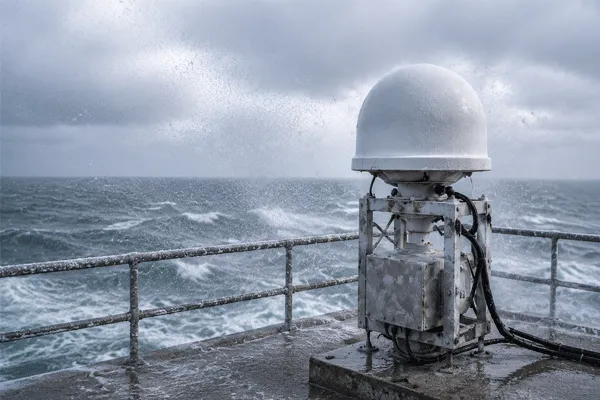
Radar for Dust, Salt Fog and Coastal Environments: What Buyers Should Verify Before Procurement
Dust Is Also a Thermal Problem
Dust can interfere with ventilation, filters, heat exchangers, fans, connector surfaces and optical windows. In a hot environment, accumulated dust can make thermal performance worse.
This means maintenance frequency should be part of the environmental design. A desert-deployment plan should answer: Who cleans the system, how often, and which components require inspection?
For large renewable-energy sites, the same evidence logic should be combined with site-specific coverage engineering; see the solar farm radar coverage assessment checklist.
Coastal Sites Create Combined Stress
A port radar may simultaneously experience salt + humidity + UV + rain + wind + condensation + lightning.
Therefore the RFQ should not contain one generic line such as “Suitable for marine environment.” It should create a specific environmental compliance matrix.
Inspect the Whole Sensor Node
A complete surveillance node may include more than the radar itself.
| Componente |
Environmental Question |
| Radar |
IP, temperature, corrosion |
| EO/IR |
Window condition, sealing |
| PTU |
Bearings, seals, corrosion |
| Switch |
Cabinet temperature |
| UPS |
Temperature and lifecycle |
| Tower |
Wind and corrosion |
| Cables |
UV and moisture protection |
| Connectors |
Sealing and materials |
A rugged radar connected through an unsuitable outdoor junction box does not create a rugged system.
Environmental Qualification Is Not the Same as Product Certification
Buyers should distinguish three things: a design claim, a laboratory test result and a third-party certification or conformity assessment. They are not interchangeable. A supplier may have valid internal or accredited-laboratory test evidence without holding a separate “certificate” for every environmental characteristic. Conversely, a marketing statement that references a standard does not prove that the delivered configuration was tested to it.
The practical procurement rule is to ask for the evidence type, tested configuration, laboratory or test source where relevant, pass/fail criteria, and whether the delivered unit matches the tested design. This avoids both over-demanding irrelevant certificates and accepting unsupported claims.
Humidity, Condensation and Thermal Cycling Deserve Separate Attention
High relative humidity and condensation are different from direct water ingress. Coastal equipment can experience repeated heating and cooling cycles that draw moisture into poorly sealed interfaces or create condensation inside cabinets. Buyers should therefore review drainage, venting, conformal protection where applicable, connector sealing and the expected behavior after thermal cycling.
For desert deployments, the combination can be reversed: high daytime temperature followed by rapid cooling at night. The environmental specification should reflect the real duty cycle rather than only the single highest or lowest ambient temperature.
Check Material Compatibility, Not Only “Stainless Steel”
Corrosion problems frequently start at interfaces between materials. Dissimilar metals, damaged coatings, trapped moisture or unsuitable fasteners can create localized corrosion even when the main enclosure material is robust. The buyer should ask how the complete mounting assembly manages coating damage, galvanic compatibility, drainage and replacement hardware.
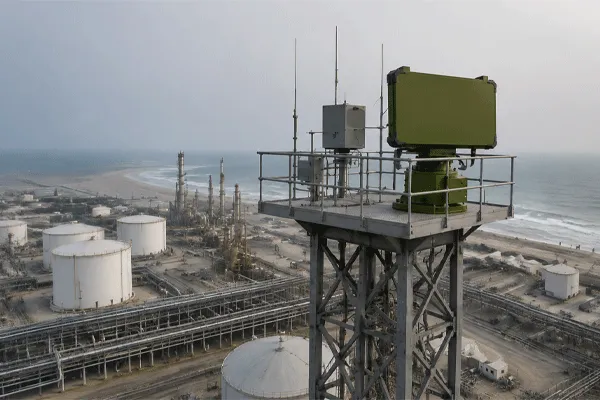
Radar for Dust, Salt Fog and Coastal Environments: What Buyers Should Verify Before Procurement
Use an Evidence Hierarchy
For critical projects, environmental claims can be reviewed in a simple hierarchy: product statement → manufacturer test report → accredited/third-party test evidence where required → delivered-configuration inspection → site acceptance. The appropriate level depends on project risk and contract requirements. Not every claim needs the same evidence burden, but every critical claim should have a defined verification path.
What Should Be Verified During FAT and SAT?
Environmental qualification may be demonstrated through documentation rather than repeating every laboratory test during project FAT. But FAT/SAT should still verify that the delivered system matches the approved configuration. Use the guida al collaudo sul campo e all'accettazione to structure the site records.
Typical items include enclosure, cable glands, grounding, mounting hardware, software temperature alarms, ventilation, connector protection and documentation.
This closes the gap between laboratory evidence and the actual field installation.
A Better RFQ Statement
Weak wording: “Radar shall be IP66 and suitable for coastal environments.”
Better wording: “Supplier shall provide the applicable ingress-protection classification, corrosion/salt-environment evidence, materials/coating description, operating-temperature conditions and installation requirements for the proposed coastal deployment.”
The second statement produces more comparable supplier responses. After compliant proposals are received, confrontare i preventivi per radar di sorveglianza on the same environmental evidence basis.
Domande Frequenti
Does IP66 prove salt-fog resistance?
No. IP classification and corrosion resistance address different environmental mechanisms.
Does a high operating-temperature rating guarantee unchanged radar performance?
Not automatically. Buyers should ask whether derating or operating limitations apply.
Should mounting hardware be included in the corrosion review?
Yes. The whole sensor installation should be evaluated.














 08:49
08:49