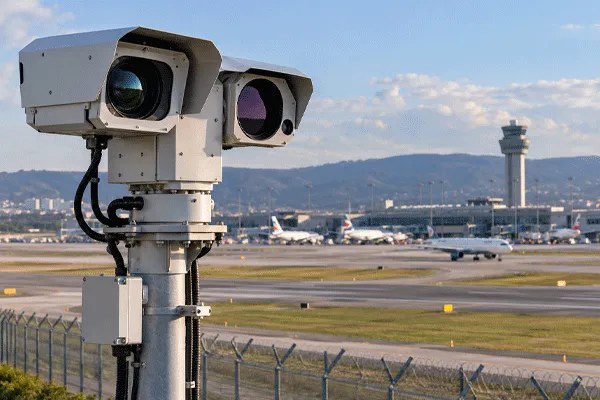
A powerful surveillance camera can still deliver unstable images when its mounting platform is poorly designed. Vibration, limited rotation, weak brackets, and incorrect wiring can compromise an entire monitoring project. A professional camera pan tilt mount helps solve these problems through stable positioning, controlled movement, and reliable system integration.
A camera pan tilt mount is a mechanical platform that lets a camera move horizontally (pan) and vertically (tilt). Motorized versions use precision motors, controllers, and position feedback to support remote positioning, automated scanning, and target tracking. Industrial systems are commonly used with visible-light cameras, thermal imaging equipment, and radar-linked surveillance platforms.
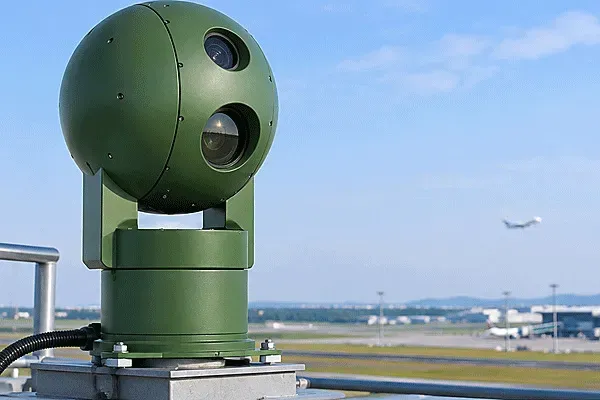
Camera Pan Tilt Mount for Surveillance: Motorized PTZ Installation & Integration Guide
What Is a Camera Pan Tilt Mount and Why Is It Important?
A camera pan tilt mount is a positioning device designed to move a camera across a defined observation area. The horizontal movement is called pan, while the vertical movement is called tilt. Together, these functions allow an operator to inspect different directions without moving the entire installation.
For a small indoor security camera, the movement mechanism may be integrated into a compact housing. A professional outdoor mount is different. It often supports larger cameras, long-focus lenses, thermal imaging equipment, and protective enclosures. The structure must remain stable despite wind, vibration, temperature changes, and repeated movement.
The main functions of a professional platform include:
- Horizontal positioning: Move the camera across the required surveillance sector.
- Vertical positioning: Adjust the observation angle for elevated or ground-level areas.
- Stable payload support: Hold the camera and associated equipment securely.
- Remote operation: Accept commands from a joystick, workstation, or management system.
- Automated movement: Support programmed patrol routes and preset positions.
- System integration: Work with compatible radar, optical, or security management platforms.
A standard camera mount holds equipment in one direction. A motorized platform adds controlled movement, making it useful for larger monitoring areas where fixed cameras alone may not provide enough flexibility.
How Does a Motorized Pan Tilt Camera Mount Work?
A motorized pan tilt camera mount uses electrical drive mechanisms to control horizontal and vertical movement. The system typically includes motors, a transmission mechanism, a controller, and position feedback components.
When an operator sends a command, the controller activates the corresponding movement axis. The platform turns to the requested position, and compatible encoders or position sensors report its movement. This process allows the system to move between observation points or follow commands from external software.
Most professional dual-axis systems use two movement directions:
| Movement |
Funzione |
Typical Application |
| Pan |
Horizontal rotation |
Wide-area scanning and directional observation |
| Tilt |
Vertical rotation |
Adjusting observation height and elevation |
| Combined movement |
Coordinated pan and tilt |
Tracking activity across a monitored area |
| Preset movement |
Returns to stored positions |
Routine monitoring of selected zones |
| Automatic scanning |
Moves through programmed sectors |
Periodic observation of a large site |
A 2 axis platform may use a servo motor, stepper motor, or another controlled drive design. The correct drive depends on the required load, movement speed, precision, duty cycle, and operating environment.
Some models support 360° horizontal rotation. However, not every product can rotate continuously. A 360° movement range and unlimited continuous rotation are different features.
Continuous rotation requires suitable electrical and mechanical arrangements, including cable management or slip-ring technology when applicable.
For professional buyers, movement capability must be verified from the specific model’s technical specifications.
What Components Make a Reliable Pan Tilt Camera Mount?
An industrial pan tilt camera mount combines several mechanical and electronic components. Each has a direct effect on performance.
The base provides structural support. The rotating assembly controls horizontal movement. The tilt mechanism supports vertical positioning, while the mounting interface connects the camera or equipment housing to the platform.
A professional assembly commonly includes:
| Componente |
Main Purpose |
What Buyers Should Check |
| Mounting base |
Secures the platform |
Installation pattern and structural stability |
| Pan mechanism |
Horizontal movement |
Rotation range and smoothness |
| Tilt mechanism |
Vertical movement |
Travel limits and payload clearance |
| Drive motors |
Controlled rotation |
Speed, duty cycle, and torque |
| Gear transmission |
Transfers motor movement |
Backlash and mechanical durability |
| Position encoder |
Reports platform position |
Accuracy and feedback availability |
| Control electronics |
Processes movement commands |
Protocol and interface compatibility |
| Mounting bracket |
Connects camera to platform |
Dimensions, attachment points, and load distribution |
| Cable interfaces |
Connect power and signals |
Weather protection and strain relief |
The mounting bracket deserves particular attention.
Two cameras with similar weight may use completely different mounting patterns. An adapter may be necessary when integrating third-party equipment, but the adapter must not reduce the structural integrity of the assembly.
A professional pan and tilt camera mount should also allow maintenance personnel to inspect important connections without completely disassembling the installation.
These small design details can make a major difference in long-term reliability.
How Do You Match Camera Payload and Mounting Brackets?
One of the most common mistakes is choosing a mounting platform using camera weight alone.
The total payload includes more than the camera body. It may also include the lens, protective housing, thermal module, mounting plate, cable assembly, and additional accessories.
For example, a project may use a camera weighing 12 kg, a protective housing weighing 5 kg, and an optical assembly weighing another 3 kg.
The total installed equipment weight would be 20 kg.
However, this does not automatically mean that every 20 kg-rated platform is suitable. The equipment’s dimensions and weight distribution also affect the load placed on the mechanism.
Before ordering, confirm:
- Total assembled camera weight.
- Camera and housing dimensions.
- Center-of-gravity position.
- Mounting-hole spacing.
- Required attachment orientation.
- Available space for cables.
- Clearance during full tilt movement.
- Outdoor wind exposure.
These checks are especially important when the camera uses a long optical housing.
A short, compact payload and a long telephoto camera may have the same mass but create different mechanical demands.
Midradar’s existing guida alla selezione dell'unità pan-tilt explains the detailed relationship between payload mass, center of gravity, inertia, and movement requirements.
For this installation-focused guide, the practical recommendation is straightforward: provide the complete camera assembly drawing before confirming the mount.
Camera Pan Tilt Mount for Surveillance: Motorized PTZ Installation & Integration Guide
Where Should a Camera Pan Tilt Mount Be Installed?
The installation position affects both camera coverage and mechanical performance.
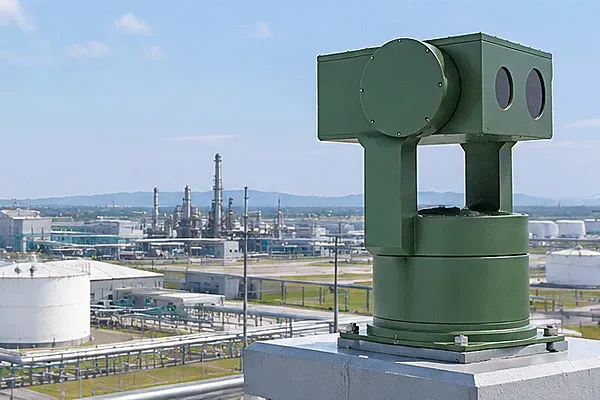
Professional monitoring systems may be installed on rooftops, towers, industrial structures, perimeter poles, or specialized mobile platforms. Each location has different structural and environmental requirements.
A mount installed on a tall tower may provide excellent visibility but also experience greater vibration and wind exposure.
A rooftop installation may simplify power and network access, but nearby walls, antennas, mechanical equipment, or building edges can create blind areas.
| Metodo di installazione |
Typical Application |
Main Consideration |
| Rooftop mounting |
Airport and industrial monitoring |
Structural support and clear sightlines |
| Tower mounting |
Long-range surveillance |
Wind resistance and vibration |
| Pole mounting |
Perimeter security |
Pole stiffness and foundation |
| Wall mounting |
Building perimeter observation |
Bracket strength and clearance |
| Platform mounting |
Integrated equipment systems |
Mechanical and electrical compatibility |
| Mobile mounting |
Temporary or vehicle-based monitoring |
Vibration and platform movement |
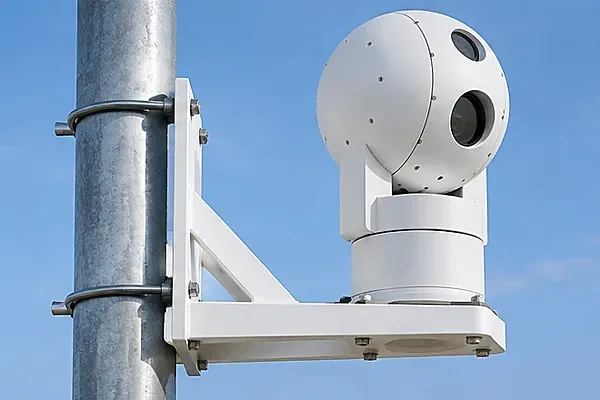
For wall mounting, the supporting structure and bracket must handle the complete equipment load and expected operating conditions.
For tower installations, the camera platform should be mounted where structural movement does not create excessive image vibration.
A long-range camera may magnify even small movements of the supporting structure.
At Midradar, our pan-tilt systems include compact dual-axis units, heavier outdoor platforms, single-axis units, and specialized rotating structures for different installation requirements.
The choice should follow the actual site conditions rather than the appearance of the mounting hardware.
How Do You Plan 360° Pan Tilt Coverage and Avoid Blind Zones?
A 360° pan tilt capability can improve directional coverage, but it does not guarantee that the complete surrounding area is visible at every moment.
A single camera observes only the area inside its current field of view.
When the camera rotates, the observation direction changes. Areas outside that field remain unobserved by that camera unless another sensor covers them.
Therefore, a 360° pan-tilt system and continuous simultaneous 360-degree monitoring are not the same thing.
Consider the complete observation geometry
Before installation, define:
- Required horizontal coverage.
- Required vertical viewing angles.
- Minimum and maximum observation distance.
- Camera installation height.
- Nearby walls, buildings, trees, and obstacles.
- Required zoom positions.
- Movement restrictions around equipment.
- Areas needing continuous observation.
A narrow-field camera may provide useful long-distance detail, but it cannot observe every direction simultaneously.
For large facilities, the solution may involve several fixed cameras, a moving platform, thermal equipment, or radar-assisted monitoring.
The platform should also have suitable movement limits.
For example, a pan tilt security camera installed near a wall must avoid mechanical collisions when changing direction. Configurable software limits can provide additional protection where supported.
Similarly, a camera with a large protective enclosure may require a restricted vertical movement range to prevent contact with its support structure.
The goal is not simply to rotate as far as possible.
It is to provide the required observation coverage safely and consistently.
What Power Supply and Cable Connections Does a Motorized Pan Tilt Mount Need?
Reliable electrical integration is essential for outdoor camera systems.
A motorized platform needs power for its drive mechanism and control electronics. The connected camera may need a separate power source, depending on the equipment design.
The power supply must account for startup current, movement demand, auxiliary components, and operating conditions.
For a typical industrial installation, engineers should confirm:
- Input voltage and acceptable tolerance.
- Peak and normal power consumption.
- Camera and platform power requirements.
- Signal and control connectors.
- Network communication method.
- Cable length and voltage drop.
- Surge protection and grounding.
- Outdoor cable protection.
- Connector sealing.
- Cable movement during rotation.
PoE, or Power over Ethernet, is common in many IP-camera products, but it should not be assumed to power a heavy industrial pan-tilt mechanism.
Some systems use separate DC or AC power for the motors while video and control data travel over Ethernet or serial connections.
Cable routing is also important.
If the platform must rotate continuously, ordinary external cables may twist unless the design includes a suitable rotating electrical interface.
For limited-angle systems, a properly designed cable loop can sometimes accommodate the expected movement.
The complete assembly should protect cables against tension, abrasion, water exposure, and repeated bending.
Proper cable planning reduces unexpected downtime and makes later maintenance easier.
How Do PTZ Controls, Presets, and AI Tracking Work?
A professional PTZ system combines pan, tilt, and camera zoom functions.
The operator may control movement through software, a dedicated joystick, or a compatible management interface. Some systems also support automated scanning, stored positions, and external control commands.
Presets are particularly useful for large facilities.
An operator can save observation positions for locations such as entrances, loading zones, access roads, storage areas, and perimeter sections. The platform then returns to those positions when requested.
Advanced equipment may also support auto-tracking or AI tracking, where image-processing software identifies an object and sends movement commands to keep it inside the camera view.
However, automated tracking is not a universal feature of every pan-tilt platform. It depends on the imaging system, software, control interfaces, and integration design.
For networked systems, communication standards should be considered early.
Industrial platforms may also provide RS485, RS232, Ethernet, or manufacturer-specific interfaces.
Midradar’s 2 kg Pan Tilt leggero intelligente a velocità variabile is one example of a compact product offering selectable communication and control configurations.
For project integration, confirm compatibility at the command level—not only the connector level.
A controller must understand the movement commands and correctly interpret position feedback.
Can a Camera Pan Tilt Mount Integrate With Radar and Thermal Imaging?
Yes. This is one of the most valuable applications of professional pan-tilt platforms.
A large security site may use radar to monitor an extensive area. When radar detects activity, a connected platform can direct an appropriate visible or thermal camera toward the reported location.
This process is commonly called radar-to-camera cueing.
A simplified workflow is:
Radar detection → Track information → Coordinate conversion → Pan-tilt movement → Camera observation → Visual verification
This integration allows operators to move from wide-area monitoring to a focused view of a specific location.
The platform must receive accurate commands, move reliably, and report its position to the control system.
The imaging equipment must also provide useful detail at the required observation distance.
Application example: Airport surveillance
Midradar’s published airport radar and electro-optical surveillance project uses elevated radar and a pan-tilt imaging system as complementary parts of an airport monitoring architecture.
The radar provides sensing information, while the optical equipment supports visual observation of the surrounding airfield.
This illustrates why the camera mount should be treated as part of the complete surveillance architecture rather than as an isolated mechanical accessory.
Similar arrangements may support:
- Airport perimeter monitoring.
- Port and coastal observation.
- Industrial facility security.
- Power and energy infrastructure monitoring.
- Logistics and warehouse perimeter monitoring.
- Large commercial and public facilities.
For integrated installations, the mount must work with the equipment’s position coordinates, network interfaces, and monitoring software.
A platform that moves smoothly under manual control is not automatically ready for automated sensor coordination.
Camera Pan Tilt Mount for Surveillance: Motorized PTZ Installation & Integration Guide
How Should a Camera Pan Tilt Mount Be Tested and Maintained?
A professional installation should be tested before entering regular operation.
Testing should cover the mounted camera, electrical connections, control functions, and supporting structure as a complete assembly.
Installation and commissioning checklist
| Test Item |
Recommended Check |
| Mounting structure |
Verify secure attachment and structural support |
| Camera bracket |
Check alignment, fasteners, and clearance |
| Pan movement |
Confirm available rotation and limit settings |
| Tilt movement |
Check vertical range and mechanical clearance |
| Alimentazione |
Verify stable operation during movement |
| Cable routing |
Inspect tension, bending, and connector protection |
| Position presets |
Confirm reliable return to programmed positions |
| Remote control |
Test software and manual commands |
| Camera image |
Check stability at required zoom settings |
| Environmental protection |
Inspect housing, seals, and outdoor connectors |
| System integration |
Verify communication with connected software |
| Recovery |
Test restart and fault handling |
Where environmental protection is required, the relevant enclosure specifications should be checked against recognized standards.
For example, IEC 60529 defines ingress-protection classifications for electrical enclosures. However, an IP rating alone does not establish corrosion resistance, wind performance, or mechanical service life.
Long-term maintenance
Regular maintenance should include visual inspection of the supporting structure, cable condition, seals, mechanical fasteners, moving assemblies, and any required lubrication points.
Where supported, operators should also review fault logs, motor operating conditions, and positional accuracy.
For coastal or industrial locations, corrosion protection deserves additional attention.
Reliable maintenance planning helps protect the equipment investment and reduces the risk of unexpected surveillance interruptions.
What Should Buyers Include in a Camera Pan Tilt Mount RFQ?
A request for quotation should describe the complete installation rather than simply asking for a motorized camera mount.
For system integrators, contractors, equipment distributors, and project procurement teams, clear requirements improve technical evaluation and reduce revisions.
Recommended project information
Camera information: Model, weight, dimensions, housing, lens configuration, and mounting drawing.
Movement requirements: Horizontal and vertical travel, rotation type, speed, and preset requirements.
Installation conditions: Rooftop, tower, pole, wall, or specialized platform.
Environmental requirements: Temperature, humidity, wind, dust, rain, corrosion exposure, and vibration.
Electrical requirements: Power input, available wiring, communication interfaces, and control system.
Integration requirements: Compatibility with an existing VMS, visible/thermal imaging platform, or radar-linked monitoring system.
Project requirements: Quantity, customization needs, delivery location, documentation, and acceptance criteria.
For new projects, our engineering team at Midradar can review these inputs and help identify suitable platform options.
Our product portfolio covers compact positioning units and heavy-duty industrial platforms, alongside electro-optical equipment, thermal imaging systems, and Sistemi a fusione radar-visione.
If your project requires a custom pan-tilt mounting solution, share the camera specification, installation drawing, movement range, and operating conditions with Midradar.
We can evaluate the application and discuss a suitable standard or customized configuration.
Contatta Midradar
Key Takeaways
- A camera pan tilt mount provides controlled horizontal and vertical positioning for surveillance equipment.
- Motorized industrial platforms offer greater installation and integration flexibility than basic fixed camera mounts.
- Camera weight alone is not enough to determine mechanical compatibility.
- Mounting brackets, structural support, camera dimensions, and cable clearance are important.
- 360° rotation does not mean simultaneous observation in every direction.
- Power, communication interfaces, and cable routing should be planned before installation.
- PTZ presets and automated tracking depend on compatible hardware and software.
- Radar-linked pan-tilt systems can support coordinated wide-area monitoring and visual verification.
- Installation quality directly affects image stability and long-term reliability.
- Factory and site testing should verify the complete installed system.
- For customized projects, buyers should provide camera specifications, mounting drawings, environmental conditions, and integration requirements.
- A reliable pan tilt mount is not simply a moving bracket. It is a critical part of a professional surveillance system that must operate accurately, safely, and consistently.
Domande Frequenti
What is the difference between a pan tilt camera mount and a PTZ camera?
A pan tilt camera mount is the positioning mechanism that moves attached equipment horizontally and vertically. A PTZ camera normally combines these movement functions with an integrated imaging and zoom system. Industrial mounts can support larger or specialized camera assemblies.
Can a pan tilt mount rotate continuously through 360 degrees?
Some models support continuous horizontal rotation, while others use limited-angle movement. Continuous rotation requires suitable mechanical and electrical arrangements. Always confirm the specific product's rotation specifications.
Can I install a heavy-duty pan tilt mount on a wall?
Yes, if the supporting wall, bracket, anchors, and installation design are suitable for the complete equipment load and operating conditions. The installation should be reviewed by qualified personnel.
Can I use a 4K camera with an industrial pan tilt mount?
Yes, provided the camera's dimensions, weight, mounting interface, electrical requirements, and control functions are compatible. Image resolution alone does not determine mechanical suitability.
Does a motorized pan tilt mount need a separate controller?
That depends on the model. Some products contain integrated control electronics, while others require an external controller. The interface may use serial communication, Ethernet, or a manufacturer-specific protocol.
Can a motorized camera mount work with thermal imaging and radar?
Yes. Compatible platforms can position thermal or visible imaging equipment and receive directional commands from an integrated surveillance system. Successful operation requires matching hardware, control interfaces, coordinate handling, and system calibration.



 15:43