Índice
• Resumen ejecutivo
• Ejemplo: Por qué un “radar de 20 km” detecta un dron a solo 4 km
• ¿Qué es la sección radar equivalente (RCS)?
• Por qué pequeños cambios en RCS tienen un gran impacto
• Por qué importa RCS
• Valores típicos de RCS de objetivos aéreos comunes
• Valores típicos de RCS de modelos populares de drones
• Por qué los drones pequeños son difíciles de detectar
• Dron vs. Bird: Por qué la detección es solo la mitad de la batalla
• El alcance de detección depende del RCS
• La relación entre RCS y alcance de detección
• Por qué el RCS es importante para industrias específicas
• Cómo evaluar un radar de detección de drones: una guía paso a paso
• Preguntas frecuentes
• Conclusión
• Artículos relacionados
RCS determina qué tan visible es un objetivo para el radar. Comprender RCS es esencial para proyectos de seguridad aeroportuaria, sistemas de vigilancia fronteriza, y la protección de la infraestructura crítica. En muchos proyectos de adquisición, la mala interpretación de RCS es una de las principales razones por las que los compradores sobreestiman el rendimiento real del radar.
Ejemplo: Por qué un “radar de 20 km” detecta un dron a solo 4 km
Consideremos a un cliente que recibe propuestas de dos proveedores de radares:
• Proveedor A: Anuncia un alcance de detección de 20 km.
• Proveedor B: Anuncia un alcance de detección de 15 km.
A primera vista, el Vendedor A parece superior. Sin embargo, tras revisar los datos detallados de rendimiento del RCS, el cliente descubre una realidad diferente:
• Proveedor A: Detección de un dron de 0,01 m² = 4 km.
• Proveedor B: Detección de un dron de 0,01 m² = 8 km.
Para detectar drones, el proveedor B ofrece en realidad la solución más sólida. Este ejemplo demuestra por qué una cifra general de alcance es secundaria frente al rendimiento del sistema contra los objetivos concretos de bajo RCS.
¿Qué es la sección radar equivalente (RCS)?
Sección transversal de radar (RCS) es una medida de cuán detectable es un objeto por radar. Expresada en metros cuadrados (m2), RCS representa la intensidad de la energía de radar reflejada en lugar del tamaño físico del objetivo. Un RCS mayor generalmente permite que un sistema de radar detecte un objetivo a mayores distancias.
Aunque el RCS se expresa como una medida de área, no representa el tamaño físico del objetivo. En su lugar, RCS describe lo grande que parece un objetivo ante el radar. Un objeto físicamente pequeño puede a veces generar un fuerte retorno de radar, mientras que un objeto más grande puede parecer mucho más pequeño dependiendo de su forma, material y orientación.
Por qué los pequeños cambios en RCS tienen un gran impacto
Una pregunta habitual entre los responsables de seguridad es por qué una pequeña reducción del tamaño del dron causa una gran caída del alcance de detección. Según la ecuación radar, el alcance es proporcional a la cuarta raíz de la sección radar equivalente del objetivo. Por tanto, reducir 100 veces el RCS, por ejemplo de 1 m² a 0.01 m², no divide el alcance por 100, pero sí puede reducir la distancia efectiva de detección en más de la mitad. Por eso los drones FPV modernos, con pocas superficies metálicas y chasis compactos, plantean un reto importante para los radares de vigilancia tradicionales.
Por qué importa RCS
Los sistemas de radar detectan objetos transmitiendo energía electromagnética y midiendo la señal reflejada. Cuanto más fuerte sea la señal reflejada, más fácil y lejano será detectar el objetivo. En comparación con aeronaves o helicópteros, la mayoría de los drones comerciales tienen firmas radar extremadamente pequeñas, lo que supone un desafío único para los sistemas tradicionales de vigilancia.
Valores típicos de RCS de objetivos aéreos comunes
| Tipo de objetivo |
RCS típico |
| Avión comercial comercial |
100–1.000 m² |
| Helicóptero |
1–10 m² |
| Aeronaves ligeras |
1–10 m² |
| Gran UAV de ala fija |
0,1–1 m² |
| Drone comercial |
0,01–0,05 m² |
| Dron FPV |
0,001–0,01 m² |
| Micro Drone |
<0.001 m² |
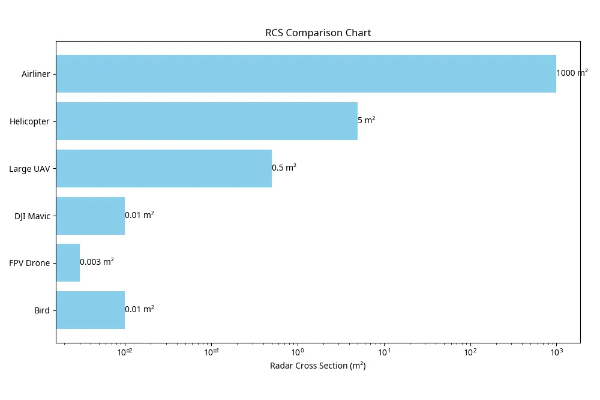
Figura 1: Comparación de la sección transversal de radar entre objetivos aéreos, destacando el desafío de detectar pequeños drones en comparación con aeronaves tradicionales.
Valores típicos de RCS de modelos populares de drones
Para los planificadores de seguridad, entender la firma de amenazas específicas es fundamental. A continuación se presentan estimaciones indicativas para modelos comunes de drones:
| Modelo de dron |
RCS aproximado |
| DJI Mini |
0,005 m² |
| DJI Mavic |
0,01 m² |
| DJI Matrice |
0,03 m² |
| Dron FPV |
0,001–0,005 m² |
Nota de origen: Los valores RCS mostrados son estimaciones de planificación indicativas derivadas de literatura de ingeniería de radar disponible públicamente y referencias de pruebas de la industria. Los valores reales varían según la frecuencia, el ángulo de aspecto, la configuración de carga útil y la metodología de medición.
Por qué los drones pequeños son difíciles de detectar
Los drones modernos están diseñados con materiales ligeros, estructuras de plástico y pequeños motores, todos los cuales reducen naturalmente las reflexiones del radar. Además, la orientación de un dron cambia constantemente durante el vuelo; Un dron que se acerca directamente hacia un radar puede parecer significativamente más pequeño que el mismo dron visto de perfil.
Para abordar esto, los sistemas de radar avanzados utilizan tecnologías como AESA y MIMO para mejorar la resolución y la relación señal-ruido, asegurando que incluso los ecos más débiles sean capturados y procesados.
Drone vs. Bird: Por qué la detección es solo la mitad de la batalla
En la seguridad a baja altitud, el principal reto no es solo encontrar un objetivo; Es identificarlo. Muchas aves tienen valores RCS casi idénticos a los de los pequeños drones, lo que provoca frecuentes falsas alarmas en sistemas menos avanzados.
| Característica |
Pájaro |
Dron |
| RCS |
Similar (0,01 m²) |
Similar (0,01 m²) |
| Patrón de vuelo |
Orgánico / Aleteo |
Estructurado / Lineal |
| Firma del rotor |
No |
Sí |
| Micro-Doppler |
Alas batiendo |
Rotores de alta velocidad |
La detección efectiva de drones requiere más que sensibilidad. Sistemas de detección de drones debe utilizar la clasificación impulsada por IA y el análisis Micro-Doppler para distinguir la rotación de alta velocidad de los motores de drones del movimiento orgánico de las alas. Esto asegura que los equipos de seguridad solo respondan a amenazas reales, manteniendo la eficiencia operativa.
El alcance de detección depende del RCS
Uno de los malentendidos más comunes en la adquisición de radares es asumir que el alcance de detección publicado se aplica por igual a todos los objetivos. Un radar anunciado con un alcance de 30 km solo puede lograr esto contra aviones grandes. Frente a un dron pequeño de consumo (RCS = 0,01 m²), el alcance real de detección puede ser significativamente menor.
Los compradores profesionales deben preguntar siempre qué RCS de objetivo se utilizó para calcular el alcance publicado.
¿Necesita determinar el alcance real frente a una amenaza de drones concreta? Contacte con nuestro equipo de ingeniería para solicitar un análisis personalizado de alcance frente a RCS.
La relación entre RCS y alcance de detección
El alcance de detección generalmente disminuye a medida que el RCS se hace más pequeño. A continuación se muestra una relación simplificada:
| RCS del objetivo |
Alcance de detección aproximado |
| 1 m² |
20 km |
| 0,1 m² |
12 km |
| 0,01 m² |
6 km |
| 0,001 m² |
3 km |
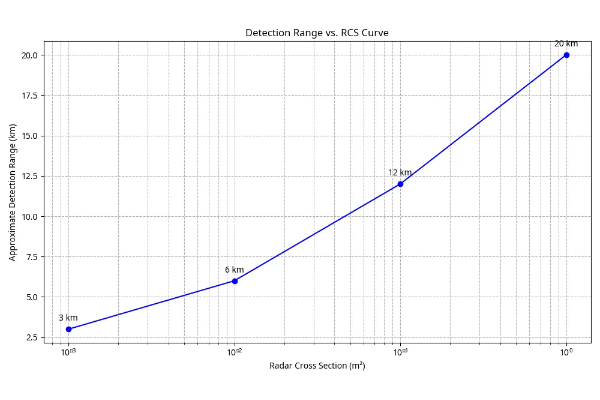
Figura 2: La relación no lineal entre la Sección Radar Equivalente (RCS) y el alcance de detección, demostrando cómo pequeñas reducciones en el tamaño del objetivo provocan caídas significativas en la visibilidad del radar.
Por qué el RCS es importante para industrias específicas
Seguridad en el aeropuerto
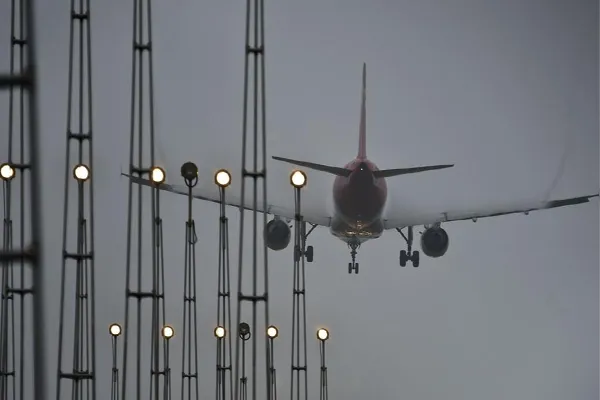
En entornos aeroportuarios, drone detection es crítico para prevenir intrusiones en la pista y monitorear las rutas de aproximación. Debido a que los aeropuertos son entornos con gran cantidad de obstáculos y actividad significativa de aves, los sistemas de radar deben equilibrar una sensibilidad extrema con la reducción inteligente de falsas alarmas. Mantener la continuidad operativa requiere un sistema que pueda detectar un dron de 0,01 m² lo suficientemente temprano como para permitir que el control del tráfico aéreo actúe sin provocar detenciones innecesarias en tierra.
Instalaciones energéticas
Las infraestructuras críticas, como centrales eléctricas o refinerías de petróleo, suelen enfrentarse a amenazas de pequeños drones que intentan aproximaciones a baja altitud. Comprender el RCS de estas amenazas permite desplegar sistemas de radar que proporcionen suficiente tiempo de alerta temprana para que los equipos de seguridad respondan.
Vigilancia fronteriza
Seguridad de las fronteras requiere vigilancia de área amplia. Sin embargo, la detección a largo alcance de objetivos de baja-RCS solo es posible si la arquitectura del radar está optimizada para la detección de señales débiles, asegurando que pequeños UAV no se escapen por las brechas en la cobertura.
Cómo evaluar un radar de detección de drones: una guía paso a paso
Si tienes la tarea de seleccionar un Sistema de radar para seguridad a baja altitud, siga estos cinco pasos para comprobar que el sistema satisface las necesidades operativas:
1 Determinar la amenaza RCS: Identificar el dron más pequeño que necesitas detectar (por ejemplo, un dron de consumo de 0,01 m² o un dron FPV de 0,003 m²).
2 Definir el alcance necesario: establezca la distancia mínima a la que debe detectarse esa amenaza concreta para disponer de tiempo de respuesta suficiente.
3 Solicitar la curva alcance-RCS: pida a los proveedores una curva de rendimiento que muestre el alcance para distintos valores de RCS, no una única cifra destacada.
4 Revisar las falsas alarmas: evalúe cómo distingue el sistema los drones de bajo RCS de las aves y el clutter ambiental mediante técnicas como la supresión adaptativa de clutter.
5 Verificar mediante pruebas de campo: valide siempre el rendimiento en el entorno operativo real para tener en cuenta el clutter local y el terreno.
Lista de comprobación gratuita: descargue las cinco preguntas esenciales antes de comprar un radar de detección de drones para realizar una evaluación exhaustiva y eficaz.
Preguntas frecuentes
¿Qué se considera un dron de bajo RCS?
La mayoría de los drones comerciales con valores de RCS inferiores a 0,05 m² se consideran objetivos de bajo RCS. Los drones FPV pueden alcanzar tan solo 0,001 m².
¿Puede el radar detectar microdrones?
Sí, pero el alcance de detección depende en gran medida del objetivo RCS, la frecuencia del radar y la capacidad de procesamiento de señales. Especializado Radar Ku-Band drone detection a menudo se prefiere para estos pequeños objetivos.
¿Está arreglado el RCS de drones?
No. El RCS varía significativamente en función del ángulo de visión (ángulo de aspecto), la banda de frecuencia y si transporta una carga útil.
¿Puede el tiempo afectar al RCS?
Aunque el clima (como la lluvia intensa) afecta principalmente a la atenuación de la señal del radar, también puede aumentar el ruido de fondo, dificultando distinguir un objetivo con bajo RCS del clutter.
¿Tienen las aves valores de RCS similares a los de los zánganos?
Sí, algunas aves tienen valores de RCS similares a los de los pequeños zánganos (0,01 m²). Por eso son necesarios algoritmos avanzados de clasificación por IA y Track-Before-Detect (TBD) para distinguirlos.
¿Cuál es el mínimo RCS que puede detectar un radar moderno de drones?
Los sistemas de vanguardia pueden detectar objetivos con un RCS tan bajo como 0,001 m² a distancias cercanas o medias.
¿Por qué los drones FPV tienen RCS más bajo?
Los drones FPV suelen ser más pequeños, utilizan más fibra de carbono o plástico, y tienen menos componentes metálicos grandes que los drones estándar de consumo.
¿Puede el radar detectar drones de fibra de carbono?
Sí. Aunque la fibra de carbono es menos reflectante que el metal, aún refleja suficiente energía para que los sistemas de radar sensibles y de alta frecuencia puedan detectarlos.
¿Cuál es un buen valor RCS para radar de detección de drones?
Para la detección de drones de grado profesional, un sistema debería ser idealmente capaz de detectar y rastrear objetivos de forma fiable con un RCS de 0,01 m² en su alcance operativo declarado.
¿Cómo se mide el RCS?
El RCS se mide típicamente en entornos controlados como cámaras anecoicas o mediante pruebas de campo con esferas de referencia calibradas. En el caso de los drones, a menudo se modela utilizando software de simulación electromagnética antes de ser verificado en el campo.
Conclusión
La sección radar equivalente (RCS) es el factor más importante para determinar la eficacia real de un radar frente a drones. Una cifra destacada de alcance tiene poco valor si no se conoce el RCS del objetivo asociado. En proyectos de seguridad para aeropuertos, fronteras o infraestructuras críticas, la curva alcance-RCS ofrece una base mucho más precisa para seleccionar el sistema.
Midradar?s Sistemas de radar AESA y Sistemas de fusión radar-visión están diseñados para sobresalir en la detección de low-RCS, proporcionando una protección fiable en todas las condiciones climáticas para los entornos más exigentes.
¿Va a evaluar los sistemas según su rendimiento real? Solicite una consulta técnica para analizar los requisitos específicos del emplazamiento.
Sobre el autor
Este artículo ha sido revisado por el equipo de ingeniería de radar de Midradar y se basa en la experiencia práctica de proyectos de vigilancia a baja altitud que involucran aeropuertos, instalaciones energéticas, puertos y sitios de infraestructuras críticas en todo el mundo. Muchos proyectos de seguridad a baja altitud no logran el rendimiento esperado porque la selección del radar se basa únicamente en el alcance máximo de detección en lugar del RCS del objetivo.
Artículos relacionados
• Radar X-Band vs. Ku-Band para detección de drones
• ¿Hasta dónde puede detectar un dron el radar?
• Guía de Diseño del Sistema de Detección de Drones en Aeropuertos
• Fusión de Radar y Visión para Seguridad a Baja Altitud


 10:00
10:00