Introduction
When a security planner first evaluates long-range optical detection technology, the first question is often: “Which system detects further?” But detection range is rarely the only factor when choosing between fixed and vehicle-mounted systems.
The more practical question is: “Where is the protected area, and where does optical monitoring risk need to be controlled?”
Fixed and vehicle-mounted optical detection systems share similar underlying technologies, including laser-active scanning, cat-eye effect detection, 360° scan coverage, target location, and optical view interruption. What differs is everything around that core capability: how the system is deployed, how quickly it can be repositioned, and what type of protection scenario it handles best.
A fixed system is built for continuous monitoring of a defined area. A vehicle-mounted system is built for mobile protection when the protected person, vehicle, or asset is moving between locations.
What Fixed Systems Do Best
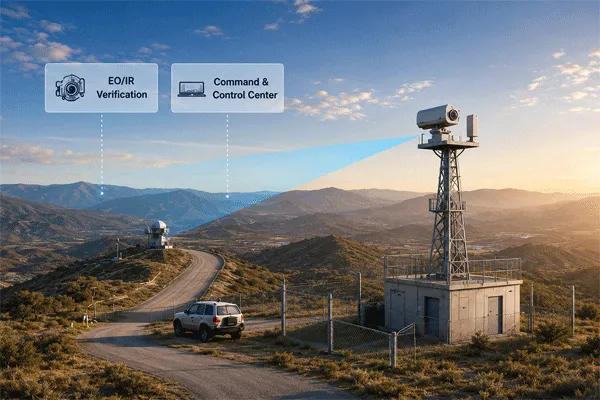
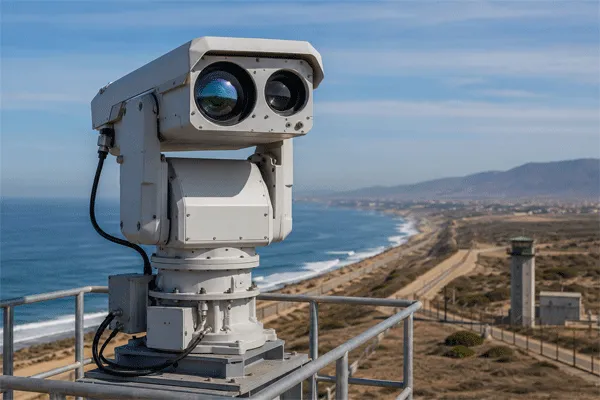
A fixed optical detection system like the FinderPro-X is designed for one main purpose: providing continuous, unattended, long-range coverage of a defined protection zone from a stable installation point.
The platform advantage is stability. A fixed mount reduces vibration and positional uncertainty, allowing the sensor suite to operate with high sensitivity and reliable geolocation accuracy. Combined with the ability to network multiple units into a shared command display, fixed systems are often the preferred choice for permanent facility protection.
Fixed systems work best when:
- The protected area is stationary, such as a critical facility, government compound, airport perimeter, or event venue
- The observation risk comes from outside a defined perimeter that can be surveyed in advance
- 24/7 unattended monitoring is required
- Multiple units can be networked to provide overlapping coverage of a complex perimeter
- Longer detection range is a priority, such as up to 2,000 m for FinderPro-X
The limitation of a fixed system is also clear: it cannot move with the protected target. A facility may be well covered by fixed systems, but once VIP personnel, vehicles, or mobile assets leave that location, a separate mobile protection layer may be required.
What Vehicle-Mounted Systems Do Best
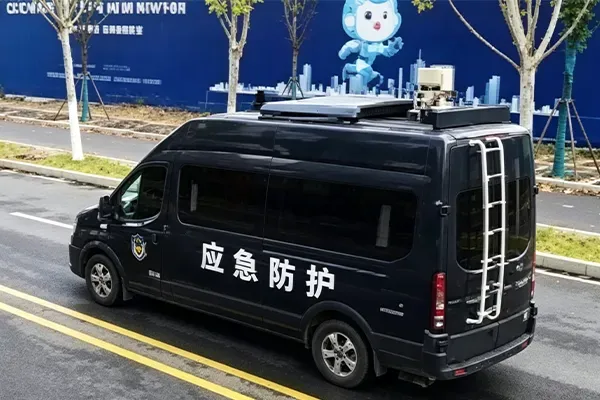
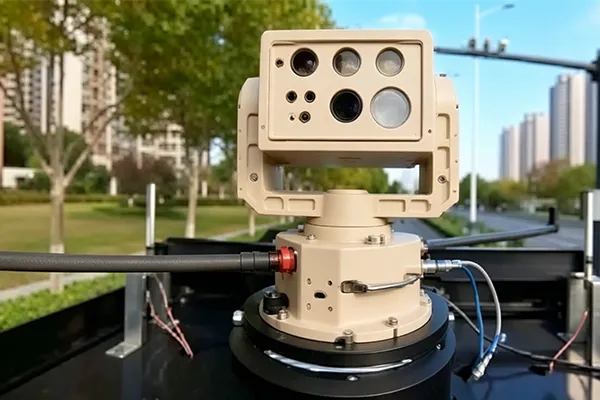
Il FinderPro-M is designed around a different operational requirement: maintaining optical detection capability while the protected vehicle or mobile team is in motion.
Installed on a vehicle platform, FinderPro-M scans the full 360° area around the moving vehicle and helps detect, locate, and interrupt unauthorized optical observation along the route in real time. This helps reduce monitoring gaps during transit between fixed protection zones.
Vehicle-mounted systems work best when:
- The protected target is moving, such as VIP transport, mobile patrol vehicles, service vehicles, or temporary command vehicles
- Urban roads, open routes, or temporary stops create multiple possible observation points
- Rapid deployment is required and there is no time for fixed site preparation
- The protection route changes frequently or cannot be fully secured in advance
- The system needs to move with the vehicle rather than remain at one location
The trade-off is detection range. FinderPro-M provides mobile optical detection coverage up to 1,000 m, while FinderPro-X provides longer fixed-site detection coverage up to 2,000 m. A moving platform may also introduce more scan-cycle variation than a stable fixed installation.
The Integrated Approach: Fixed and Mobile Protection Together
The most demanding protection scenarios are not simply “fixed or mobile.” In many projects, the right answer is “fixed and mobile.”
For example, a high-level public event may require fixed system coverage at the venue, accommodation area, and vehicle arrival zone, plus vehicle-mounted coverage for the transit routes between these locations. A critical infrastructure operator may use fixed systems for long-term perimeter monitoring while using vehicle-mounted systems for patrol routes, temporary deployments, and mobile inspection tasks.
In these scenarios, the two platform types complement each other:
- Fixed systems establish continuous protection coverage at known static locations
- Vehicle-mounted systems maintain optical detection capability during transit
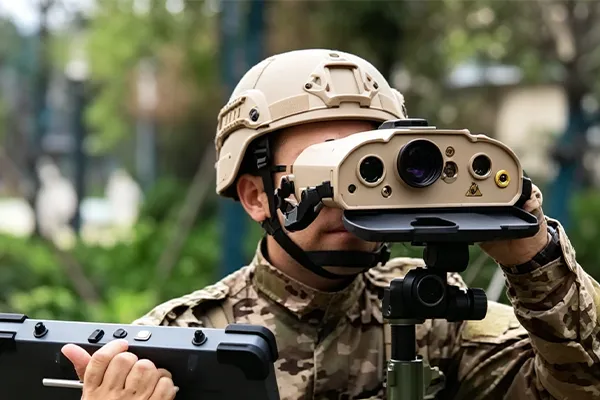
- Handheld systems such as FinderPro-P support advance-team checks, temporary site inspections, and quick verification at secondary locations
For a practical example of how fixed and handheld optical detection systems can support a high-profile event environment, see the government summit protection case study.
Decision Framework
| Criteria |
Fixed System: FinderPro-X |
Vehicle-Mounted System: FinderPro-M |
| Protected target |
Stationary site or defined area |
Moving vehicle or mobile team |
| Max detection range |
Up to 2,000 m |
Up to 1,000 m |
| Deployment mode |
Installazione fissa |
Vehicle-mounted deployment |
| Deployment preparation |
Requires site selection and installation |
Installed on vehicle for mobile use |
| Operation model |
Suitable for 24/7 unattended monitoring |
Operates with vehicle-based teams |
| Network deployment |
Supports multi-unit network coverage |
Supports mobile route-based coverage |
| Best-fit scenario |
Facility perimeter, event venue, airport area, critical site |
VIP transport, mobile patrol, temporary routes, field inspection |
If your main concern is a fixed asset such as a building, facility perimeter, airport area, or event venue, start with a fixed optical detection system. If your main concern is a person, vehicle, or mobile team in transit, a vehicle-mounted optical detection system is the better foundation.
If both situations apply, a combined deployment can provide wider coverage and fewer monitoring gaps.
Key Questions Before Choosing
Before selecting between a fixed and vehicle-mounted system, security planners should answer several practical questions:
- Is the protected target stationary or mobile?
- Does the project require continuous 24/7 monitoring?
- Are the main observation points known in advance?
- Is the required detection range closer to 1,000 m or 2,000 m?
- Will the system be used from fixed towers, rooftops, vehicles, or temporary positions?
- Does the team need central command software integration?
- Are handheld units needed for quick field verification?
The answers to these questions usually make the platform choice much clearer.
Explore the Full System Range
Il Optical Surveillance Detection Systems catalog compares the FinderPro series across fixed, vehicle-mounted, handheld, multi-spectral, and indoor deployment types. Each variant is designed for a different protection environment, detection range, and deployment model.
Explore the Public Security Solutions page to learn how optical detection can work together with radar, EO/IR cameras, command software, and warning devices in a complete security architecture.
For project planning, the best approach is to start from the deployment scenario rather than the product model. Once the protected area, route, detection range, and response workflow are clear, the choice between FinderPro-X, FinderPro-M, or a combined FinderPro deployment becomes much easier.



 10:12
10:12