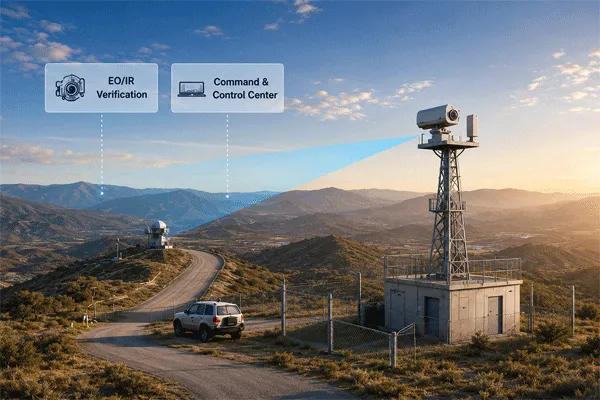
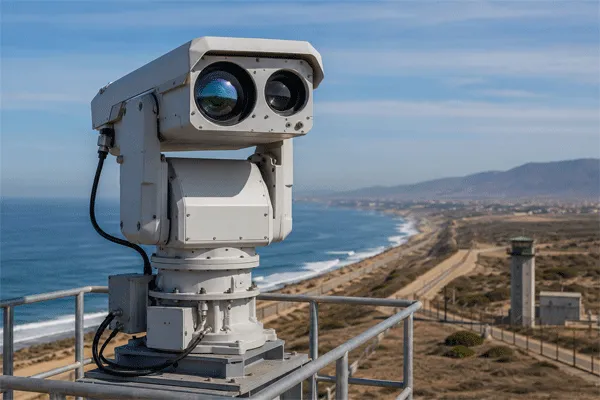
Long-range camera datasheets often present one headline distance: detection up to a certain number of kilometers, recognition at a shorter distance and identification at another. Those figures look easy to compare, but they can be misleading unless every supplier uses the same target, atmosphere, probability criterion and image-quality model.
EO/IR range is not a property of the lens alone. It is the outcome of an imaging chain that includes target size, focal length, detector pitch, sensor resolution, optical transmission, atmospheric attenuation, target-to-background contrast, stabilization, image processing, display conditions and the observer or classification algorithm.
This guide provides a transparent way to screen camera configurations and, more importantly, explains what must be verified during procurement and acceptance testing.
How to Calculate EO/IR Detection, Recognition and Identification Range
1. Detection, Recognition and Identification Are Different Tasks
| DRI level |
Operational question |
Example |
| Detection |
Is a relevant object present? |
A warm object is visible against the background. |
| Recognition |
What general class is it? |
The operator can distinguish a person from a vehicle. |
| Identification |
Which member or subtype is it? |
The operator can identify a pickup truck rather than a generic vehicle, subject to the agreed task definition. |
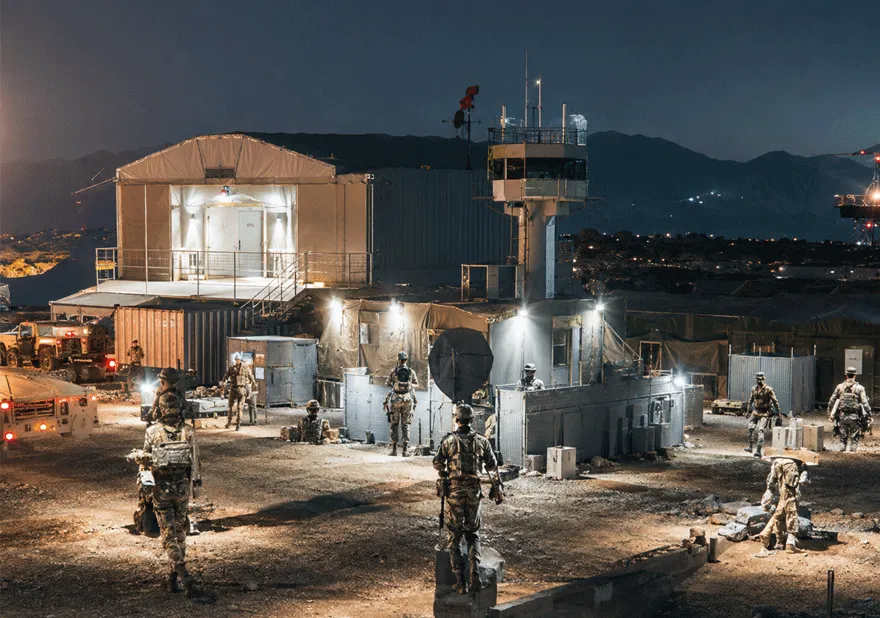
These definitions must be written into the requirement. “Identification” can mean different things to a border operator, port authority, airport or industrial security team. Facial identification, vehicle-type classification and confirmation that a target is carrying an object require very different image detail.
How to Calculate EO/IR Detection, Recognition and Identification Range
2. Start with Angular Sampling: IFOV
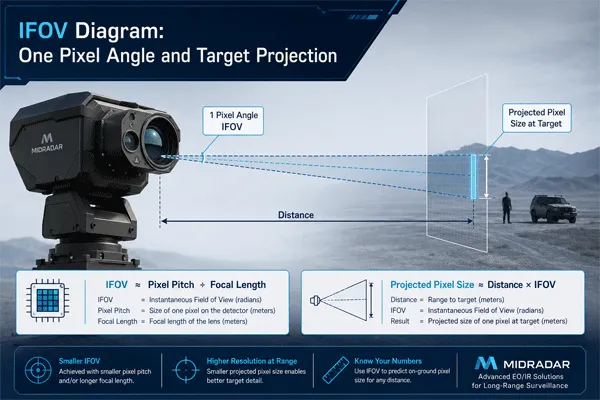
The instantaneous field of view (IFOV) is the angle represented by one detector pixel. Under the small-angle approximation:
IFOV (radians per pixel) ≈ Pixel Pitch ÷ Focal Length
Ground Sample Size per Pixel ≈ Distance × IFOV
Pixels on Target ≈ Target Dimension ÷ (Distance × IFOV) |
All dimensions must use consistent units. For example, a 12 µm pixel pitch is 12 × 10⁻⁶ m. A 300 mm focal length is 0.300 m.
This calculation estimates geometric sampling. It does not yet include blur, optical modulation transfer, atmosphere, noise, contrast, stabilization or image processing.
3. Worked First-Order Example
Assume an uncooled thermal camera with:
- Detector: 640 × 512 pixels
- Pixel pitch: 12 µm
- Focal length: 300 mm
- Representative target dimension: 1.8 m person height
- Range: 5,000 m
IFOV ≈ 12 × 10⁻⁶ m ÷ 0.300 m = 40 µrad/pixel
Projected size per pixel at 5 km ≈ 5,000 × 40 µrad = 0.20 m/pixel
Pixels across 1.8 m target height ≈ 1.8 ÷ 0.20 = 9 pixels |
Nine pixels over target height may be enough for detection in a favorable scene, but it does not automatically prove recognition or identification. Target orientation, thermal contrast, blur and atmospheric transmission may reduce the useful information. If the critical target dimension is width rather than height, the pixel count may be much lower.
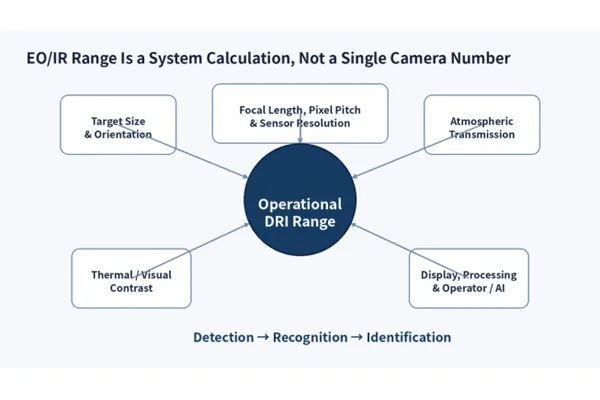
Operational DRI range is determined by the full imaging chain, not by focal length or digital zoom alone.
4. Johnson Criteria: Useful Starting Point, Not an Absolute Guarantee
Johnson-style criteria relate the number of resolvable cycles across a target’s critical dimension to the probability of detection, recognition or identification by a human observer. They remain widely referenced because they offer a simple bridge between target angular size and discrimination task.
However, Johnson criteria originated in an earlier imaging era. Modern sampled sensors, digital enhancement, compression, colored noise and AI analytics can behave differently. U.S. Army researchers developed the Targeting Task Performance metric partly because the classical criteria do not fully model modern imagers.
For procurement, the safe approach is:
- State the exact DRI task and target.
- State the probability level or pass/fail rule.
- Show the assumed cycles or pixels on target.
- Apply optical, atmospheric and signal-processing losses.
- Validate with recorded imagery or a controlled field test.
5. Why Pixel Count Alone Overestimates Range
Optical blur and MTF
A pixel grid does not guarantee that fine detail reaches the detector. Lens quality, focus, diffraction, detector response and motion blur reduce contrast at higher spatial frequencies. Two systems with the same focal length and detector pitch can therefore produce different usable detail.
Atmospheric attenuation
Long-range EO/IR performance is strongly affected by humidity, aerosol loading, fog, rain, dust, sea spray and thermal turbulence. The atmosphere reduces target contrast and can blur the apparent image. A configuration that works in cold, dry air may perform much worse in a humid coastal or hot desert environment.
Target-to-background contrast
Thermal detection depends on the apparent temperature difference between the target and its background. A person can be easier to detect against a cold night sky than against sun-heated terrain near body temperature. Visible-light performance similarly depends on illumination, haze, camouflage and background complexity.
Stabilization and pointing
At long focal lengths, small angular vibration causes large image motion. Tower sway, wind, pan-tilt backlash and imperfect stabilization can eliminate detail that the optical calculation predicts.
Compression and display
Video compression, network bandwidth, sharpening, denoising and display scaling influence what the operator sees. Digital zoom enlarges existing pixels; it does not create additional optical information.
6. Visible, Thermal and Laser-Assisted Channels
| Channel |
Strengths |
Limitations to specify |
| Visible / low-light |
Color and fine detail in favorable lighting; useful for evidence. |
Illumination, haze, glare, atmospheric turbulence and night performance. |
| LWIR thermal |
Passive night operation and heat-contrast detection. |
Thermal crossover, humidity, rain, detector resolution and lower fine-detail content. |
| MWIR cooled thermal |
High sensitivity and long-range potential in demanding systems. |
Cost, maintenance, cooler life and export/compliance considerations. |
| Near-IR laser-assisted visible |
Can improve active night illumination and reveal visible-like detail. |
Backscatter in fog/rain, eye-safety classification, illumination range and scene reflectivity. |
A multispectral platform is valuable because the best channel changes with time, weather and target. Fusion should not be described as a universal improvement without defining whether the system is combining imagery, switching channels or using one sensor to cue another.
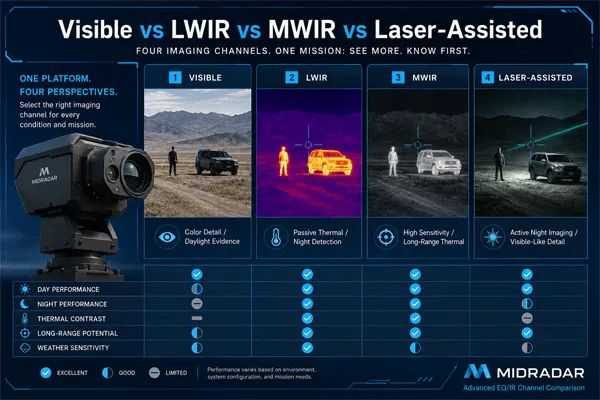
How to Calculate EO/IR Detection, Recognition and Identification Range
7. A Practical Range-Calculation Workflow
- Define the target class and critical dimension: person height/width, vehicle width, boat freeboard or another relevant feature.
- Define the task: detection, class recognition, subtype identification or evidential confirmation.
- Select detector format, pixel pitch and focal length.
- Calculate IFOV and geometric pixels on target.
- Apply optical-quality and motion/stabilization allowances.
- Model atmospheric transmission for the wavelength, range and climate.
- Estimate target-to-background contrast for day, night and thermal-crossover conditions.
- Assess display, compression, processing and operator/AI performance.
- Set an engineering margin rather than publishing the theoretical limit.
- Validate with a representative target and synchronized environmental records.
8. What a Supplier Should Disclose
| Required disclosure |
Why it matters |
| Target dimensions and orientation |
A person’s height and width lead to different range results. |
| Sensor resolution and pixel pitch |
Required for IFOV and sampling calculations. |
| Optical focal length and clear aperture |
Needed to assess field of view and light collection. |
| DRI criterion and probability |
Prevents different definitions from being compared as if identical. |
| Atmospheric model and visibility |
Long-range results are highly climate-dependent. |
| Target/background contrast |
Especially important for thermal imagery. |
| Optical vs digital zoom |
Digital zoom must not be counted as added resolving power. |
| Image processing settings |
Sharpening and denoising can change perceived performance. |
| Recorded test images and metadata |
Allows independent evaluation of real image quality. |
| Site acceptance method |
Turns a marketing claim into a measurable requirement. |
A field test should use the target and discrimination task relevant to the project. The test plan should include:
- Known target dimensions and clothing/paint condition.
- Multiple orientations and backgrounds.
- Day, night and thermal-crossover periods where relevant.
- Measured visibility, humidity, temperature, wind and precipitation.
- Fixed optical focal length and documented processing settings.
- Original-resolution recordings without social-media recompression.
- Blind scoring by more than one observer or a defined analytics model.
- A pass/fail threshold based on probability or repeated successful trials.
- Separate results for detection, recognition and identification.
IEC 62676-4 provides an application-oriented framework for planning, designing, installing, testing, commissioning and maintaining video surveillance systems. It supports the principle that camera selection should be tied to a defined operational requirement and verified performance rather than a single catalogue number.
10. Applying the Method to Midradar EO/IR Systems
Midradar’s electro-optical portfolio includes laser night-vision cameras, thermal imaging cameras, multispectral systems and vehicle-mounted observation platforms. The appropriate model should be selected from the required DRI task, target dimensions, range, climate, installation stability and integration method.
For long-range projects, the recommended quotation package should include an optical configuration, target-specific DRI calculation, atmosphere assumptions, field-of-view table and an agreed acceptance-test method.
FAQ
Does a longer focal length always increase identification range?
It increases angular magnification and pixels on target, but narrows field of view, magnifies vibration and may reduce search efficiency. Optical quality, aperture, atmosphere and stabilization can become the limiting factors.
Can digital zoom be included in DRI calculations?
Digital zoom can make an image appear larger on screen but does not add new optical samples. DRI calculations should be based on native detector sampling and optical focal length.
Is NETD the same as thermal-camera range?
No. NETD describes sensitivity to small temperature differences under specified conditions. Range also depends on target contrast, lens, detector resolution, atmosphere, processing and task definition.
Why do two suppliers quote different DRI ranges for similar hardware?
They may use different targets, critical dimensions, Johnson-cycle assumptions, probability levels, atmospheres or image-processing factors. Request the complete calculation basis.
Should person range use height or width?
Use the dimension relevant to the discrimination task and target orientation. Height may overstate performance when the person is partially obscured or viewed from an unfavorable angle.














 14:18
14:18