Wu Kang | Radar System Specialist | Updated August 22, 2026
Perimeter intrusion detection radar uses microwave beams and Doppler processing to detect people, vehicles, and low-altitude drones along a boundary, filtering rain, foliage, and wave clutter out of the signal before it reaches an operator. Midradar’s RDG and RDA series document ranges from roughly 3 km to 50 km, with separate figures for personnel, vehicle, and small-UAV targets.
Perimeter Intrusion Detection Radar: A Buyer’s Guide
What Is Perimeter Intrusion Detection Radar?
A perimeter intrusion detection system (PIDS) is designed to flag unauthorized entry along a defined boundary before the intruder reaches whatever the boundary protects. Radar is one of several sensor types used for this — alongside fence-mounted vibration sensors, buried fiber-optic cable, video analytics, and microwave beam breakers — and it earns its place in a layered system because <cite index=”30-1″>it operates independently of light and continues functioning through rain, fog, snow, and dust</cite>, conditions that degrade camera-only detection.
The trade-off is clutter. A radar beam covering open ground picks up wind-blown foliage, standing water, and wildlife along with the people and vehicles it’s meant to catch. Everything downstream of that raw return — clutter suppression, target classification, alarm logic — exists to solve that one problem: telling a real intrusion apart from a tree branch moving in the wind.
How Radar Compares with Other Perimeter Technologies
Fence-mounted and buried-cable sensors detect contact at the boundary itself, which means the alarm fires only once someone is already touching or crossing the line — there’s no standoff distance to react. Microwave beam breakers and photoelectric barriers extend that line slightly but can’t see past it, and beam breakers in particular are prone to high false-alarm rates in changing weather. Video analytics needs adequate lighting and a clear sightline, and narrow camera fields of view mean covering a long perimeter takes many units.
Radar’s standoff detection — spotting a target hundreds of meters to kilometers out, rather than at the fence — is what changes the response model from reactive to preemptive. That gap is real: one industry vendor comparison put <cite index=”29-1″>traditional fence-mounted and motion-based alarm technology at a 94-98% false alarm rate</cite>, against which even a moderately well-tuned radar system with clutter suppression is a substantial improvement — though “moderately well-tuned” is doing real work in that sentence, since a poorly configured radar can still generate nuisance alarms from the same foliage and weather that trip other sensors.
None of this makes radar a replacement for cameras. In practice, radar earns its role as the detection and cueing layer — it decides something is there and roughly where — while EO/IR cameras confirm what it is. That pairing, not radar alone, is what most integrators actually deploy.
Perimeter Intrusion Detection Radar: A Buyer’s Guide
Inside Adaptive Clutter Suppression and Track-Before-Detect
The general technique behind most modern clutter suppression is a form of adaptive thresholding — <cite index=”22-1″>constant false alarm rate (CFAR) processing, which adjusts the detection threshold based on the surrounding noise and clutter level instead of using one fixed threshold for the whole scene</cite>. That’s the industry-standard concept; Midradar’s RDG and RDA lines implement their own version of it as “adaptive clutter suppression,” filtering recurring returns from foliage, waves, and weather before a return is passed to the tracking stage.
Track-before-detect (TBD) is the second layer. Instead of deciding target-or-not on a single scan, TBD correlates weak returns across multiple scans and only confirms a track once a consistent pattern emerges. This is what keeps a slow-moving or low-RCS target — a crawling person, a small drone, a small boat in chop — from getting filtered out along with the clutter it resembles on any one sweep.
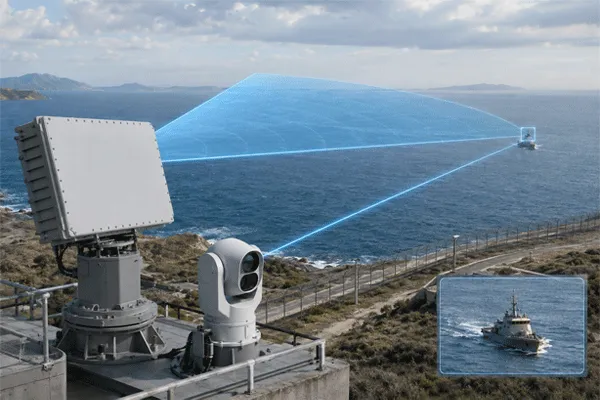
Radar-EO slew-to-cue closes the loop: once a track is confirmed, the radar hands its bearing to a PTZ or fixed EO/IR camera so the camera locks onto the target automatically. For an integrator, this is the point where radar output becomes an actionable alarm with video, rather than a coordinate on a map.
Choosing Between the RDG and RDA Series
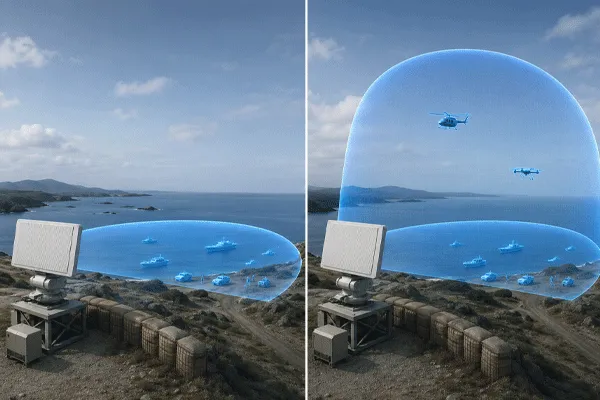
Midradar’s ground-focused product line splits into two series with different coverage envelopes. The RDG series is a 1-D radar line optimized for ground and surface targets — personnel, vehicles, vessels — across six models from compact short-range units to long-range 50 km systems. The RDA series adds a second detection axis: 2-D AESA architecture that covers ground and low-altitude airborne targets together, including small UAVs, from the same radar.
For a perimeter where the threat model is limited to people and vehicles on the ground, the RDG series is the simpler fit. For a site where low-altitude drone incursion is also a concern — an increasingly common requirement for critical infrastructure and airport-adjacent perimeters — the RDA series covers both envelopes without adding a second sensor type.
Range and Coverage by Model
| Giải pháp an ninh tích hợp chuyên dụng, hỗ trợ giám sát liên tục, đánh giá rủi ro và phản ứng vận hành hiệu quả. |
Dòng Sản Phẩm |
Band / Architecture |
Ground Target Range |
Small UAV / Air Range |
Azimuth |
| MR-RDG50K |
RDG |
X-band, 1-D AESA |
Vehicle ≥25 km, personnel ≥15 km |
— |
90° (7° elevation) |
| MR-RDG20K |
RDG |
X-band, 1-D AESA |
Vehicle ≥15 km, personnel ≥10 km |
— |
95° |
| MR-RDG07K |
RDG |
X-band AESA, 9.55–9.75 GHz |
Vehicle ≥15 km (RCS 5 m²), personnel ≥10 km (RCS 0.5 m²) |
— |
90° |
| MR-RDG06K |
RDG |
X-band, compact 1-D AESA |
Vehicle ≥8 km, personnel ≥5 km |
— |
Not published |
| MR-RDG03K |
RDG |
Ku-band, DBF multibeam |
Vehicle ≥6 km, personnel ≥3 km |
— |
Not published |
| MR-RDG03-4R |
RDG |
Ku-band, 4-face DBF |
Vehicle ≥6 km, personnel ≥3 km |
— |
90°/face, 360° assembled |
| MR-RDA15K-4R |
RDA |
X-band, 2-D AESA, 4-array |
Vehicle/helicopter ≥8 km |
Small UAV ≥5 km, altitude ≤1,500 m |
360° (elevation -2° to 45°) |
| MR-RDA10K-4R |
RDA |
X-band, 2-D phased array, monopulse |
Vehicle/ship ≥15 km, personnel ≥12 km |
Small UAV ≥10 km (RCS 0.01 m²), altitude not stated |
90°/face or 360° four-face |
One flag before this table goes into a proposal: Midradar publishes two separate product pages for the MR-RDA10K-4R with materially different specifications listed for the same model name. The figures above come from the primary product page; before specifying this model in a bid, request the current signed datasheet directly rather than relying on either published page, since the discrepancy hasn’t been resolved publicly as of this writing.
Perimeter Intrusion Detection Radar: A Buyer’s Guide
Environmental Ratings for Outdoor Deployment
All RDG models carry an IP67 rating and a -40°C to +55°C operating range, consistent with the company-wide environmental spec. The RDA15K-4R is rated IP66 at the system level and IP67 at the host unit level — worth noting separately if a bid spec calls out one rating uniformly across a mixed RDG/RDA deployment, since the two aren’t identical. Total power draw runs up to 1.6 kW for the RDA15K-4R, notably higher than any single RDG model, which affects mast power budgeting on remote or solar-fed sites.
Where False Alarms Actually Come From
Three sources account for most of the nuisance alarms integrators troubleshoot after commissioning:
Vegetation and wind. Tall grass, shrubs, and tree lines within the detection zone move constantly and inconsistently, which is exactly the pattern adaptive clutter suppression is built to filter — but a detection zone that includes dense, unmanaged foliage close to the radar will still generate more nuisance returns than one with a cleared buffer strip, regardless of how good the filtering is.
Wildlife. Birds and ground animals cross detection zones in ground and coastal deployments alike. Classification logic reduces false positives here, but a system tuned purely for maximum sensitivity to small, slow targets — the same profile as a crawling person — will also pick up more wildlife.
Terrain and mounting height. Radar range and blind-zone size both scale with antenna height and terrain. A radar mounted too low relative to the protected area’s terrain will have a larger near-field blind zone; mounted too high, it may lose low-elevation coverage close to the mast. Site survey, not just the datasheet range figure, determines actual coverage.
None of these are configuration failures unique to one vendor’s equipment — they’re inherent to how outdoor radar perimeter detection works, and the reason pre-installation site survey and post-commissioning tuning matter as much as the hardware spec sheet.
Integrating Radar into an Existing Security Stack
RDG and RDA radars connect through GB/T 28181 and ONVIF for video and security-platform integration, RTSP for streaming, and RESTful APIs and SDKs for custom software work. For most EPC and integrator projects, the practical questions are: which VMS or PSIM platform is receiving the alarm, whether that platform consumes radar track data (position, classification, confidence) or just a binary alarm trigger, and how many PTZ cameras need to be mapped to each radar’s slew-to-cue output. Confirming those three points with the platform vendor before commissioning avoids the most common integration delay — a radar that’s detecting correctly but whose data isn’t reaching the operator console in a usable form.
Seven Steps to Plan a Radar Perimeter Deployment
- Survey the site and classify threat zones.Not every meter of a perimeter needs the same detection priority — identify where standoff distance matters most.
- Decide whether low-altitude coverage is in scope.If drone incursion is a realistic threat, plan for the RDA series from the start rather than adding a second sensor type later.
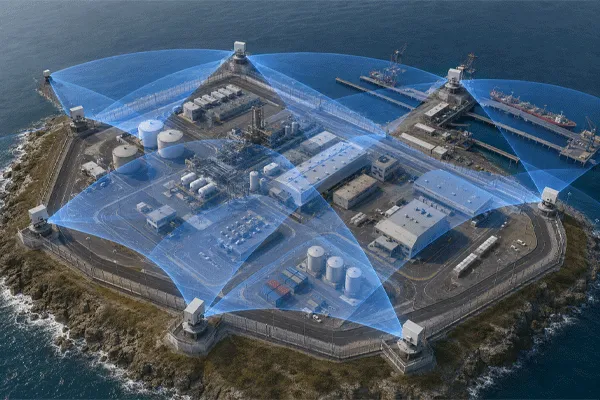
- Map coverage using overlapping azimuth footprints.Single-face radars covering 90–95° need multiple units or four-face models for continuous coverage without gaps.
- Size power infrastructure to the highest-draw unit in the deployment, not the average — an RDA15K-4R’s 1.6 kW draw changes solar and battery sizing compared to a 75 W RDG06K.
- Pair each radar zone with EO/IR cameras for slew-to-cue confirmation, and confirm camera field-of-view overlaps the radar’s detection zone rather than just its mounting location.
- Specify the integration protocol and target platform in writing— GB/T 28181, ONVIF, or a direct API/SDK integration — before procurement, not during commissioning.
- Budget time for post-installation tuning.Clutter suppression settings tuned to the specific site’s vegetation, terrain, and weather pattern take field time to get right; a first-pass configuration from the factory default rarely matches the final tuned state.
What This Product Line Doesn’t Publish
Buyer’s guides tend to list strengths and skip past gaps; the gaps here are specific enough to plan around. Range accuracy and angle accuracy are published for only three of the six RDG models (RDG50K, RDG20K, RDG07K). Blind zone is published for exactly one model (RDG06K, ≤50 m). Per-model certification numbers aren’t public for either series — only the company-level ISO 9001:2015, CE, and National High-Tech Enterprise designations are. And, as noted above, the MR-RDA10K-4R has two public spec pages that don’t agree with each other. None of this is disqualifying for a bid — Midradar’s independent R&D covers its own TR modules, signal processors, and control software, and the company has been through more than 1,000 projects across 50-plus countries — but the missing figures need to come from a direct data request, not an assumption, before they go into a technical proposal.
Câu hỏi thường gặp
Does radar replace cameras in a perimeter security system?
No. Radar provides standoff detection and cueing; EO/IR cameras provide visual confirmation through slew-to-cue. Most deployed systems pair the two rather than relying on either alone.
How does adaptive clutter suppression differ from basic motion detection?
Basic motion detection flags any change in the scene. Adaptive clutter suppression filters out recurring, non-threat motion patterns — wind-blown vegetation, waves, weather — using a variable threshold tuned to current conditions, rather than a single fixed sensitivity level.
Can one radar cover ground intrusion and low-altitude drone detection together?
The RDA series (2-D AESA) covers both from a single unit; the RDG series (1-D) is built for ground and surface targets only. Choose based on whether drone incursion is part of the actual threat model, not by default.
What causes most false alarms after installation?
Vegetation movement, wildlife, and terrain-related blind zones are the three most common sources, based on how outdoor radar deployments generally behave. Site survey and post-commissioning tuning address most of it; no factory default configuration accounts for a specific site's conditions.
Is there a published price for the RDG or RDA series?
No. Both route to a quote request. Pricing depends on site survey, mounting, and integration scope more than the radar unit alone.



 10:18
10:18