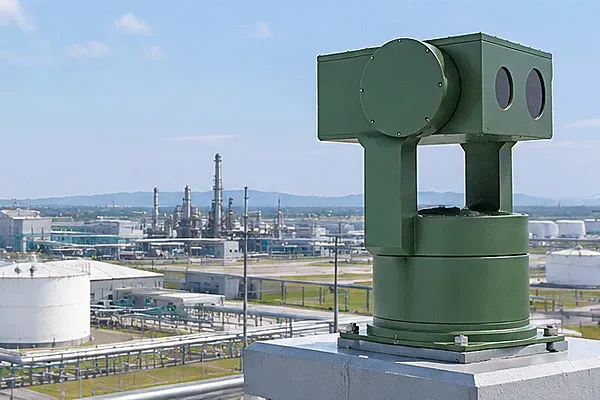
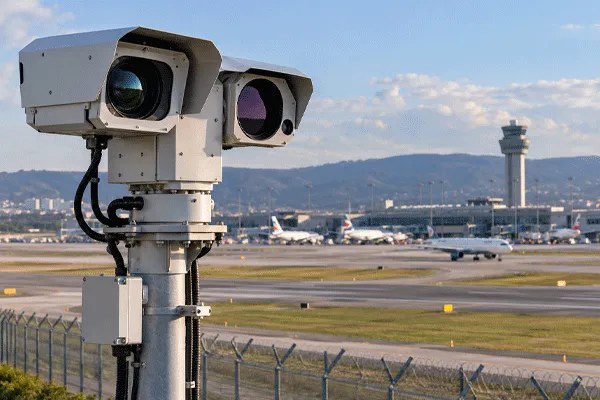
A security project can fail even when the equipment looks strong on paper. Poor sensor placement, weak target definition, clutter, blind zones, or slow verification may reduce real detection performance. A well-designed radar detection system solves this by combining reliable sensing, tracking, processing, and visual confirmation into one practical surveillance workflow.
A professional radar detection system sends or receives radio-frequency energy, processes returned signals, detects objects, estimates position and movement, and maintains target tracks. Modern systems may combine radar de vigil芒ncia, electro-optical cameras, thermal imaging, pan-tilt platforms, and management software to provide continuous situational awareness across airports, ports, industrial sites, borders, coastlines, and other large areas.
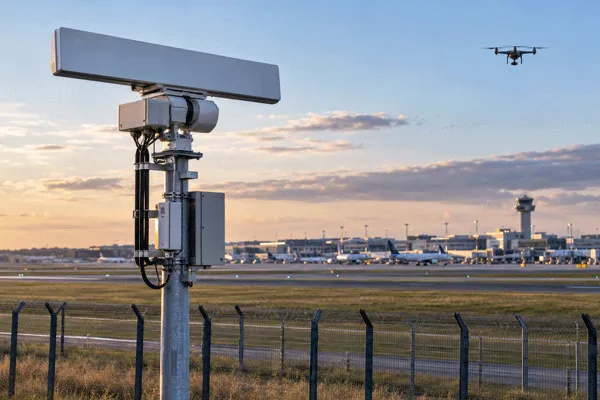
Radar Detection Systems Explained: Radar Detector Functions, Radar Sensors, and Modern Surveillance
What Is a Radar Detection System?
The word radar originally comes from radio detection and ranging. In simple terms, a radar system uses electromagnetic energy to find objects and measure information such as distance, direction, and movement.
In a conventional active system, a transmitter generates radio waves. An antenna directs that energy toward an observation area. When the energy reaches an object, part of it returns as reflected energy. A receiver captures the reflected signal, while signal processing software determines whether a meaningful target is present.
NOAA explains the same basic principle through weather Doppler systems: a transmitter sends radio signals, the antenna receives returned energy, and the time taken for a transmitted pulse to return can be used to determine range. Doppler processing can also provide information about movement.
A modern security installation goes further. It normally needs to:
- detect targets within a defined area;
- estimate their position and direction of movement;
- maintain stable tracks over time;
- separate useful returns from environmental clutter;
- classify or prioritize objects when possible;
- send coordinates to other sensors;
- support visual or thermal verification;
- record alarms, tracks, and supporting evidence.
That is why buyers should think of the equipment as a complete sensing chain rather than simply a detector.
How Does Radar Detection Work From Transmitter to Receiver?
A basic detection cycle begins when the system creates electromagnetic waves and directs them into the monitoring zone. These waves travel outward until they meet an object or environmental feature.
The returned energy is normally much weaker than the transmitted signal. The receiving electronics therefore need enough sensitivity and processing capability to separate useful echoes from background noise.
A simplified chain looks like this:
| Palco |
Main Function |
Why It Matters |
| Transmitter |
Generates the operating waveform |
Influences available signal energy |
| Radar antenna |
Directs and receives energy |
Affects coverage and angular resolution |
| Receiver |
Captures weak returned signals |
Influences sensitivity |
| Signal processing |
Filters clutter and extracts useful information |
Helps separate targets from background returns |
| Detection logic |
Determines whether a target is present |
Affects alarm stability |
| Tracking engine |
Links detections over time |
Creates useful movement tracks |
| Sensor integration |
Sends target data to cameras or software |
Supports verification and operator awareness |
With pulsed radar, the system sends short pulses of radio waves and listens between transmissions. Distance can be estimated from the delay between transmission and reception. NOAA notes that Doppler processing also uses changes in returned signal phase to estimate target velocity.
This is only the beginning. A useful surveillance installation must repeatedly detect and track targets while dealing with buildings, trees, waves, precipitation, traffic, terrain, and other background returns.
What Is the Difference Between a Radar Detector and a Professional Radar System?
The phrase radar detector can be confusing.
In everyday consumer searches, it often refers to a small device designed to sense nearby radio-frequency emissions. That is not what professional surveillance buyers normally need.
A professional radar system is an active sensing and tracking platform. Its job is not simply to recognize that a signal exists. It must observe an area and produce useful target information.
For a security project, this usually means answering questions such as:
- Where is the object?
- How far away is it?
- Is it moving?
- What direction is it travelling?
- Can the system maintain a stable track?
- Can another sensor verify it?
- Can the event be recorded and reviewed?
This distinction matters for SEO and procurement alike. A buyer searching for radar detection systems for an airport, refinery, port, logistics hub, or industrial facility usually needs surveillance capability—not a consumer radar detector.
When we discuss a detector function in professional systems, we therefore mean the detection stage inside the wider sensing and tracking architecture.
How Do Pulsed Radar, Continuous Wave, and Passive Radar Differ?
There is no single type of radar suitable for every sensing task.
Pulsed Radar
A pulsed radar sends energy for a short period and then listens for echoes. Measuring the return delay allows the system to estimate target distance.
This principle is widely used where range information is important.
Continuous Wave Radar
A continuous wave system transmits continuously rather than sending separate pulses. A basic CW radar can use the Doppler shift to determine the velocity of moving objects.
An unmodulated continuous-wave design does not provide range in the same way as a pulse-based system. Frequency or phase modulation can add additional measurement capability. RadarTutorial describes this distinction between simple CW and frequency-modulated continuous-wave systems.
Passive Radar
Passive radar works differently because it does not rely on its own dedicated transmitter. Instead, the receiver can use suitable transmitters in the environment as illumination sources and process energy reflected from objects.
IEEE describes passive systems as using existing broadcasts, communications, or navigation signals rather than a dedicated transmitter. This commonly creates bistatic radar systems, where the illumination source and receiving site are in different locations.
For a commercial project, the correct architecture depends on coverage, target type, environment, integration needs, spectrum conditions, and required performance. Technology should follow the application—not the other way around.
How Do Radar Sensors Detect Moving Objects?
Movement is especially useful because it helps the system distinguish an object from stationary background features.
A Doppler radar measures changes associated with motion along the line between the target and the sensor. This enables the processing system to estimate radial speed and helps identify moving objects.
Modern surveillance platforms may combine Doppler information with range, bearing, track history, and other measurements. Instead of treating every echo as an alarm, the software evaluates how a return changes over time.
This matters in environments such as:
- industrial perimeters;
- airport boundaries;
- logistics parks;
- coastal areas;
- ports;
- remote facilities;
- large energy sites.
A good installation should not simply detect moving objects. It should create tracks that operators can understand.
For example, an object that appears once and disappears may be less useful than a stable track containing position, direction, speed, and history.
Midradar’s current technology architecture combines AESA hardware, digital beamforming, adaptive clutter suppression, Track-Before-Detect processing, and multi-sensor integration to support target detection and tracking in complex environments.
What Determines Radar Detection Range in a Real Project?
A published detection range is useful, but it should never be treated as a universal distance.
Actual performance depends on several connected factors.
1. Target characteristics
A large object generally returns more energy than a very small one. Shape, material, orientation, movement, and target geometry can all affect the returned signal.
2. Installation height
A sensor installed too low may lose useful coverage because of buildings, walls, terrain, vegetation, parked equipment, or other obstacles.
3. Environment
Sea waves, rain, moving trees, machinery, road traffic, and nearby structures can produce clutter.
4. Operating frequency
The operating frequency influences antenna design, propagation behavior, resolution, and other system characteristics. Different solutions may operate across different GHz frequency bands.
A compact 24 GHz sensor used for industrial sensing, for example, serves a very different purpose from a long-range surveillance installation. Frequency alone does not tell a buyer whether a system fits a large security project.
5. Processing
Hardware creates measurements. Software turns measurements into useful information.
Adaptive filtering, track logic, target models, clutter suppression, and other algorithms can strongly affect field performance.
6. Site geometry
There is a major difference between covering an open coastal area and monitoring an industrial zone filled with tanks, buildings, cranes, pipes, fences, and vehicle roads.
For this reason, we recommend treating detection range as a project-specific engineering question:
What target must be detected, under what conditions, from what mounting point, and with what probability and track quality?
That question is far more useful than simply asking, “How many kilometers can the unit see?”
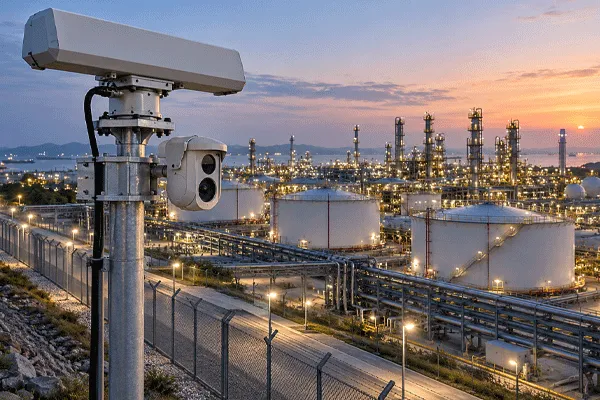
Radar Detection Systems Explained: Radar Detector Functions, Radar Sensors, and Modern Surveillance
Why Does Radar-Vision Fusion Improve a Sensor Solution?
A radar is excellent at wide-area awareness, but it does not always give an operator the visual context needed to understand an event quickly.
A camera has the opposite strength. It provides intuitive imagery, but its performance can be affected by darkness, fog, distance, line of sight, or a narrow field of view.
This is why a combined sensor solution can provide more operational value.
A typical workflow is:
Radar detection → target track → coordinate output → pan-tilt cueing → visible or thermal observation → operator verification
Midradar’s radar-vision architecture uses radar measurements to guide electro-optical equipment toward detected targets. The company’s technology platform describes this as radar-EO intelligent slew-to-cue, where target data automatically drives imaging equipment toward the relevant area.
Its current radar-vision product portfolio combines radar with visible and thermal imaging for applications ranging from compact perimeter monitoring to wider-area installations.
For buyers, this architecture offers three practical advantages.
First, it shortens search time. The camera does not need to scan the entire site manually.
Second, it provides visual context. Operators can compare radar tracking data with live imagery.
Third, it builds a stronger event record. Tracks, alarms, images, and video can be stored together.
This is especially valuable for sites where security teams need both early awareness and clear verification.
What Are the Main Uses of Radar in Modern Surveillance?
The uses of radar extend well beyond one industry.
The FAA, for example, continues to use ground-based systems as an important surveillance source for airspace monitoring, including detecting aircraft that may not provide cooperative surveillance data.
In commercial security engineering, applications are broader.
| Aplicação |
Typical Requirement |
Supporting Sensors |
| Segurança em aeroportos |
Airspace, bird, and perimeter monitoring |
Radar + EO/IR |
| Port monitoring |
Small vessel and shoreline observation |
Surface radar + thermal |
| Industrial perimeter |
Personnel and vehicle movement |
Ground-based radar + PTZ |
| Energy facilities |
Wide-area early warning |
Radar + thermal imaging |
| Logistics parks |
Large open-area monitoring |
Short/mid-range sensors + cameras |
| Coastal sites |
Water-surface and shoreline awareness |
Surface radar + long-range imaging |
| High-security compounds |
Continuous perimeter observation |
Multi-sensor architecture |
There are also many civilian radar-based applications outside security. Examples include weather monitoring, air traffic control, collision avoidance, automotive adaptive cruise control, industrial level measurement, and measurement of material fill levels.
These applications demonstrate how flexible radar technology can be, but they should not be confused with professional wide-area surveillance design.
A sensor intended for shorter ranges inside a vehicle or tank measurement system has completely different requirements from one used to monitor a multi-kilometer outdoor area.
How Should Buyers Evaluate Radar Sensors for a Real Site?
We normally recommend starting with the site and operational requirement rather than the product model.
Before comparing equipment, define at least the following.
Classes-alvo
Do you need to observe:
- people;
- vehicles;
- small vessels;
- birds;
- low-altitude unmanned aircraft;
- several target types at the same site?
Geometria de cobertura
Ask:
- Is 90° sector coverage enough?
- Is 360° coverage required?
- Are there buildings or terrain obstacles?
- Are several monitoring zones needed?
- Will one installation point create blind areas?
Required track output
A project may need more than an alarm.
Confirm whether the platform provides:
- range;
- bearing;
- coordinates;
- velocity;
- target ID;
- track history;
- classification;
- confidence information;
- alarm-zone rules;
- interfaces for third-party systems.
Verificação visual
If the radar detects something 2 km away, can the imaging system actually provide useful verification at that distance?
This is where buyers should compare the radar and camera as one system instead of purchasing each sensor independently.
Integração
System integrators should also confirm:
- data protocol;
- coordinate format;
- network architecture;
- API or SDK availability;
- time synchronization;
- third-party platform compatibility;
- pan-tilt control;
- alarm output;
- event recording.
Good procurement begins with the operational workflow, not the brochure.
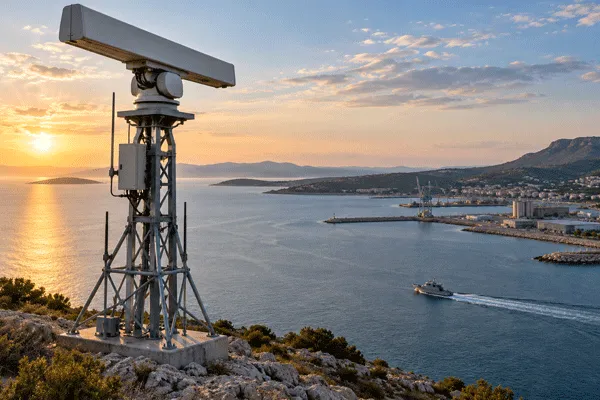
Radar Detection Systems Explained: Radar Detector Functions, Radar Sensors, and Modern Surveillance
What Can a Real Radar-Vision Project Teach Us?
A published Midradar petrochemical project provides a useful example.
The site included an open boundary exceeding 8 km, refinery and storage areas, loading zones, nearby public-road access, personnel movement, vehicle activity, and low-altitude monitoring requirements.
Instead of relying on one technology, the project combined three MR-RDT20K vigilância de baixa altitude units with nine long-range thermal PTZ cameras and a radar-video fusion platform. The system used virtual zones, multi-target tracking, camera linkage, alarm management, and event recording.
The important lesson is not the number of devices.
It is the architecture.
A large site has several different questions:
- Can the system detect something early enough?
- Can it maintain the track?
- Can it point another sensor toward the event?
- Can the operator understand what is happening?
- Can the event be recorded for later review?
This is a more realistic way to evaluate surveillance performance.
The same logic can apply to airports, ports, industrial parks, power facilities, logistics areas, and other high-security environments.
How Do You Specify a Radar System Before Requesting a Quote?
A useful request for quotation should contain enough information for the supplier to recommend the right architecture.
Instead of sending:
“We need a 5 km radar. Please send price.”
provide a short project brief.
Recommended RFQ information
1. Application
Airport, port, industrial facility, coastal area, logistics park, energy site, or another location.
2. Target
What must the system detect and track?
3. Required range
State the required range for each target class rather than giving one universal distance.
4. Coverage
Sector angle, 360° coverage, site dimensions, or boundary length.
5. Site environment
Include terrain, buildings, vegetation, coastline, weather, and possible sources of clutter.
6. Mounting conditions
Provide approximate installation height and available structures.
7. Verification requirement
Do you need visible cameras, thermal imaging, or both?
8. Integration
Explain whether the equipment must connect to an existing VMS, C2 platform, security management system, or third-party software.
9. Network and power
Describe available network links and site power conditions.
10. Project stage
Concept design, tender preparation, technical evaluation, pilot project, or implementation.
When our engineering team reviews a project, these details are often more useful than a long specification copied from another installation.
They allow us to determine whether the customer needs one surveillance radar, several coordinated radar sensors, radar-vision fusion, or a wider integrated monitoring architecture.
Why Work With a Radar Manufacturer and System Integration Partner?
A standalone product specification rarely solves an entire surveillance problem.
A project may involve sensing hardware, imaging equipment, mounting, pan-tilt control, networking, software, coordinate alignment, environmental configuration, field testing, and long-term technical support.
Working with a supplier that develops and integrates multiple parts of the system can reduce interface problems between separate vendors.
At Midradar, our portfolio covers surveillance sensing, radar-vision fusion, electro-optical imaging, thermal imaging, pan-tilt platforms, and integrated monitoring software. Our technical approach combines AESA, DBF, MIMO, adaptive clutter suppression, target tracking, and radar-guided optical verification.
For system integrators, engineering contractors, distributors, project developers, and end users, we can support the process from requirement analysis through system configuration and integration planning.
The objective is simple: build the right detection architecture for the actual site instead of forcing every project into the same standard package.
If you are planning a new airport, port, industrial, energy, coastal, border-monitoring, or high-security surveillance project, start by sharing your target types, coverage area, required range, site drawings, and integration requirements. Those details make it much easier to build an accurate technical proposal.
Key Things to Remember
- Radar is a complete sensing process, not just a detector that produces an alarm.
- A professional system combines the transmitter, antenna, receiver, processing, detection, and tracking functions.
- Pulsed, continuous-wave, and passive architectures operate differently and suit different applications.
- Real detection performance depends on target type, environment, site geometry, installation height, and processing—not range alone.
- Stable radar tracking is often more useful than isolated detections.
- Radar and EO/IR cameras complement each other: one provides wide-area awareness, while the other supports visual verification.
- Large airports, ports, industrial sites, energy facilities, coastal locations, and high-security compounds usually require system-level design rather than a single sensor.
- Before requesting a quote, define the target, coverage, range, environment, mounting conditions, integration interfaces, and verification requirements.
- A good supplier should help translate your site requirements into a practical sensor architecture.
- The best radar detection system is not the one with the biggest number on the datasheet. It is the system that reliably produces useful, verifiable information in your real operating environment.
Perguntas Frequentes
Can radar detect targets at night?
Yes. Radar does not depend on visible light in the same way as a conventional camera. This makes it useful for continuous day-and-night monitoring. A thermal or visible camera can then provide additional visual confirmation.
Can radar detect both moving and stationary objects?
The answer depends on the system architecture and processing method. Many surveillance applications focus heavily on motion because Doppler information helps separate moving objects from stationary background features. Other radar architectures can also measure stationary objects.
What is the difference between monostatic and bistatic radar?
In a monostatic arrangement, transmitting and receiving functions are located at the same radar site or share closely located hardware. In bistatic arrangements, the transmitter and receiver are geographically separated. Passive systems commonly use bistatic geometry.
Does a higher GHz operating frequency always mean better detection?
No. Frequency is only one design parameter. Target size, waveform, antenna design, transmitted energy, processing, bandwidth, environment, installation height, and clutter conditions also affect performance. Buyers should evaluate complete system performance rather than one number.
Why combine radar with a thermal camera?
Radar provides wide-area position and movement information. Thermal imaging provides visual context in darkness and many low-visibility conditions. Linking the two can help operators move from initial detection to faster verification.
How can I compare two radar systems fairly?
Define the same target, environment, mounting height, coverage area, test route, detection criteria, and tracking requirements for both systems. Datasheet range alone is not a fair comparison. When possible, create measurable site-acceptance criteria before selecting a supplier.




 10:04