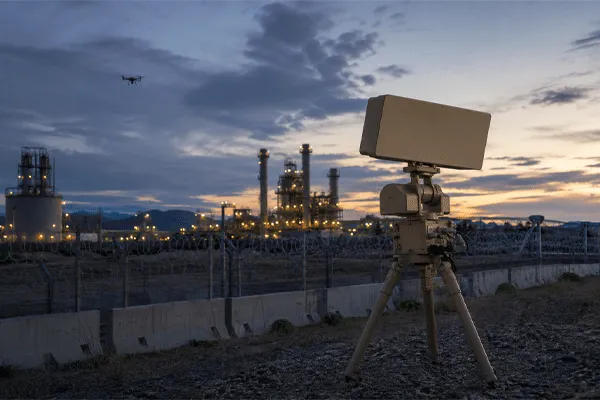
Resumo Executivo
This is an interface-requirements guide, not a sensor-selection guide. It defines what radar, C2 and EO/IR components must exchange and how the command loop should be tested. A counter-UAS command-and-control platform receives target tracks, manages identifiers and priorities, assigns EO/IR devices, records evidence and supports authorized response workflows. Before contract award, the project should lock the track data model, coordinate reference, timestamp and synchronization method, device-control commands, cybersecurity boundary, degraded behavior and FAT/SAT evidence.
Midradar’s MR2000 platform is designed to coordinate radar, spectrum-detection, EO/IR and authorized response devices in a unified operating environment. Confirmed functions include centralized device and user management, map-based track display, multi-source track fusion, radar-to-EO/IR cueing, video monitoring and playback, alarm-zone management, unattended operation and event recording. Exact API, SDK, third-party protocol and cybersecurity support remains subject to the selected product, software version and project interface review.
Key Questions This Guide Answers
- How does a radar integrate with a Counter-UAS C2 platform?
- What track fields, coordinates and timestamps should the radar provide?
- How should coordinate, time, device-control and handoff rules be defined?
- What should be tested in radar-to-EO/IR cueing and third-party device integration?
- Which FAT/SAT evidence is required before operational acceptance?
Applicability, Assumptions and Limits
This guide applies to projects that connect one or more radar, RF and EO/IR sensors to Midradar MR2000 or to a third-party C2, PSIM or VMS. It is a requirements and acceptance framework, not a universal interface specification. Actual transport protocols, message fields, coordinates, timing, authentication and cybersecurity controls must be locked for the selected model and software release. The guide assumes that the buyer can provide the existing-system topology, interface documents, site geometry and an agreed operational workflow. It does not establish compatibility with a named third-party platform until implementation and interoperability testing are complete.
1. What C2 Integration Must Accomplish
C2 integration is not completed when a radar icon appears on a map. The system must preserve the meaning, timing and quality of sensor data from detection through operator decision. At minimum, it should create a stable track identity, convert positions into a common coordinate frame, account for data age, select an appropriate EO/IR device, issue a cueing command, receive position and tracking feedback, and combine the resulting track, video and operator action into one auditable event.
This end-to-end workflow is important because a project can fail even when every individual device works. A coordinate-sign error can point the camera in the wrong direction. Unsynchronized clocks can attach video to the wrong track. A missing device-health message can leave the operator unaware that a sensor is offline. Integration therefore has to be specified as a system behavior, not as a list of product interfaces.
2. Reference Architecture
A practical counter-UAS architecture has five layers. The sensor layer detects and measures targets. The interface and fusion layer adapts messages, unifies coordinates and time, filters tracks and associates observations. The C2 layer presents the operational picture, applies rules, manages permissions and records decisions. The EO/IR and PTU layer performs visual verification and tracking. The evidence and operations layer stores tracks, alarms, video, screenshots, device status and operator actions.
Responsibility must be explicit. Midradar can provide the radar sensor layer, MR2000 C2 functions, project-specific interface clarification, geometry review, calibration and integration support. When a third-party C2, PSIM or VMS is used, the platform owner normally remains responsible for its business logic, cybersecurity policy and external-system orchestration unless the contract states otherwise.
For the full system workflow, review Midradar’s arquitetura integrada contra UAV
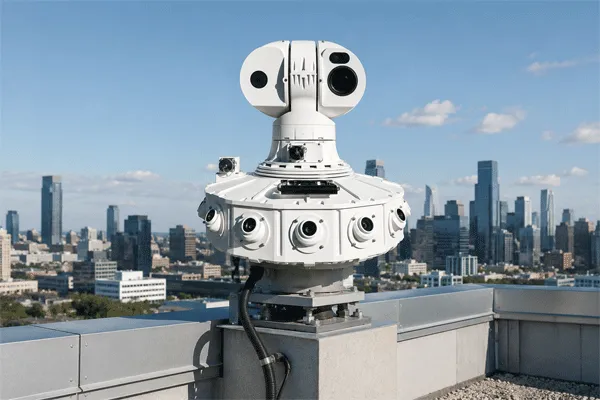
llustrative reference architecture; not a protocol compliance statement
C2 Integration Acceptance Matrix
| Control Point |
Required Evidence |
Acceptance Focus |
| Track data |
Versioned ICD, sample messages and field dictionary |
Track-ID lifecycle, units, null values, update rules and reconnect behavior |
| Coordinates |
Datum, altitude reference, units, north convention and measured test points |
Residual error across range, azimuth and elevation |
| Time |
Clock architecture and timestamp definition |
Clock offset, data age, loss-of-sync alarm and recovery |
| Cueing loop |
Command, acknowledgement, PTU feedback and video evidence |
Time to first target-in-frame, pointing error and reacquisition |
| Health and faults |
Heartbeat, fault codes, version and degraded-mode rules |
Detection, logging, safe degradation and recovery sequence |
| Event evidence |
Common Event ID linking tracks, alarms, video and operator actions |
Completeness, time consistency, export and access control |
3. Minimum Interface Requirements
The interface specification should define transport and network behavior, track-message fields, coordinate reference, timestamps, device status, command acknowledgement, error handling, logging and version control. A useful radar track normally needs a source sensor ID, track ID, measurement or update time, position, velocity, track state and quality indicator. Projects may also require classification, RCS estimate, confidence, threat priority and covariance or accuracy information, but these fields should not be assumed unless they are documented and tested.
Time synchronization deserves separate attention. Radar, C2, PTU, camera and recorder clocks must be compared during integration. The project should define the synchronization method, acceptable clock offset, loss-of-sync alarm and recovery behavior. NTP may be appropriate for some installations, while higher-precision or isolated systems may require a different project-specific approach.
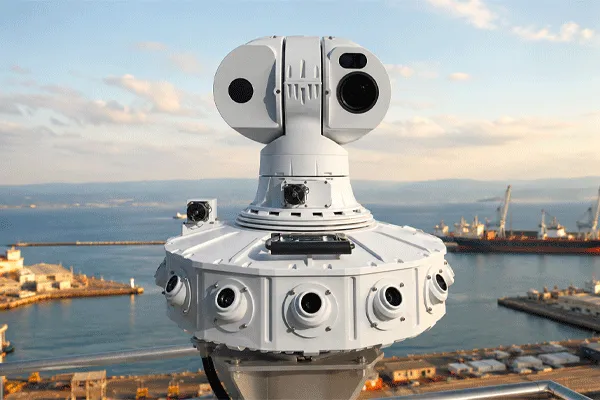
Requisitos da Interface C2 de Counter-UAS: Dados de Rastreio, Sincronização de Tempo e Indicação EO/IR
4. Radar-to-EO/IR Cueing
Radar-to-EO/IR cueing is an end-to-end system function. The radar first establishes and updates a target track. The integration layer converts the target into the coordinate frame required by the PTU and predicts the line of sight when network and processing delay are significant. The C2 then issues an absolute pan/tilt command or target-coordinate command. The PTU reports position and motion status, while the EO/IR payload provides video, tracking state and optional recognition results.
Acquisition performance depends on radar accuracy and update behavior, coordinate conversion, timestamp consistency, network latency, PTU absolute positioning, boresight calibration, focal length, structural deflection, wind load and target motion. For this reason, a brochure claim such as “automatic linkage” should be converted into measurable acceptance points: track-establishment time, command latency, time to first target-in-frame, target-in-frame error, tracking retention and recovery after track loss.
Projects focused on detection and visual confirmation can review Midradar’s sistemas de fusão de visão por radar.
For sensor-role allocation, observation-association logic and verification boundaries, continue with Midradar’s Counter-UAS sensor fusion guide.
5. MR2000 Confirmed Functions and Project-Specific Items
MR2000 provides unified management of radar, spectrum-detection, EO/IR and authorized response devices, with user and role management, real-time video, target localization, alarms, identification and tracking, multi-source fusion, map display, radar-to-EO/IR cueing, synchronized playback, electronic fences and unattended operation. These functions provide a real software basis for system-level discussions with integrators.
However, exact REST, WebSocket, binary-message, SDK, ASTERIX, SAPIENT, ONVIF or other protocol support should be stated only after the required version, message set, device role and acceptance scope are defined. The correct commercial statement is that project-specific integration can be evaluated subject to protocol, data-field, cybersecurity and interoperability review.
6. FAT/SAT Acceptance
Acceptance should cover normal operation and degraded conditions. Recommended tests include startup and reconnection, field-by-field message validation, clock comparison and simulated loss of synchronization, coordinate checks at measured reference points, fully automatic radar-to-camera acquisition, multi-target prioritization, device disconnection, event export and recovery after failure.
The contract should define the test target, route, system configuration, measurement method, evidence format, pass/fail thresholds and retest procedure. Fixed universal thresholds should not be copied from marketing material. They should be agreed for the selected radar, network, PTU, payload, site and operating procedure.
Utilize os recursos da Midradar para site assessment and integration support for project-specific engineering.
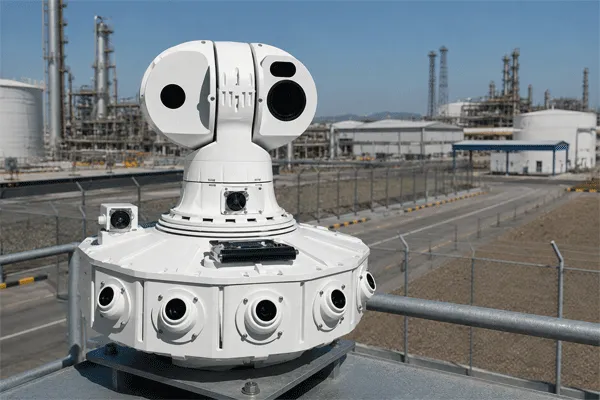
Requisitos da Interface C2 de Counter-UAS: Dados de Rastreio, Sincronização de Tempo e Indicação EO/IR
Conclusion and CTA
A counter-UAS project should treat C2 integration as a controlled engineering scope rather than a generic compatibility claim. The decisive questions are whether target data remains meaningful across systems, whether the EO/IR device can acquire the intended target, whether operators can understand and audit the event, and whether failure behavior is defined.
For a preliminary Midradar interface review, provide the target types, site map, required coverage, selected radar, existing C2 or VMS, EO/IR and PTU models, available interface documents, coordinate and time requirements, cybersecurity constraints and planned FAT/SAT conditions.
Perguntas Frequentes
Does MR2000 integrate radar, RF and EO/IR devices?
MR2000 is designed for unified management and coordination of radar, spectrum-detection, EO/IR and authorized response devices. Exact third-party device integration is confirmed through project interface review.
Does Midradar support any C2 platform?
No universal compatibility claim should be made. Project-specific C2, PSIM or VMS integration can be evaluated after the required protocol, fields, security and acceptance criteria are defined.
What is the most important cueing acceptance metric?
There is no single metric. Projects should measure track continuity, data age, command latency, time to first target-in-frame, pointing error, tracking retention and recovery after loss.
What data should a radar send to the C2 platform?
At minimum, define sensor ID, Track ID, timestamps, position, velocity, track state, quality, update behavior and device status. The exact field set and coding must be confirmed in the project ICD.
How should third-party device compatibility be confirmed?
Lock the model and software version, review the protocol and fields, connect representative equipment, test normal and degraded conditions, and record the result in FAT/SAT evidence.


 09:04
09:04