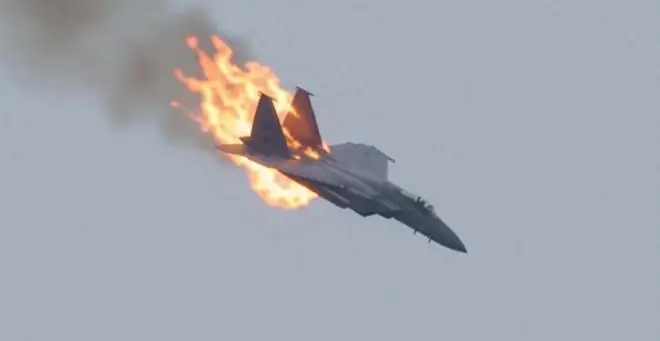
The recent F-15E incident has pushed one question into the spotlight:
If parts of an air-defense network were already damaged, how could it still detect, track, or threaten an advanced fighter jet?
That question became even more interesting after public reports confirmed that a U.S. F-15E Strike Eagle was shot down over Iran and that the United States later launched a very large rescue operation to recover the crew. Public reporting also makes one thing clear: while the event itself is real, the exact detection-and-engagement chain has not been fully confirmed in public. In other words, people know what happened, but not exactly how the target was found and tracked. (
That uncertainty is exactly why this topic matters.
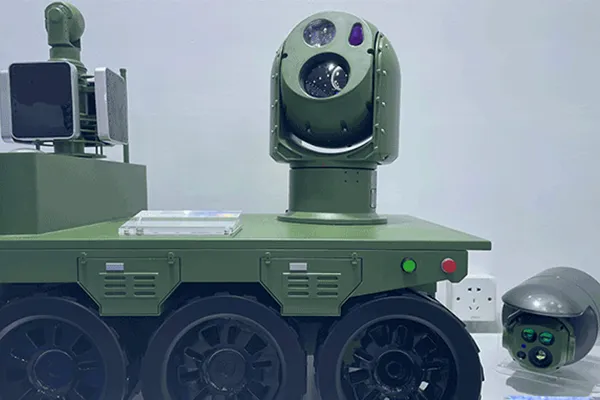
Many people still think air defense works in a simple way: radar turns on, radar sees the aircraft, missile is launched. But modern air defense is much more complicated than that. In many cases, it is no longer centered on a single radar. Instead, it works more like a network of different sensors and systems that support each other. That is where electro-optical (EO) and infrared (IR) systems enter the picture.
A Simple Way to Understand EO/IR Systems
If radar is like using a flashlight in the dark and looking for the reflection, then an electro-optical or infrared system is more like watching quietly from the shadows.
EO/IR systems usually include:
- visible-light cameras,
- thermal imaging,
- infrared detection,
- and sometimes Infrared Search and Track (IRST) capability.
These systems are passive. That means they do not need to broadcast radio waves in order to detect a target. Instead, they observe light, heat, contrast, and movement. That passive nature is one reason they are so valuable in contested environments. Defense references describe EO/IR systems as passive imaging sensors that can provide situational awareness and long-range precision tracking without emitting detectable energy.
The key science is simple:
Anything above absolute zero gives off thermal radiation.
That includes people, vehicles, missiles, and aircraft.
So even if a fighter jet is difficult to detect with radar, it may still be noticeable in other ways:
- its engine exhaust is extremely hot,
- the airframe heats up during fast flight,
- and the aircraft may stand out against a cooler sky or terrain background.
This is why passive infrared detection keeps coming back into the conversation whenever people discuss stealth aircraft, counter-stealth sensing, or degraded air-defense environments.
Can EO/IR Systems Really Detect Fighter Jets?
Yes—but not in a magical or unlimited way.
A fighter jet is not just a moving shape in the sky. It is also a moving heat source. Its exhaust plume, hot engine area, and heated surfaces can all create an infrared signature. That is the basic idea behind IRST and related thermal detection systems: they can detect and track airborne targets based on emitted infrared radiation rather than reflected radar energy. This is important because many people misunderstand stealth. Stealth does not mean a fighter becomes invisible in every part of the spectrum. It usually means it is harder to detect with radar, not that it produces no heat at all. In fact, published discussions of IRST specifically note that infrared systems are passive, can track aircraft by their infrared signatures, and in some cases offer strong angular resolution, even though their range is affected by atmosphere and weather.
So when people ask, “Can a system still see a fighter without radar?” the answer is:
Yes, under the right conditions, a passive EO/IR system may still detect and follow an aircraft.
That does not mean it works perfectly in every environment. But it absolutely means that a damaged or emission-limited defense network is not automatically blind.
Then How Can a Target Be Tracked Without Radar?
This is where the discussion gets interesting.
A single camera or thermal imager can often tell you where something is in the sky, but it may not always give you perfect 3D target information all by itself. That is why modern systems usually rely on more than one sensor.
1. Continuous Passive Tracking
Once an EO/IR system has found a target, it can keep following that target by measuring its position, direction, and movement frame by frame. In simple terms, it can “keep its eyes on it.”
That alone is useful. Even if the system cannot do everything radar does, it may still maintain a usable target track for classification, observation, and handoff to other systems.
2. Multiple Viewpoints
If more than one EO/IR station sees the same target from different locations, the system can estimate position more accurately by comparing the lines of sight. People often call this triangulation.
You do not need to explain the mathematics in a popular blog. The simple version is enough:
one sensor can watch, two or more sensors can estimate where the object really is in space.
3. Sensor Fusion
This is probably the most important concept in the whole article.
Modern air defense is not usually:
- EO or radar,
- passive or active,
- camera or fire control.
It is usually all of them working together.
A modern network may combine:
- EO/IR sensors for passive observation,
- radar for wide-area warning,
- electronic support systems for signal awareness,
- UAVs for extra reconnaissance,
- and command software for data fusion.
That is what people mean when they say modern warfare is becoming system-centric. One sensor alone may be limited. But a group of sensors working together becomes much more powerful.
Why Passive Detection Matters So Much Today
There are three big reasons passive systems are receiving so much attention.
First: they are harder to notice
Radar has to emit energy. That can reveal its location or make it a target. EO/IR systems usually do not have that problem because they are mainly watching, not broadcasting.
Second: they are more comfortable in electronic warfare
Radar can be jammed, spoofed, or forced into emission control. EO/IR systems are not invulnerable, but they are not dependent on active RF emission to see a target. That makes them valuable in heavily contested electromagnetic environments. EO/IR standards and defense references repeatedly highlight their value for passive threat assessment and target tracking in day, night, and adverse conditions.
Third: they can help against low-observable aircraft
A low radar cross-section can reduce radar visibility. It does not eliminate engine heat, skin heating, or thermal contrast. That is why IRST continues to be relevant in discussions about modern aircraft tracking.
But EO/IR Systems Also Have Real Limits
To keep this article balanced, it is important to say clearly: EO/IR systems are not magic.
They have real limitations.
Weather matters
Cloud, haze, humidity, and atmospheric absorption can all reduce infrared performance. Technical guidance on EO/IR sensing makes clear that atmospheric conditions strongly affect how well these systems perform.
Range can be limited
Passive systems may be excellent at seeing a target under good conditions, but they do not always match radar for wide-area search at long range.
Direct range measurement is harder
A passive camera can tell you where to look, but not always how far away the target is unless it is combined with other sensors, geometry, or additional processing.
Background clutter is real
Hot terrain, urban environments, sunlight reflection, and countermeasures like flares can all make tracking more complicated.
So the realistic conclusion is not:
“EO replaces radar.”
The better conclusion is:
“EO/IR helps keep the air-defense picture alive when radar cannot do everything alone.”
What the F-15E Incident Suggests
This is the part that has made the story a global talking point.
Public reporting confirms that a U.S. F-15E was lost, that both crew members were eventually recovered, and that the rescue effort was extremely large and risky, involving scores of aircraft and a major coordinated operation. At the same time, public reporting has not established one fully verified sensor-to-shooter explanation for how detection, tracking, and engagement happened.
That means people should be careful about making overconfident claims.
But the incident still reveals something important:
A damaged air-defense posture may still remain dangerous if enough sensing, tracking, and coordination capability survives.
That capability may include:
- surviving radar elements,
- passive EO/IR observation,
- mobile or distributed sensors,
- tracking handoff between systems,
- and integrated fire control.
In other words, the real question is not only whether radar was damaged. The bigger question is whether the overall system still had enough awareness to detect and follow a target.
The Bigger Lesson: Modern Air Defense Is About Systems
This may be the most useful takeaway for readers.
Modern air defense is no longer just about one radar truck, one missile battery, or one camera tower. It is about how different parts of the system work together:
- radar for early warning,
- EO/IR for passive confirmation and tracking,
- stabilized platforms for continuous observation,
- command-and-control systems for decision-making,
- and engagement systems for response.
That is why passive detection has become such a hot topic after the F-15E incident. People are starting to realize that even if a radar network is weakened, a defense system may still retain dangerous capability if it can see, track, and coordinate through other means.
Final Takeaway
So, can electro-optical systems track fighter jets without radar?
Yes—up to a point, and especially as part of a larger network.
They may not fully replace radar in every situation, but they can absolutely support detection, classification, and tracking in modern air-defense architectures. And in some contested situations, that passive capability may become extremely important.
The bigger lesson from the current debate is simple:
A damaged radar network does not always mean a blind air-defense network.
In modern warfare, the side that combines radar, EO/IR, tracking systems, and command integration most effectively is often the side that keeps its awareness—and its threat—alive.













 11:08
11:08