In the bustling operations of modern airports, the takeoff and landing phases are the most critical windows for flight safety. Traditionally, tower monitoring has relied on visual observation by controllers and radar screens. However, how can we quantitatively evaluate if an aircraft is precisely aligned with the runway? How can we monitor in real-time if its descent trajectory deviates from the standard glideslope?
Midradar’s TF1000 Aircraft Takeoff and Landing Identification, Tracking, and Analysis System provides a revolutionary digital auxiliary monitoring solution for control towers, leveraging AI visual recognition and high-precision sensor fusion technology.
1. Core Technology: Radar-Vision Fusion and Multi-Dimensional Monitoring
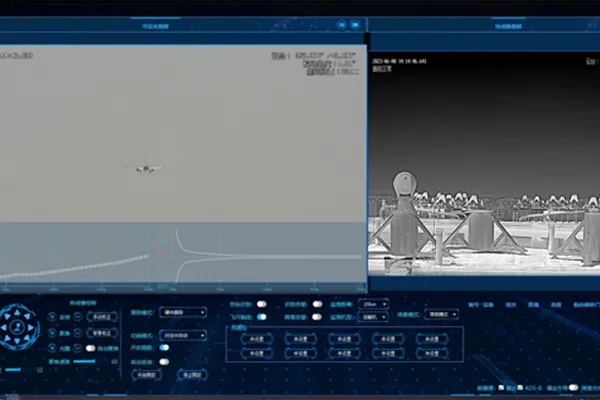
The TF1000 is far more than a high-definition camera. It integrates ultra-low-light visible imaging, cooled infrared thermal imaging, laser rangefinding, and AI recognition algorithms to achieve 24/7 precise tracking of aircraft.
• All-Weather Visual Verification: In nighttime, heavy fog, or low-visibility conditions, the system utilizes its cooled MCT detector (thermal imaging) to penetrate atmospheric interference and capture the aircraft’s thermal signature, ensuring uninterrupted monitoring.
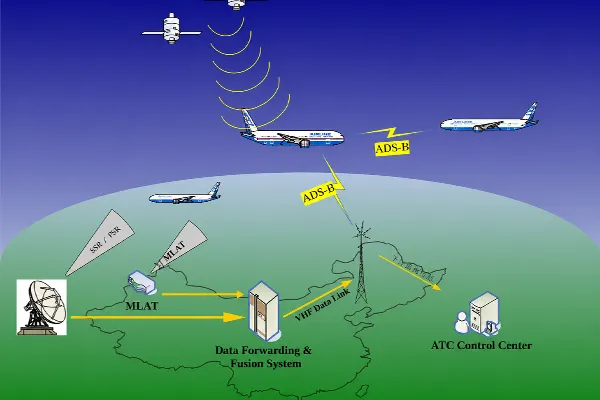
• Multi-Source Data Guidance: The system supports radar guidance, ADS-B guidance, and preset-based auto-locking. By receiving latitude, longitude, altitude, and velocity data from surveillance radars, the electro-optical gimbal automatically points toward the target and maintains stable tracking with centimeter-level precision.
2. Real-Time Analysis: Glideslope and Centerline Deviation
The core value of the system lies in transforming complex flight dynamics into intuitive, quantitative digital charts:
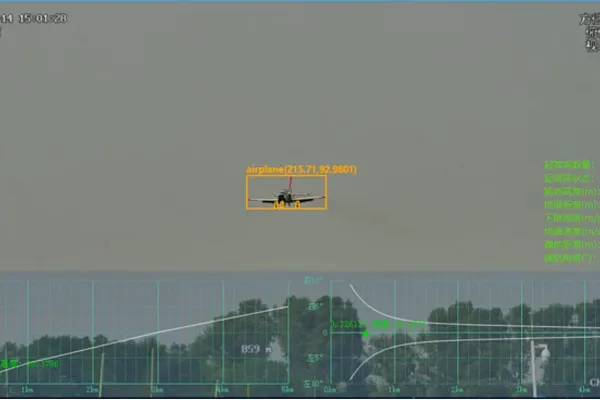
• Dynamic Glideslope Plotting: The system calculates the aircraft’s spatial coordinates in real-time and plots the actual descent curve on the monitor. By comparing this with the standard glideslope (e.g., a 3° descent angle), controllers can clearly visualize altitude deviations, preventing risks associated with being too high or too low on approach.
• Runway Alignment Monitoring: Using high-precision ranging and angular resolution, the system calculates the lateral offset distance relative to the runway centerline. If the deviation exceeds a preset threshold (e.g., ±10 meters), the system immediately triggers visual and audio alerts.
3. Intelligent Recognition: Automatic Landing Gear Status Detection
Utilizing deep learning models, the TF1000 can automatically identify critical aircraft configurations:
• Landing Gear Recognition: The system automatically detects whether the landing gear has been successfully deployed. If the aircraft drops below a safety altitude (e.g., 200 feet) without the landing gear being detected, an emergency alert is sent to the tower.
• Multi-Model Adaptation: The AI model covers a wide range of aircraft, from civil airliners to helicopters, maintaining high recognition rates in both visible and thermal imaging modes.
4. Digital Management and Post-Event Analysis
All monitoring data—including dual-channel video, trajectory coordinates, and deviation curves—are recorded synchronously.
• Sortie-Based Playback: Operators can replay data by specific takeoff or landing sorties, viewing video footage and flight parameters simultaneously.
• Data-Driven Insights: This data provides scientific, quantitative support for flight training, incident investigation, and airport operational efficiency analysis.
Conclusion: The “Digital Co-Pilot” for Smart Airports
As an auxiliary tool independent of existing Air Traffic Control (ATC) systems, the TF1000 acts as a “Digital Co-Pilot” for tower controllers. Through the fusion of AI and sensor technology, it elevates takeoff and landing monitoring from “qualitative observation” to “quantitative analysis.”
The Midradar TF1000 System is already in operation at several smart airports. For a detailed technical white paper or a customized deployment plan,please contact us.


 14:32
14:32