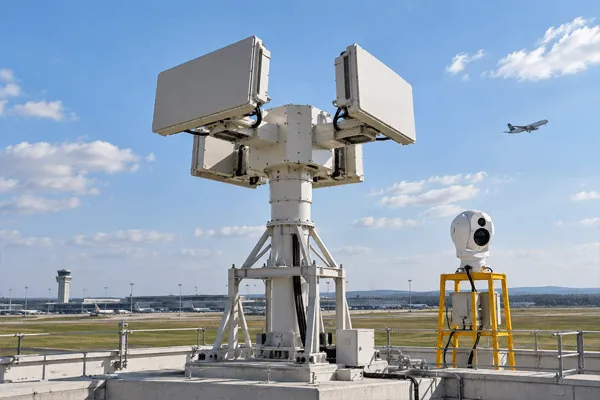
Traditional cameras can miss important details in darkness, haze, or complex outdoor environments. These blind spots create serious challenges for security teams monitoring large facilities. Multispectral intelligent imaging combines information from different parts of the light spectrum to provide clearer observation and support better decisions.
Multispectral intelligent imaging cameras capture information from selected wavelength bands or combine complementary sensing channels to reveal details that ordinary color cameras may miss. Depending on their design, they can support object recognition, material analysis, thermal observation, and automated monitoring. Applications range from scientific research and industrial inspection to border security and critical infrastructure protection.
Multispectral Intelligent Imaging Cameras: How Do They Work and Why Are They Important?
1. What Is Multispectral Imaging and How Does It Work?
Multispectral imaging is a method of collecting image information from several selected portions of the electromagnetic spectrum. Instead of recording only the red, green, and blue colors visible to the human eye, a specialized device measures light within additional wavelength bands.
Each spectral band captures different information about an object. For example, two materials that look almost identical in a normal photograph may reflect light differently outside the visible spectrum.
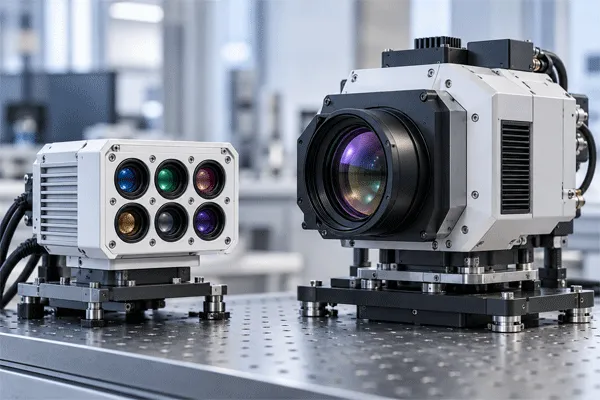
A multispectral camera may use special filters, dedicated detectors, or multiple optical channels to capture these differences. The captured information is then processed into individual images or combined into a data set.
Understanding the Main Wavelength Bands
| Spectral Region |
Approximate Wavelength |
Typical Purpose |
| Lumière visible |
400–700 nm |
Conventional color observation |
| Near-Infrared (NIR) |
700–1,000 nm |
Vegetation analysis and material differentiation |
| Shortwave Infrared (SWIR) |
1,000–2,500 nm |
Moisture and selected material analysis |
| Longwave Infrared |
8,000–14,000 nm |
Thermal radiation observation |
The selected wavelength determines what kind of information the equipment can collect.
For example, visible imaging is useful for identifying colors and structural details, while a thermal sensor captures emitted infrared radiation associated with an object’s temperature and emissivity.
This combination is particularly useful when a security operator needs more than a standard daytime image.
2. How Is a Multispectral Image Different from an Ordinary RGB Image?
Most consumer cameras use RGB sensors to reproduce the colors we normally see. Red, green, and blue channels are combined to create a familiar color photograph.
However, a conventional RGB image does not provide detailed information about how an object responds at additional selected wavelengths.
A multispectral image captures information beyond these three broad color channels. This makes it possible to compare selected spectral characteristics and identify details that may remain hidden in ordinary photography.
Consider two surfaces with similar visible colors. They may appear almost identical in daylight, even though their material composition or moisture characteristics differ.
Additional spectral measurements may help distinguish them.
Key Differences
| Caractéristique |
RGB Camera |
Multispectral Camera |
| Main Channels |
Red, green, blue |
Several selected bands |
| Typical Output |
Conventional color image |
Multiple wavelength-based images |
| Visible Information |
Oui |
Usually included |
| NIR Capability |
Not standard in ordinary color configurations |
Available in selected configurations |
| Material Differentiation |
Limited to visible characteristics |
Additional information from selected bands |
| Data Processing |
Relatively simple |
Requires band-specific processing |
| Applications types |
Photography, CCTV, general inspection |
Specialized monitoring, agriculture, research, industrial inspection |
The number of bands matters, but more channels do not automatically guarantee better performance.
Each additional band should provide useful information for the intended application.
For intelligent security projects, combining visible observation with thermal information may be more useful than purchasing a scientific device designed primarily for material analysis.
The correct choice depends on what the operator needs to see, measure, and understand.
3. What Are the Main Components of a Multispectral Imaging System?
An effective multispectral imaging system involves more than an image detector.
Its performance depends on the relationship between its sensing channels, lens configuration, processing electronics, control platform, and operating environment.
The main components commonly include:
- Sensor modules: Collect information within selected wavelength regions.
- Optics: Focus incoming radiation onto the relevant detector.
- Multispectral filter: Separates selected bands in filter-based configurations.
- Processing hardware: Converts captured signals into usable digital information.
- Control software: Manages acquisition, calibration, and device functions.
- Interface de liaison: Transfers images and other information to connected systems.
Different architectures offer different benefits.
For example, a cmos sensor can provide efficient visible-light acquisition, while a dedicated thermal module is required for longwave thermal observation.
A scientific device may use a cmos image sensor with a dedicated filter arrangement to produce a cmos image containing selected spectral information. Other designs use separate detectors for each channel.
A snapshot multispectral configuration captures its selected channels during one acquisition, which can be useful when objects are moving.
However, not every design provides simultaneous capture. Some systems acquire information sequentially, requiring additional consideration of timing and scene movement.
Why Sensor Selection Matters
Choosing the appropriate sensor involves evaluating sensitivity, operating range, resolution, and environmental conditions.
A device intended for outdoor monitoring must also account for temperature changes, vibration, weather exposure, and long operating hours.
In addition, the equipment should provide a suitable dynamic range to preserve useful details across bright and dark areas.
These details affect real-world performance far more than simply selecting the camera with the highest published megapixel count.
4. Multispectral vs. Hyperspectral Imaging: Which Technology Is Better?
Multispectral and hyperspectral imaging follow related principles, but they collect information at different levels of detail.
A multispectral system measures several selected portions of the spectrum. Hyperspectral imaging generally uses many more, often narrower, adjacent channels to build a detailed spectral profile.
Technical Comparison
| Paramètre |
Multispectral |
Hyperspectral |
| Number of Bands |
Usually several selected bands |
Often tens to hundreds or more |
| Spectral Resolution |
Modéré |
Generally finer |
| Data Volume |
Relatively manageable |
Often significantly larger |
| Processing Requirements |
Application-dependent |
Often more demanding |
| Equipment Complexity |
Varies by architecture |
Frequently higher |
| Common Purpose |
Selected material or scene characteristics |
Detailed spectral analysis |
Hyperspectral cameras are valuable when a project requires detailed material identification through many narrow channels.
They may use imaging spectrometers or specialized scanning methods to construct a data cube containing spatial and spectral information.
Some snapshot hyperspectral devices can acquire their channels during a single exposure, although trade-offs may exist between channel count, light sensitivity, and spatial resolution.
Neither technology is universally better.
A scientific project requiring hyperspectral mapping may justify the additional data and processing requirements. A practical outdoor security project, however, may benefit more from complementary visible and thermal sensing.
The best system delivers the information needed for the application without unnecessary complexity.
5. How Do Sensor Resolution, Spectral Range, GigE, and FPS Affect Performance?
Technical specifications help buyers compare equipment, but every figure needs to be understood within the intended operating conditions.
A high-resolution detector does not automatically produce a clearer image at a long distance. Lens quality, environmental conditions, target characteristics, and processing software all influence the final result.
The following parameters deserve particular attention.
Important Technical Specifications
| Paramètre |
Ce que cela signifie |
Why It Matters |
| Plage spectrale |
Supported wavelength coverage |
Determines available sensing information |
| Spectral Resolution |
Ability to separate nearby wavelength intervals |
Influences spectral discrimination |
| Spatial Resolution |
Level of detail captured across the scene |
Affects object detail |
| Pixel Count |
Number of detector sampling elements |
Influences image dimensions |
| Frame Rate |
Images acquired per second |
Important for moving scenes |
| Dynamic Range |
Ability to capture different signal levels |
Helps preserve bright and dark details |
| Sensor Sensitivity |
Response to available radiation |
Influences operation under difficult conditions |
| GigE |
Gigabit Ethernet interface |
Supports network data transfer |
| Camera Link |
Dedicated high-throughput camera interface |
Used in certain industrial configurations |
For example, a frame rate of 30 fps means the device produces 30 frames per second under the specified operating mode.
However, the actual acquisition speed may change when resolution, exposure time, processing functions, or the number of bands increases.
High-speed operation is especially relevant to machine vision cameras used in industrial inspection.
Some specialized systems use GigE or Camera Link interfaces, while conventional security equipment may rely on standard IP networking and established video protocols.
Buyers should always confirm the exact interface supported by the selected model rather than assuming that all imaging systems use the same connection standard.
Multispectral Intelligent Imaging Cameras: How Do They Work and Why Are They Important?
6. What Are the Main Applications of Multispectral Intelligent Imaging?
Different industries use multispectral data to answer different questions.
Scientific users may examine how materials respond to selected wavelengths, while industrial operators may look for surface differences or production defects.
In security environments, the priority is often reliable observation across changing lighting and weather conditions.
Common Imaging Applications
| Industrie |
Typical Application |
Main Value |
| Sécurité des frontières |
Day-and-night observation |
Improved situational awareness |
| Sécurité aéroportuaire |
Monitoring designated operational areas |
Complementary visual information |
| Infrastructures essentielles |
Perimeter and facility monitoring |
More comprehensive observation |
| Energy and Petrochemical |
Equipment and site monitoring |
Visual and thermal information |
| Precision Agriculture |
Crop condition assessment |
Vegetation analysis |
| Industrial Inspection |
Surface and material differentiation |
Quality monitoring |
| Semiconductor Manufacturing |
Specialized wafer inspection |
Identification of selected material or surface characteristics |
| Environmental Research |
Vegetation and water quality analysis |
Additional spectral measurements |
A well-known example is the normalized difference vegetation index (NDVI).
It compares red and near-infrared reflectance to help estimate vegetation condition:
NDVI = (NIR − Red) / (NIR + Red)
Industrial applications may involve line scan cameras, monochrome detectors, or selected spectral measurements to evaluate production materials.
Some semiconductor applications use specialized systems to examine wafer characteristics, although suitable equipment depends heavily on the material and inspection objective.
For Midradar’s security customers, the main opportunity is different: using complementary observation channels to support dependable monitoring of people, vehicles, facilities, and surrounding activity.
7. Why Are Multispectral Imaging Cameras Valuable for Security Surveillance?
Security operators rarely work under perfect conditions.
At an airport, monitoring equipment may encounter strong sunlight during the day and limited visible illumination after sunset. Border and coastal installations face additional challenges from distance, weather, and complex terrain.
A single conventional camera may not provide all the information needed in these situations.
Combining complementary imaging channels helps overcome some of these limitations.
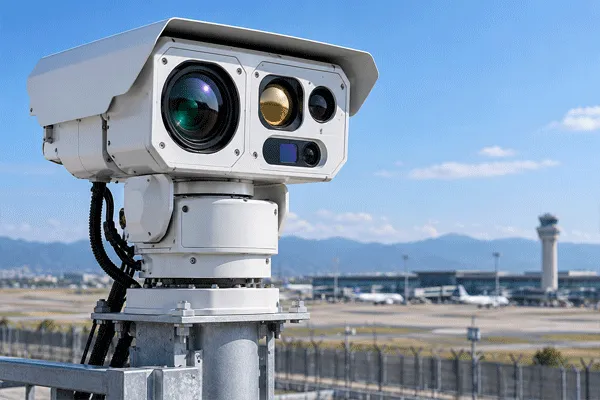
For example, a visible-light device captures recognizable scene details, while a thermal detector responds to emitted radiation and can remain useful when ordinary illumination is limited.
Key Benefits for Security Projects
Day-and-night observation
Complementary channels help operators monitor protected areas under different lighting conditions.
Improved target assessment
Using more than one type of image can provide additional information when evaluating an object or activity.
Long-distance monitoring
Appropriate long-focus equipment can support observation across large sites, subject to visibility and system specifications.
Flexible installation
Integrated devices can be installed on fixed platforms, towers, rooftops, or compatible pan-tilt structures.
Centralized monitoring
Compatible equipment can share information with a common management platform.
It is important to remember that imagerie thermique does not provide unlimited visibility through all weather conditions. Heavy rain, dense fog, and atmospheric effects can reduce performance.
Likewise, adding more channels does not guarantee better detection unless the complete system has been properly configured and tested.
The value comes from selecting the right combination for the project.
Multispectral Intelligent Imaging Cameras: How Do They Work and Why Are They Important?
8. How Can Intelligent Imaging Work with Radar-Vision Fusion Systems?
Radar and imaging equipment provide complementary information.
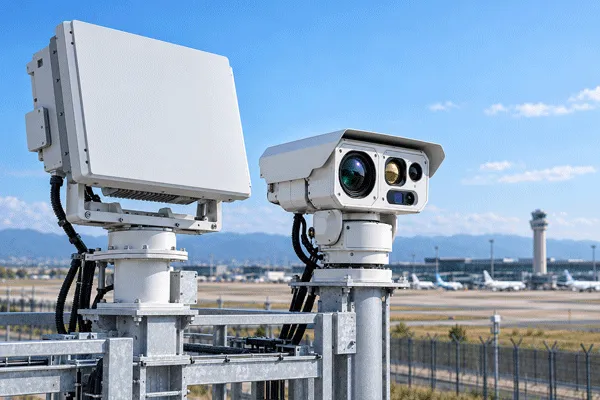
Radar-based equipment can support the detection and tracking of objects within its operating coverage, while electro-optical devices provide visual information for further assessment.
When integrated through suitable communication and control software, these technologies can contribute to a coordinated security workflow.
At Midradar, we specialize in developing and integrating intelligent security solutions that bring different technologies together according to project requirements.
Our portfolio includes advanced surveillance equipment, electro-optical platforms, thermal observation systems, intelligent pan-tilt units, and integrated counter-UAV solutions.
Typical System Architecture
| Composant |
Primary Function |
| Radar Equipment |
Detects and tracks objects within its specified coverage |
| Caméra à lumière visible |
Provides recognizable visual details |
| Thermal Module |
Provides temperature-contrast-based imagery |
| Intelligent Pan-Tilt Unit |
Directs compatible observation equipment |
| Processing Platform |
Organizes available information |
| Management Software |
Supports centralized observation and event management |
| Operator Workstation |
Presents relevant information to security personnel |
A typical integrated process begins when compatible detection equipment identifies an object of interest.
The management platform can use the available information to support directional observation by an appropriate electro-optical device.
Operators can then review the resulting visual information and assess whether additional action is necessary.
The exact functions depend on equipment compatibility, supported protocols, software configuration, and project-specific requirements.
This approach is particularly valuable for customers who need a coordinated monitoring solution rather than several independent devices.
9. How Should Buyers Select the Right Multispectral Imager?
Selecting a multispectral imager starts with one practical question:
What information must the system provide that a standard camera cannot?
The answer determines whether the project requires narrowband material analysis, visible and thermal observation, SWIR sensing, or another specialized configuration.
A research laboratory and an airport security operator may use related terminology while requiring completely different equipment.
Before choosing a multispectral camera, buyers should evaluate the following factors.
Essential Procurement Checklist
| Item d’évaluation |
Questions to Ask |
| Application |
Is the system intended for security monitoring, industrial inspection, or scientific imaging? |
| Spectral Bands |
Which wavelength regions are actually required? |
| Résolution |
What detail must the equipment provide at the intended distance? |
| Detection Conditions |
What target characteristics and environmental assumptions apply? |
| Acquisition Speed |
Is continuous video or individual image capture required? |
| System Integration |
Must the device connect to existing monitoring infrastructure? |
| Installation |
Will the equipment be mounted indoors, outdoors, or on a moving platform? |
| Protection environnementale |
What temperature, weather, and ingress-protection requirements apply? |
| Maintenance |
What calibration, inspection, and support will be necessary? |
| Personnalisation |
Can the manufacturer adapt the configuration to project requirements? |
For industrial applications, additional factors may include controlled illumination, acquisition synchronization, and quantitative calibration.
For long-distance security installations, lens selection, mounting stability, weather resistance, and integration capability often deserve greater attention.
Buyers should also avoid treating off-the-shelf scientific cameras as direct replacements for rugged outdoor surveillance platforms.
The required performance, enclosure design, software, and maintenance arrangements may differ substantially.
A good supplier should be able to explain these differences and recommend a configuration based on actual project needs.
10. Why Choose Midradar for Multispectral Intelligent Imaging Solutions?
As a professional provider of advanced radar surveillance systems and intelligent security solutions in China, Midradar focuses on helping international customers develop integrated monitoring capabilities for complex operating environments.
Our work covers research and development, manufacturing, equipment integration, and international project support.
We understand that government agencies, infrastructure operators, system integrators, and engineering contractors often need more than an individual camera.
They need equipment that can work within a complete operational environment.
Integrated Visible and Thermal Imaging
Our existing product portfolio includes multi-sensor platforms that combine visible-light and thermal observation.
One example is Midradar’s Multi-Sensor Long-Range PTZ Surveillance Camera, which combines a visible imaging module, thermal detector, and pan-tilt control architecture.
The published product information includes the following configuration details:
| Paramètre |
Published Configuration |
| Visible Imaging |
2 MP |
| Résolution thermique |
Model-dependent; published options include 336 × 256 and 640 × 512 |
| Monitoring Architecture |
Combined visible and thermal observation |
| PTZ Function |
360° directional monitoring |
| Protection environnementale |
IP66 |
| Main Applications |
Border monitoring, facility security, transportation, and outdoor observation |
This product is best understood as a multi-sensor electro-optical surveillance platform. It should not be confused with a calibrated narrowband camera designed for scientific spectroscopy.
That distinction allows customers to select equipment based on its actual intended function.
Customized Solutions for Global Security Projects
Midradar supports different project requirements through a broader portfolio of surveillance technologies.
Depending on the application, these may include:
- Long-range visible-light observation.
- Intelligent thermal monitoring.
- Multi-sensor imaging platforms.
- Radar-linked visual observation.
- Intelligent pan-tilt equipment.
- Integrated security management solutions.
- Related monitoring and deterrent technologies.
We work with airport operators, border security organizations, infrastructure owners, engineering contractors, system integrators, and international distributors.
Our goal is to help customers understand the available technologies and identify equipment configurations suitable for their installation and operating requirements.
Rather than recommending the same device for every project, we encourage customers to define their monitoring objectives, environmental conditions, integration requirements, and expected performance before selecting a system.
Looking for a customized intelligent imaging solution?
Contact Midradar to discuss your application, request relevant technical specifications, and explore suitable equipment configurations for your project.
Key Takeaways
- Multispectral imaging captures information from selected wavelength regions beyond ordinary RGB photography.
- A multispectral image can reveal characteristics that may not appear clearly in conventional color images.
- Multispectral and hyperspectral technologies serve related but different measurement needs.
- Sensor sensitivity, wavelength selection, image resolution, acquisition speed, and optics all influence system performance.
- Scientific imaging equipment and integrated security cameras should not be treated as identical product categories.
- Combining visible-light and thermal observation can provide complementary information for demanding security environments.
- Radar-vision integration helps bring detection and visual monitoring information into a coordinated workflow.
- Equipment selection should begin with actual project requirements rather than headline specifications alone.
- Midradar provides professional multi-sensor surveillance equipment and customized intelligent security integration solutions for international customers.
Contact Midradar to discuss your monitoring requirements and explore the right intelligent imaging solution for your project.
FAQ
What is a multispectral intelligent imaging camera?
It is a specialized device that collects image information from several selected wavelength regions. Depending on its architecture, it may use dedicated filters, multiple detectors, or complementary sensing modules to provide information beyond conventional color photography.
What is the difference between multispectral and thermal imaging?
Multispectral equipment typically captures several selected wavelength regions, often using reflected radiation. Thermal devices measure emitted infrared radiation and provide images based on thermal contrast. Integrated systems may combine both approaches, but the technologies are not interchangeable.
Can multispectral imaging cameras work at night?
Some can, depending on their sensing architecture. Thermal channels are particularly useful when visible illumination is limited. However, passive visible-light channels generally require sufficient available light, while certain infrared systems may require suitable illumination.
How many spectral bands does a multispectral camera need?
There is no universal number. Some applications require only a few selected bands, while others benefit from additional channels. The correct choice depends on the materials, objects, and characteristics that must be observed.
What is the difference between multispectral and hyperspectral cameras?
Multispectral devices capture several selected portions of the spectrum. Hyperspectral devices generally collect many narrower, often adjacent channels, producing more detailed spectral information but frequently requiring greater data-processing resources.
Can Midradar provide customized multi-sensor imaging solutions?
Yes. Midradar offers integrated surveillance solutions combining technologies such as visible-light observation, thermal imaging, radar-linked monitoring, and intelligent pan-tilt control. Customers should contact our technical team to confirm suitable equipment configurations, available interfaces, and project-specific requirements.



 09:02