Résumé exécutif
Low probability of intercept, or LPI, is not a single waveform name or a label that can be verified from peak power alone. It describes a radar design objective: achieve the required detection and tracking performance while making the transmitted signal more difficult for an intercept receiver to detect, classify or exploit. The result depends on waveform energy distribution, time-bandwidth product, modulation, power and duty-cycle management, antenna pattern and sidelobes, beam scheduling, operating geometry and the capability of the intercept receiver.
Buyers should therefore request evidence tied to a defined threat receiver, operating mode and test method. FMCW, pulse-compression, frequency agility or AESA beam control may contribute to an LPI design, but none automatically proves LPI performance. Midradar should describe product-specific LPI functions only after the exact radar, software version, waveform mode, disclosure boundary and technical evidence have been approved.
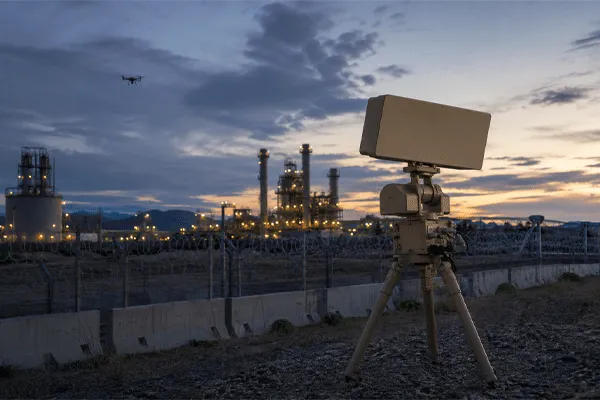
LPI Radar Guide: What Buyers Should Know Before Selecting a Surveillance Radar
Questions clés auxquelles ce guide répond
- What does low probability of intercept mean in a radar procurement context?
- Why do low peak power, frequency agility or AESA architecture not prove LPI alone?
- How should FMCW and pulse-compression claims be compared?
- Which receiver assumptions, geometry and mission conditions must be stated?
- What evidence can a buyer request without demanding sensitive waveform details?
For broader procurement context, review the guide d'achat de radar de détection de drones.
Applicability, Evidence Boundary and Confidentiality
This guide is for buyers comparing general LPI design claims in surveillance radar. It explains evaluation logic rather than disclosing a sensitive waveform or establishing that a specific Midradar model has a verified probability of intercept. LPI is relative to an assumed intercept receiver, geometry, bandwidth, observation time, processing capability and radar mission. A supplier may protect implementation details, but the buyer still needs a controlled statement of operating conditions, the verification method, performance trade-offs and contractual acceptance basis.
1. What LPI Means in Practice
An intercept receiver tries to detect emissions in noise and interference, estimate their parameters and identify a radar or operating mode. An LPI-oriented radar attempts to reduce the intercept receiver’s advantage without sacrificing the radar’s mission. Research commonly treats this as a trade-off among radar detection, resolution and the intercept receiver’s ability to distinguish the signal from background noise.
This means LPI is relative, not absolute. A signal that is difficult for one receiver at one geometry may be detectable by another receiver with greater sensitivity, bandwidth, processing gain or proximity. Claims should therefore avoid language such as “undetectable radar.”
2. Energy Distribution and Pulse Compression
Conventional short pulses can have high peak power concentrated in time. Pulse-compression and other wideband modulations can transmit a longer coded or frequency-modulated waveform and compress it in the receiver. This can spread instantaneous spectral energy while preserving range resolution and processing gain.
The design is not free of trade-offs. Waveform autocorrelation and processing can create sidelobes that mask weak targets near strong ones. A supplier should explain waveform bandwidth, time-bandwidth product, compression processing, sidelobe control and the operating conditions under which the claimed performance is achieved, without exposing protected design details.
Evidence and Test Design
Buyers should first ask what the LPI claim means: reduced peak power, broader spectral occupancy, lower sidelobes, agile scheduling, low duty exposure, adaptive power or a measured intercept outcome. These are not interchangeable. The test plan should identify the radar operating mode, target or simulation, antenna orientation, range and geometry, intercept receiver bandwidth and sensitivity, observation interval, detection algorithm and comparison baseline.
A single spectrum-analyzer screenshot is not enough. Useful evidence may include calibrated emission measurements, antenna patterns, waveform occupancy, dwell and revisit behavior, power-control logic, receiver assumptions and repeatable test records. When acceptance criteria are being defined, use the radar field-test and acceptance guide to structure repeatable test records. The evaluation must also address radar-performance trade-offs. Techniques that reduce intercept opportunity can affect detection range, update rate, ambiguity, sidelobes, processing load or target-tracking continuity. The project should therefore evaluate LPI together with mission performance rather than as an isolated label.
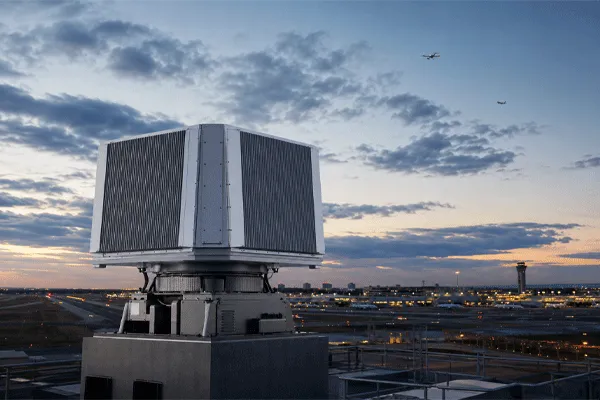
LPI Radar Guide: What Buyers Should Know Before Selecting a Surveillance Radar
LPI Claim Verification Matrix
| Claim Area |
Buyer Question |
Evidence or Limitation |
| Power and duty |
Which mode, average/peak definition and measurement point? |
Calibrated method and mission trade-off |
| Spectrum and agility |
What occupancy, hopping rule and regulatory limit apply? |
Controlled description; no unsupported “spread spectrum” label |
| Antenna sidelobes |
Which azimuth/elevation pattern and scan condition? |
Measured or approved pattern under stated configuration |
| Waveform processing |
What pulse-compression or coding trade-offs exist? |
Resolution, ambiguity, range sidelobes and processing assumptions |
| Intercept receiver |
Against what bandwidth, sensitivity and observation time? |
Receiver assumptions are mandatory; no universal result |
| Mission performance |
Does the LPI mode preserve required detection and tracking? |
Joint acceptance of detection, update, continuity and emission evidence |
3. Frequency Agility and Waveform Diversity
Frequency agility, stepped-frequency operation, phase coding and waveform diversity can make a transmission less predictable and distribute energy across time or frequency. The benefit depends on how the schedule is generated, how quickly the radar and receiver adapt, spectrum constraints, coherent processing and the intercept receiver’s algorithms.
The buyer does not need classified scheduling details. It does need a controlled capability statement: what modes exist, whether they are standard or optional, how they affect detection and update behavior, which spectrum approvals are required and how performance is verified. Buyers can define those disclosure boundaries earlier in the drone detection radar RFI/RFP guide.
4. Antenna Pattern, Sidelobes and Beam Management
Energy outside the intended direction can increase the opportunity for interception. Antenna sidelobe control, electronically steered beams, adaptive scheduling and reduced dwell outside priority sectors may contribute to the overall LPI objective. These measures also interact with search volume, revisit time, track capacity and target maneuver.
AESA does not automatically mean LPI. It provides beam-control tools that can support power and dwell management, but the actual operating software, antenna pattern, waveform and mission schedule determine the result.
5. Power Management and Geometry
LPI should not be reduced to “low power.” Radar performance depends on power, antenna gain, bandwidth, integration time, processing, propagation, target RCS and geometry. A design may use lower peak power, higher duty cycle, directional gain and coherent processing to meet the mission with a lower instantaneous signature. Whether this improves intercept performance depends on the receiver and geometry.
Buyers should ask for average and peak power definitions, duty cycle, operating modes and test conditions, but sensitive internal values may be limited by technical-security and export controls. A useful supplier response explains the principle and evidence boundary without inventing a universal classification.
6. Is FMCW Automatically Better for LPI?
No. FMCW often uses continuous transmission with relatively low instantaneous power and frequency modulation, which may support a low spectral-density design. But interceptability also depends on sweep pattern, bandwidth, leakage, antenna pattern, operating duration, geometry and the receiver’s processing. A repetitive or easily recognized modulation can still be detected.
Pulse radars can also use long coded waveforms, pulse compression, frequency agility, low sidelobes and adaptive scheduling. The correct comparison is between complete operating modes under the same mission and intercept scenario, not between the labels “FMCW” and “pulse.”

LPI Radar Guide: What Buyers Should Know Before Selecting a Surveillance Radar
7. Buyer Verification Checklist
Ask the supplier to define the intended meaning of LPI, the assumed intercept receiver, geometry and frequency coverage, the radar mission and target, the operating waveform mode, the evidence method and the performance trade-offs. Request a distinction among standard capability, optional configuration, project development and protected information.
Avoid accepting a statement based only on low peak power, FMCW, AESA or frequency hopping. Before treating those claims as comparable, apply the counter-UAS supplier due diligence criteria. Ask how detection and tracking performance are preserved, how emissions are managed across time and direction, whether the claim has been tested, and which parameters can be included in the contract and acceptance plan.
Utilisez le low-altitude surveillance radar selection guide to define coverage before comparing LPI claims. After compliant proposals are received, comparer les devis de radars de surveillance on a normalized basis.
Conclusion et appel à l'action
LPI is a system-level design objective and a relative performance claim. A responsible supplier should explain contributing technologies, operating conditions, evidence and limitations while protecting sensitive implementation details.
For a Midradar LPI capability clarification, specify the radar model or required coverage class, target, site, operating mode, spectrum constraints and the level of technical disclosure required. Product-specific claims will be provided only after internal technical and compliance review.
FAQ
Does low peak power prove LPI performance?
No. Interceptability depends on the complete waveform, antenna pattern, timing, geometry, processing and intercept receiver.
Is every AESA radar an LPI radar?
No. AESA enables flexible beam and dwell management, but actual LPI performance depends on waveform, antenna sidelobes, scheduling, power management and evidence.
Can an LPI grade be compared across suppliers?
Only when the receiver model, geometry, waveform mode, mission, test method and performance threshold are normalized.
Is frequency hopping alone sufficient to establish LPI performance?
No. Frequency agility is one contributing technique. Antenna sidelobes, waveform occupancy, timing, power management, geometry, mission scheduling and the assumed intercept receiver must also be considered.
Must a supplier disclose detailed waveform implementation?
Not necessarily. Buyers should receive enough information to understand operating conditions, verification method, trade-offs and acceptance basis, while sensitive implementation details may remain controlled.














 15:56
15:56