Mobile, High-Speed & All-Weather Airport Runway Safety Technology
Foreign Object Debris (FOD) remains one of the most serious safety risks in civil aviation. A small metal fragment as tiny as 1 cm can cause severe aircraft damage during takeoff or landing, leading to costly delays, runway closures, and safety hazards.
Traditional manual inspection methods are slow, labor-intensive, and cannot operate efficiently in poor weather or at night.
The W-Band Synthetic Aperture Radar (SAR) Airport FOD Detection System provides a breakthrough solution for modern airports, enabling high-speed, high-accuracy, and all-weather runway inspection without interrupting airport operations.

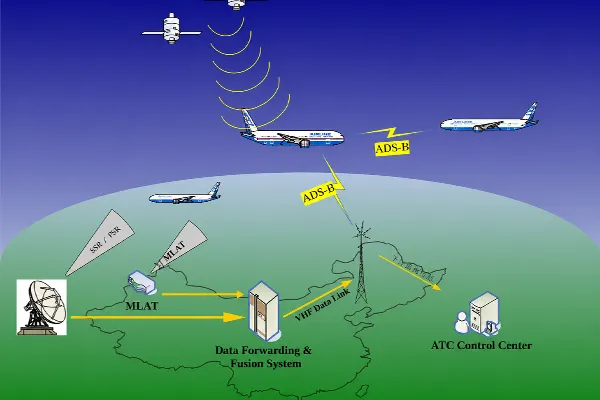
Vehicle-Mounted Mobile FOD Detection System Concept Illustration
What Is W-Band Radar in Airport FOD Detection?
Die W-Band radar (75–110 GHz) is an advanced millimeter-wave sensing technology designed for ultra-high-resolution detection.
Our system operates in the 92–94 GHz atmospheric low-loss window, making it ideal for airport surface monitoring.
Key Advantages of W-Band Airport Radar:
- Centimeter-Level Detection Accuracy (≈1 cm FOD detection)
- Strong Metal Target Sensitivity (high RCS response)
- All-Weather Operation (fog, rain, snow, dust, night conditions)
This makes it one of the most effective technologies for runway inspection radar systems and airport surface safety monitoring.
Mobile SAR Technology for Runway Inspection
Synthetic Aperture Radar (SAR) uses platform motion to generate high-resolution imaging, allowing continuous runway scanning while moving.
Our Mobile Airport FOD Detection System is mounted on a standard inspection vehicle and does not require runway closure.
Working Process:
1. High-Speed Runway Scanning
The system operates at 40–80 km/h without interrupting airport traffic.
2. Real-Time SAR Imaging
Side-looking SAR generates high-resolution runway surface maps in real time.
3. AI-Based FOD Detection
Artificial intelligence automatically detects foreign objects and calculates precise coordinates (≤1 m accuracy).
4. Intelligent Maintenance Guidance
The system provides optimized removal paths for maintenance teams.
👉 A full 3 km runway can be inspected in approximately 5 minutes.
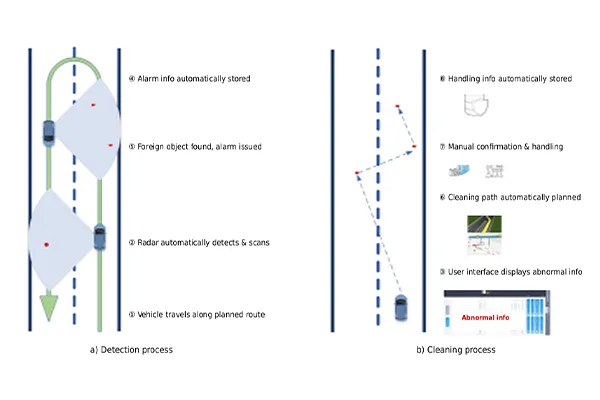
Vehicle-Mounted Millimeter-Wave High-Resolution Pavement Small-Object Detection System Working Diagram
Why Choose W-Band SAR FOD Detection System?
Compared with traditional airport inspection methods, the W-Band SAR system provides significant performance and operational advantages:
| Detection Method |
Auflösung |
Speed |
Weather Resistance |
Operational Cost |
| Manual Inspection |
Visual-only |
2–3 km/h |
Limited |
High labor cost |
| Fixed Radar Array |
High precision |
Real-time |
Yes |
Very high infrastructure cost |
| Mobile W-Band SAR System |
1 cm level |
40–80 km/h |
24/7 all-weather |
Cost-efficient single system |
Key Applications
The Airport FOD Detection Radar System is widely used in:
- International airports runway safety inspection
- Military and civil aviation airports
- Smart airport automation systems
- Runway surface condition monitoring
- Airport safety management platforms
Beyond detection, the system integrates a complete airport runway safety management platform:
✔ Real-Time Alarm & Positioning
Instant alerts with precise GPS-based target localization.
✔ Data Recording & Analysis
Automatically stores FOD type, size, and location for long-term analysis.
✔ Heatmap Generation
Identifies high-risk runway zones for preventive maintenance.
✔ Extreme Environment Adaptability
Stable operation from -30°C to +50°C, suitable for global deployment.
Benefits for Airports
Implementing the W-Band SAR FOD detection system helps airports achieve:
- Reduce runway inspection time by up to 90%
- Eliminate runway closure during inspections
- Improve flight safety and operational efficiency
- Lower long-term maintenance and labor costs
- Enable full digitalization of runway safety management
The Future of Smart Airport Safety
The W-Band SAR Airport FOD Detection System represents the next generation of runway safety technology.
With its combination of high resolution, high speed, AI intelligence, and all-weather capability, it is becoming a core component of modern smart airport infrastructure worldwide.



 14:26
14:26