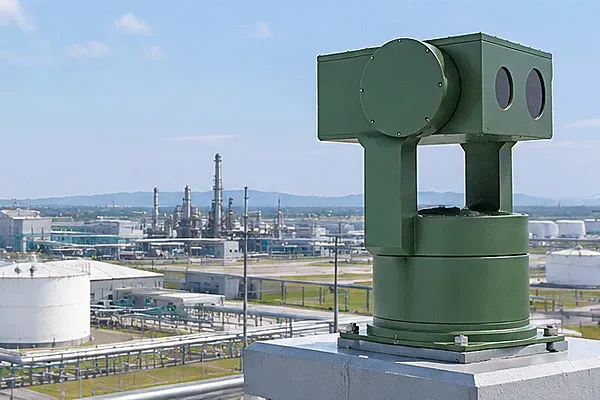
A camera may look powerful on a datasheet yet perform poorly at the real site. Darkness, haze, narrow field of view, vibration, and poor sensor integration can quickly reduce useful visibility. The solution is to design electro optical equipment as a complete surveillance system, not as an isolated camera.
An electro optical system converts visible or infrared energy into usable images and digital information. Modern surveillance equipment may combine a daylight camera, thermal camera, pan-tilt platform, image processing, tracking software, and external sensor data. The right configuration depends on required observation distance, day/night conditions, field of view, environment, installation method, and system integration.
Electro Optical Equipment: How an Electro Optical Surveillance System Works
What Is Electro Optical Equipment and How Does It Work?
Electro optical equipment connects optics, detectors, electronics, mechanics, and software into one observation chain. Light or infrared energy enters through the lens, reaches a sensor, becomes an electrical signal, and is processed into an image that an operator or software platform can use.
The National Academies describes electro-optical detectors as devices that sense radiation emitted or reflected by objects within the optical field of view. The detector converts incoming radiation into an electrical signal that can then be processed, transmitted, or stored.
A simplified system looks like this:
| Bühne |
Main Function |
Buyer Question |
| Optik |
Collect and focus incoming energy |
What field of view and focal length are required? |
| Sensor |
Converts optical or infrared energy |
Visible, NIR, LWIR, or another channel? |
| Image processing |
Improves and analyzes the image |
What processing is available in real time? |
| Pan-tilt platform |
Positions the camera |
How accurately can it point and track? |
| Control software |
Manages video and alarms |
Can it integrate with the existing platform? |
| External sensors |
Provide additional awareness |
Will radar or another sensor cue the camera? |
This is why we normally describe professional electro optics as a system engineering problem. A high-resolution camera alone cannot guarantee useful long-range observation.
Midradar’s current elektro-optisches Portfolio follows this system approach, covering laser imaging cameras, multispectral intelligent imaging cameras, thermal imaging cameras, and vehicle-mounted systems.
What Are the Main Components of an Electro Optical System?
A professional electro optical sensor system usually contains more than one electro optical component. The exact architecture changes according to the site, but several building blocks appear repeatedly.
Core electro optical components
- HD daylight camera for detailed daytime observation
- Infrared or thermal imaging channel for night and low-light monitoring
- Optical zoom lens
- Image processor
- Pan-tilt or 2-axis positioning mechanism
- Rugged outdoor housing
- Position feedback and control electronics
- Network interface
- Tracking or video analytics software
- Optional range or positioning sensors
The visible channel gives operators familiar visual detail. A thermal channel observes infrared radiation and can remain useful when visible illumination becomes poor. Pan-tilt equipment lets the system direct narrow-field optics toward a selected area instead of requiring a fixed camera to watch everything at once.
For an integrated outdoor product, these pieces must behave as one highly integrated optical-mechanical-electro system. Lens stability, enclosure rigidity, sensor alignment, processing latency, and mechanical pointing accuracy all affect the final image.
This is one reason buyers should avoid comparing systems only by megapixels.
A 4K visible sensor with unstable long-focus optics may deliver less useful information than a lower-resolution sensor on a properly designed platform.
Why Combine a Daylight Camera With an Infrared or Thermal Camera?
No single imaging channel performs best in every condition.
A daylight camera provides natural colors and high visual detail when lighting and atmospheric conditions are favorable. It is useful for understanding scene context, vehicle appearance, structures, and other visible characteristics.
An IR camera or thermal camera gives the operator another source of information when visible-light contrast becomes weak.
| Condition |
Daylight Optical Channel |
Thermal Channel |
| Bright daylight |
Excellent detail |
Useful thermal contrast |
| Dusk |
Performance gradually decreases |
Often remains effective |
| Complete darkness |
Needs illumination or another method |
Can operate without visible light |
| Strong backlight |
Can be difficult |
May provide complementary information |
| Haze/fog |
Performance depends on severity and wavelength |
Performance also depends on atmosphere |
| Hot industrial background |
Good visual context |
Requires careful thermal contrast evaluation |
The important point is complementarity, not that one sensor is always better.
Midradar already separates this issue in its technical content. Its current MWIR/LWIR guide notes that thermal performance depends on the complete detector-and-optics channel, atmosphere, target-background contrast, and operating conditions rather than on a simple wavelength label.
For the same reason, a buyer should not simply ask:
“Should I choose visible or thermal?”
A better question is:
“What information must the operator obtain during daytime, nighttime, bad weather, and low-contrast conditions?”
That question leads to a much stronger camera system design.
Cooled or Uncooled Thermal Camera: Which Is Better?
Both architectures have useful roles.
An uncooled thermal camera normally offers lower system complexity, quick startup, smaller size, and easier deployment. For many perimeter, industrial, airport, and infrastructure monitoring projects, an uncooled LWIR channel can provide the required observation capability without adding unnecessary complexity.
A cooled thermal camera is usually considered when longer-distance observation, higher thermal sensitivity, or more demanding optical performance is required.
Midradar’s existing thermal portfolio includes both cooled and uncooled product classes, so the decision can be made around project requirements rather than forcing every customer into one architecture.
A basic comparison looks like this:
| Faktor |
Ungekühlt |
Cooled |
| Startup |
Fast |
Cool-down may be required |
| Größe |
Often smaller |
Usually larger |
| Stromversorgung |
Generally lower |
Generally higher |
| Wartung |
Simpler |
More components to manage |
| Cost |
Usually lower |
Usually higher |
| Long-range potential |
Good for many projects |
Strong for demanding long-range use |
Specifications such as LWIR uncooled VOx FPA, detector resolution, pixel pitch, NETD, lens aperture, and focal length matter. But they should never be evaluated separately from the actual operating scene.
The correct thermal channel is the one that meets the project’s observation and verification requirements with a reasonable lifecycle burden.
How Does Optical Zoom Affect Long-Range Electro Optical Imaging?
Long-range imaging depends heavily on optics.
When a system needs to observe a large area, it normally starts with a wider field of view. When an object of interest is located, the camera can move to a narrower field of view and higher optical magnification.
A continuous zoom lens makes that transition smoother.
But focal length alone does not tell you how well the system will perform.
Buyers should evaluate:
- horizontal and vertical field of view;
- aperture;
- detector resolution;
- pixel pitch;
- image stabilization;
- atmospheric transmission;
- target size;
- installation vibration;
- optical alignment;
- focus stability;
- image processing;
- actual DRI criteria.
For example, doubling focal length does not automatically double usable identification distance. Atmospheric loss, vibration, contrast, and target sampling can become limiting factors first.
Midradar already has a dedicated article covering EO/IR detection, recognition, and identification calculations, so this article does not need to repeat that formula-heavy topic. The practical lesson is simpler: compare long-range electro optical equipment using the same target, atmosphere, field of view, and scoring method.
For procurement teams, common-scene comparison is far more useful than comparing unrelated catalog screenshots.
Electro Optical Equipment: How an Electro Optical Surveillance System Works
Why Is a 2-Axis Pan-Tilt Important for Electro-Optical Surveillance?
A long-range camera is only useful when it can point accurately at the right place.
A 2-axis pan-tilt platform controls horizontal and vertical movement. In a fixed observation role, this lets operators inspect different sectors. In a linked surveillance architecture, the platform can automatically turn toward coordinates received from another sensor.
This becomes especially important with narrow-field optics. The longer the focal length, the more visible small pointing errors become.
For example, Midradar’s existing PTU engineering guide explains that payload weight alone is not enough to select a platform. Center of gravity, rotational inertia, wind load, minimum stable speed, backlash, absolute accuracy, and settling time all influence real tracking performance.
A buyer evaluating a gimbal electro optical assembly should therefore ask:
- What payload does the platform carry?
- Where is the payload’s center of gravity?
- What pointing accuracy is required?
- What is the minimum smooth tracking speed?
- What wind conditions must it operate in?
- How quickly can it move and settle?
- How stable is the image at maximum optical zoom?
- Does it provide real-time position feedback?
A dual-sensor gimbal with excellent cameras can still disappoint if its mechanical platform cannot hold the line of sight steadily.
The optics and mechanics must be selected together.
How Does Radar Improve an Electro Optical Surveillance System?
This is one of the most valuable combinations for wide-area monitoring.
An optical camera normally sees only the area inside its current field of view. A narrow long-range lens may provide strong visual detail, but the visible area becomes small.
Radar solves a different problem. It can monitor a much wider area and produce target position and movement information.
The two systems can therefore work together:
Wide-area radar detection → target track → coordinate transfer → pan-tilt movement → electro-optical tracking → visual or thermal verification
This creates a more useful surveillance and tracking system than treating the radar and camera as separate devices.
Midradar’s current airport case demonstrates this architecture in practice. Radar equipment and a pan-tilt electro-optical system were deployed together at an elevated airport location to support coordinated monitoring of the surrounding airfield.
The company’s current website also describes radar-vision fusion as a combination of radar detection, PTZ camera auto-tracking, and visual verification.
For system integrators, several details become critical:
- coordinate conversion;
- sensor location survey;
- common time reference;
- PTU positioning accuracy;
- radar-to-camera latency;
- optical boresight calibration;
- network reliability;
- video management;
- tracking rules.
A good electro-optical surveillance system does more than show a picture. It becomes part of the site’s complete information flow.
Where Is Electro Optical Equipment Used?
Professional electro-optical surveillance supports many outdoor and high-security environments.
Airport monitoring
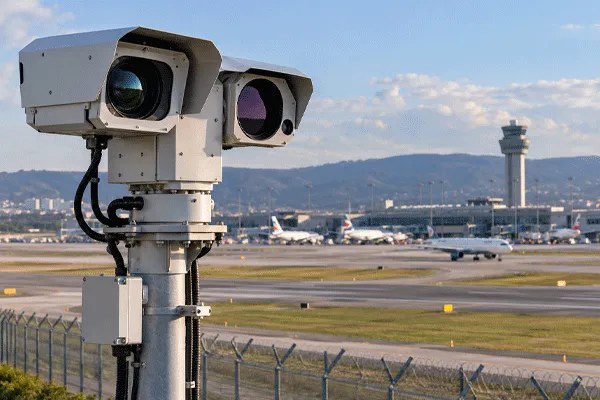
A radar may provide wide-area awareness while an EO camera helps operators visually assess activity around airfield or perimeter areas.
Ports and coastal facilities
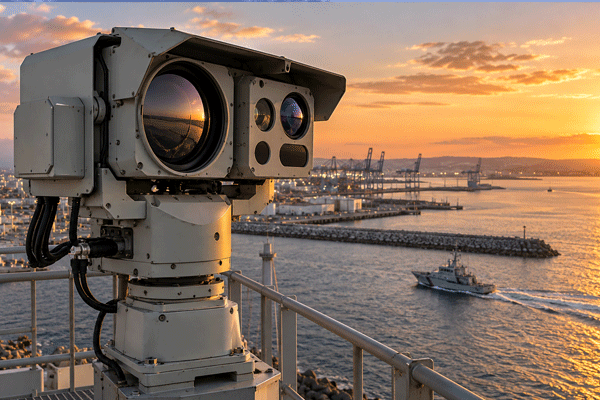
Long-range imaging can support observation of vessels, harbor entrances, shoreline areas, and restricted zones.
Energy and petrochemical facilities
Thermal and visible channels can support wide-area perimeter monitoring around tank farms, refineries, substations, and other large sites.
Industrial parks and logistics centers
A PTZ-based system for surveillance can complement fixed cameras where a facility includes large yards, roads, loading areas, and long boundaries.
Border and remote-site monitoring
Long-range optical sensing can provide visual information after another sensor identifies activity in a large observation area.
Mobile installations
Vehicle-mounted imaging systems allow a monitoring platform to move between sites or support temporary security requirements. Midradar’s current electro-optical catalog includes multiple vehicle-mounted thermal and multi-sensor configurations designed for mobile outdoor monitoring.
Maritime installations
A shipborne or coastal EO system faces additional challenges such as vibration, corrosion, platform movement, haze, and changing backgrounds.
A ship-borne electro-optical surveillance system therefore requires more than a good camera. Stabilization, environmental protection, mechanical strength, and platform integration become major design factors.
Electro Optical Equipment: How an Electro Optical Surveillance System Works
How Should Buyers Select Long-Range Electro Optical Equipment?
Start with the application—not the model number.
In our project discussions, we first want to understand what the operator must see, from where, and under what conditions.
Step 1: Define the observation task
Specify whether the system must provide:
- initial observation;
- visual verification;
- persistent tracking;
- event recording;
- day/night monitoring;
- radar-linked camera movement;
- multi-sensor observation.
Step 2: Define distance by task
Do not write only:
“Range: 10 km.”
Instead define what must happen at that distance.
For example:
- detect activity;
- recognize target type;
- obtain useful visual detail;
- maintain tracking.
These are very different requirements.
Step 3: Describe the environment
Tell the supplier whether the site is:
- coastal;
- humid;
- desert;
- cold;
- industrial;
- dusty;
- exposed to vibration;
- installed on a tower;
- installed on a building;
- installed on a moving platform.
Step 4: Select the sensing channels
A project may need:
HD daylight + uncooled thermal
or:
high-definition visible + cooled thermal
or:
visible + thermal + another complementary sensor
More channels are not automatically better. Every sensor should serve a defined operational need.
Step 5: Define interfaces
An integrated sensor system with IR may need to connect with:
- radar;
- VMS;
- command software;
- existing security platforms;
- alarm systems;
- mapping software;
- recording servers.
This step is often overlooked until installation.
That creates avoidable integration work.
What Specifications Matter Most in an Electro Optical Sensor System?
Procurement teams often receive specification sheets containing dozens of numbers. The challenge is knowing which ones actually affect the project.
A useful comparison can start here:
| Spezifikation |
Why It Matters |
| Visible resolution |
Determines available spatial detail |
| Thermal detector format |
Influences thermal image sampling |
| Pixel pitch |
Part of the imaging geometry |
| Spektralbande |
Defines the infrared region being observed |
| Brennweite |
Affects field of view and image scale |
| Optischer Zoom |
Enables wide-to-narrow observation |
| Minimum illumination |
Relevant to low-light visible imaging |
| NETD |
One measure related to thermal sensitivity |
| Pan/tilt accuracy |
Influences cueing and long-range pointing |
| Stabilisierung |
Helps maintain usable imagery |
| IP/environmental rating |
Supports outdoor deployment planning |
| Network protocol |
Determines system interoperability |
| Operating temperature |
Important for field reliability |
Do not select from one row.
For example, high accuracy pan-tilt positioning is valuable only if the sensor alignment, mounting structure, coordinate conversion, and timing are also controlled.
Likewise, a high-definition visible channel does not guarantee long-distance performance if atmospheric turbulence or platform vibration limits the delivered image.
This is why experienced system integrators compare the entire optical chain rather than individual headline specifications.
How Should Electro Optical Equipment Be Tested Before Acceptance?
The best time to define acceptance criteria is before ordering.
A practical factory or site acceptance plan should verify the functions that matter to your project.
Recommended checks
Image performance
Test visible and infrared channels using agreed targets and representative ranges.
Zoom and focus
Verify focus stability through the required zoom positions.
Pan-tilt movement
Check positioning, repeatability, low-speed movement, slew-and-settle behavior, and preset return.
Day/night operation
Confirm the system under more than one lighting condition.
Video and network
Verify streams, latency, recording, control, and system recovery.
Environmental operation
Check temperature, enclosure, connectors, corrosion protection, and mounting requirements according to the intended site.
External sensor linkage
For radar-connected installations, verify the complete chain:
Detection → coordinate transfer → camera movement → target-in-frame → tracking or operator verification
That final end-to-end test often tells more than individual component tests.
For a long-range system, keep original recordings and test metadata. Record range, weather, focal length, camera mode, installation height, time, and target type.
A polished demonstration video is useful for marketing.
A traceable test record is useful for engineering.
Why Work With an Electro Optics Systems Manufacturer That Also Integrates Radar?
Buying cameras is easy.
Building an effective multi-sensor system is harder.
A specialist electro optics systems manufacturer should understand not only imaging hardware but also optics, thermal channels, mechanical positioning, environmental protection, control protocols, tracking, and system integration.
For projects requiring wide-area awareness, the ability to integrate EO equipment with radar becomes especially important.
Midradar currently develops and supplies radar systems alongside electro-optical products, Wärmebildkameras, pan-tilt platforms, and radar-vision fusion systems. Its electro-optical catalog covers laser imaging, multispectral imaging, thermal products, and mobile configurations rather than a single camera family.
From our perspective, the correct workflow is:
Requirement → coverage analysis → sensor selection → optics selection → PTU matching → interface design → integration → testing → site commissioning
That approach is particularly useful for airports, ports, industrial facilities, energy infrastructure, large perimeter projects, logistics sites, and other environments where one standalone camera cannot provide complete coverage.
If you are preparing an electro optical project, provide your target observation distance, day/night requirements, site layout, installation height, environmental conditions, preferred sensor channels, and integration requirements.
With these inputs, we can evaluate whether the project needs a simple EO camera, a thermal PTZ, a multi sensor electro optical package, or a radar-linked surveillance architecture.
Key Things to Remember
- Electro optical equipment is a complete imaging chain, not simply a camera.
- Optical performance depends on the lens, sensor, processing, atmosphere, mechanics, and installation.
- A daylight camera and thermal camera provide complementary information.
- Cooled and uncooled thermal sensors should be selected according to actual range, sensitivity, size, power, maintenance, and lifecycle needs.
- Continuous zoom helps operators move between wide-area observation and narrow-field detail.
- Long-range optics require a stable, accurate pan-tilt platform.
- Radar can provide wide-area detection while EO/IR equipment provides visual or thermal verification.
- Airports, ports, industrial sites, energy facilities, coastlines, logistics areas, and large perimeters may benefit from integrated EO surveillance.
- Do not compare products only by resolution, focal length, or maximum claimed range.
- Define target, environment, observation task, range, interfaces, and acceptance criteria before selecting equipment.
- Test the complete detection-to-imaging workflow when the EO equipment is linked to another sensor.
- A supplier with research and development, manufacturing, imaging, pan-tilt, radar, and system-integration capabilities can simplify customized projects.
- The best electro optical surveillance system is the one that delivers useful, stable, verifiable imagery under the real conditions of your site.
Häufig gestellte Fragen
What is the difference between electro optical and ordinary CCTV equipment?
Ordinary CCTV is mainly designed for video observation. Professional electro optical equipment may combine long-focus optics, infrared imaging, thermal sensors, precision positioning, tracking, environmental protection, and external sensor integration. It is usually designed for larger areas and more demanding outdoor conditions.
Is thermal imaging the same as infrared imaging?
Thermal imaging is a form of infrared imaging, but the term infrared covers a broader range of wavelengths and technologies. A security project should specify the actual spectral band, detector type, optics, and required observation task instead of using “IR” as a complete specification.
Does an electro optical system need both visible and thermal cameras?
Not always. A dual-channel design is useful when the project requires detailed daytime imagery plus reliable night or low-visibility observation. Some sites need only one channel, while more complex projects may use several complementary sensor systems.
Is an uncooled thermal camera suitable for long-range monitoring?
It can be. Modern uncooled cameras support many medium- and long-range security projects. The correct choice depends on target size, required image detail, lens, detector, atmosphere, and actual range requirement. More demanding applications may justify a cooled architecture.
Can an EO camera automatically follow a radar track?
Yes, when the systems support compatible interfaces and the project includes correct coordinate transformation, time synchronization, PTU control, and calibration. The radar identifies and tracks activity across a wide area, while the optical system turns toward the corresponding location for visual or thermal observation.
What information should I send when requesting an electro optical system quotation?
Provide the application, required observation distance, target type, day/night requirement, installation height, site environment, desired visible and thermal channels, mounting method, required pan-tilt movement, network interfaces, and whether the camera must integrate with radar or another security platform.



 15:37