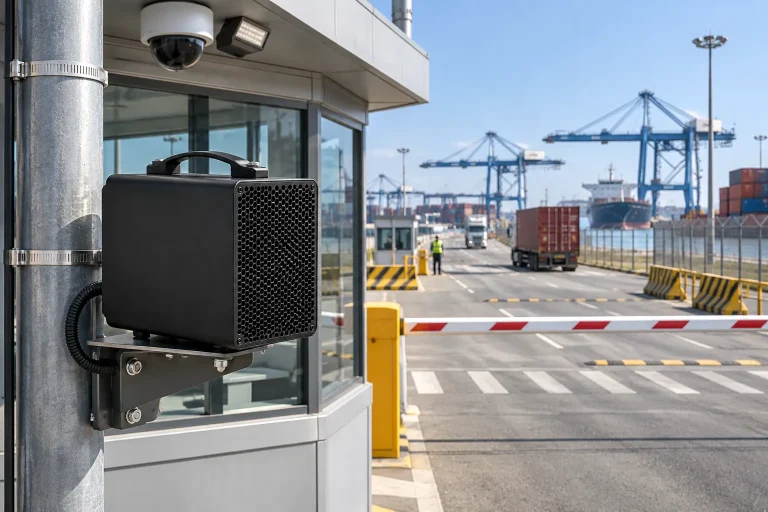
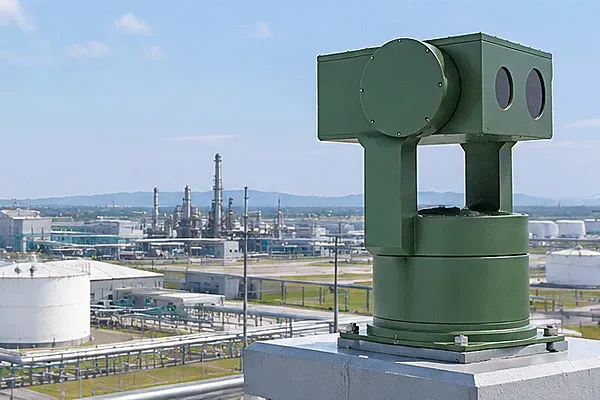
Large outdoor sites often struggle to deliver clear instructions across distance, traffic, wind, and machinery noise. A standard loudspeaker may not reach the intended area, while poorly planned high-output equipment can create safety and compliance concerns. A purpose-designed acoustic system makes remote communication more controlled and reliable.
An acoustic hailing deterrent system is a long-range public-address platform that projects live voice messages, recorded announcements, and warning tones toward a defined area. Depending on the model, it may use a focused directional unit, a 360° modular array, or a vehicle-mounted or pan-tilt configuration. Selection should consider message intelligibility, site coverage, environmental protection, control interfaces, and hearing-safety procedures.
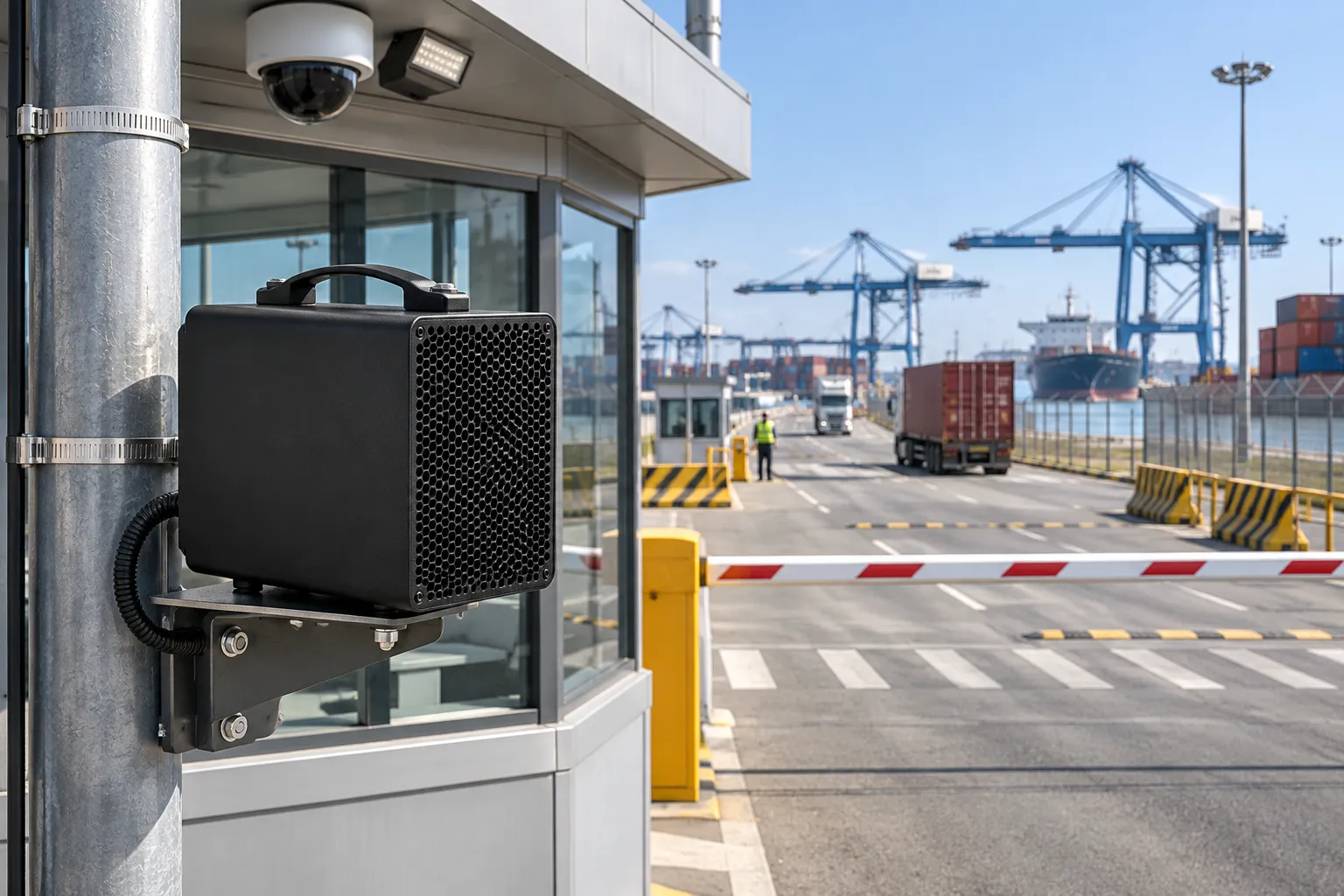
Acoustic Hailing Deterrent Systems: Long-Range Acoustic Devices for Public Safety
What Is an Acoustic Hailing Deterrent System?
An acoustic hailing system is designed to deliver voice messages and sound alerts over distances where conventional public-address equipment may have limited effectiveness. It converts electrical audio signals into sound and directs that sound toward a selected observation or communication area.
Unlike an ordinary loudspeaker, a directional acoustic hailing device is designed to concentrate sound within a defined coverage angle. This helps deliver instructions to a particular area while reducing unnecessary sound distribution in other directions. Some systems use a focused acoustic array, while others use modular units to provide wider coverage.
The main functions include:
- Long-distance voice communication.
- Remote public announcements.
- Recorded warning messages.
- Emergency notification.
- Site access instructions.
- Maritime communication.
- Perimeter warning and alerting.
- Support for evacuation procedures.
The term LRAD, or long-range acoustic device, may also appear in international product searches. However, different manufacturers and models can have different structures, output characteristics, and intended applications. Buyers should always compare actual product specifications rather than relying on an acronym alone.
For industrial and security projects, acoustic systems are best considered part of a broader communication and safety architecture.
How Does a Directional Acoustic Hailing Device Work?
A directional acoustic system uses an array of acoustic components to produce and direct sound toward a selected area. Its electronic system receives an audio signal from a microphone, audio storage unit, or external communication source and converts it into an output signal.
The acoustic components then reproduce the voice message. Their arrangement helps control the sound beam and improve communication over longer distances.
A typical system includes:
| Component |
Main Function |
| Acoustic transducer array |
Produces sound output |
| Audio amplifier |
Drives the acoustic components |
| Microphone |
Supports live voice announcements |
| Audio storage |
Stores recorded messages |
| Control unit |
Manages operating functions |
| Power supply |
Provides electrical energy |
| Mounting assembly |
Supports fixed or mobile installation |
| Communication interface |
Connects external control equipment |
The sound beam is an important design feature. A narrower beam provides more focused directional coverage, while a wider beam can cover a larger horizontal area.
This does not mean that narrower is always better. The correct design depends on the site’s geometry, the intended communication area, background noise, and the number of people or locations that need to receive the message.
Directional or Omnidirectional Acoustic Devices: Which Is Better?
The first major decision is whether the project needs directional communication or wide-area broadcasting.
Directional acoustic devices focus sound toward a selected area. They are useful when the operator needs to communicate with a particular location, such as a remote entrance, vessel, facility boundary, or access point.
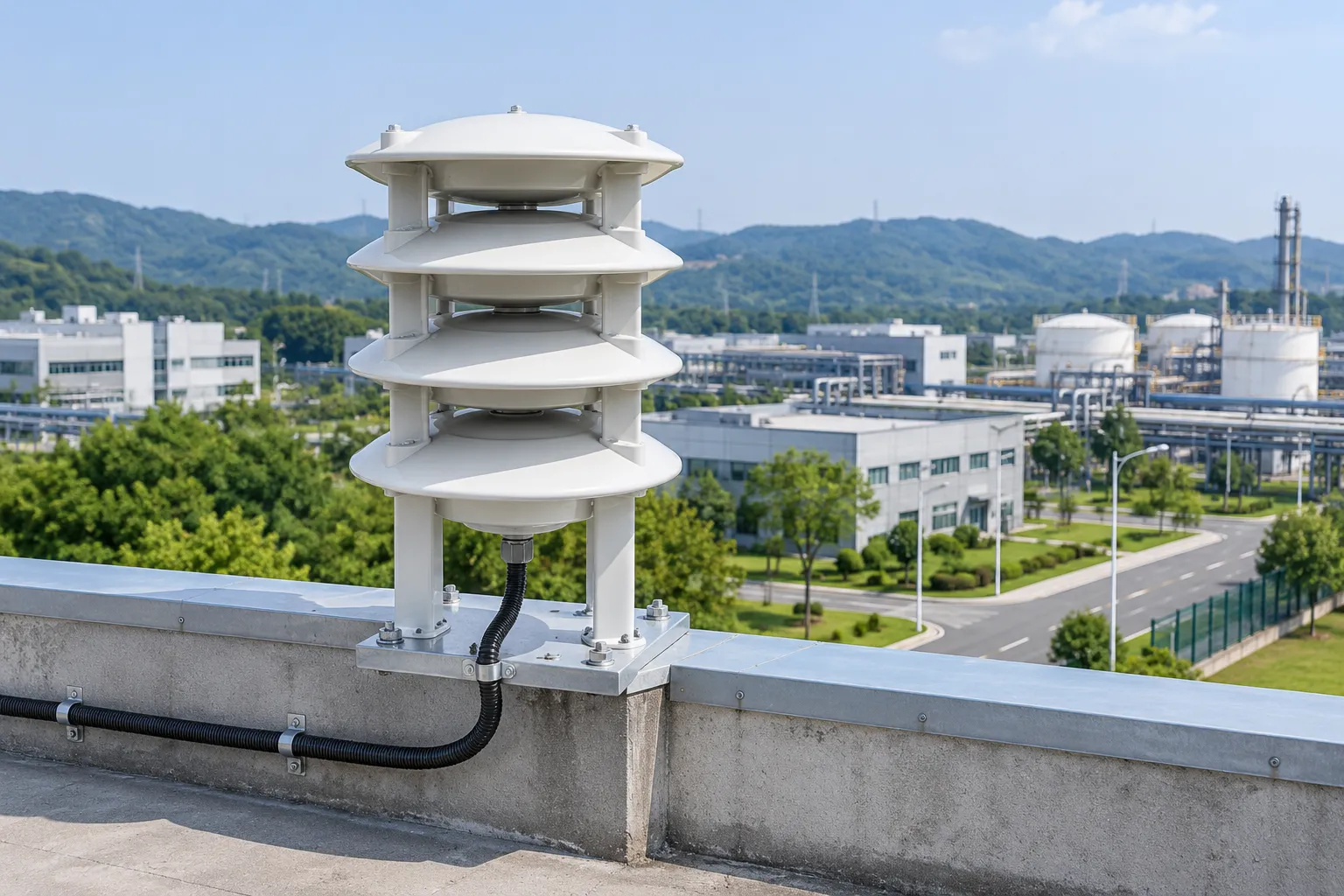
Omnidirectional acoustic devices use a different design. Instead of concentrating sound in one direction, they provide wider coverage around the installation point.
| Comparison |
Directional System |
Omnidirectional System |
| Coverage |
Focused area |
Wider surrounding area |
| Sound distribution |
Controlled direction |
Multiple directions |
| Typical installation |
Fixed or mobile |
Usually fixed or modular |
| Main purpose |
Targeted communication |
Area-wide announcements |
| Configuration |
Directional acoustic array |
Multiple acoustic disc units |
| Project consideration |
Beam coverage and alignment |
Area layout and sound distribution |
Midradar offers both configurations.
The MR-LAD146-M and MR-LAD160-M are portable directional models. The MR-LAD152-PChttps://midradar.com/mr-lad152-pc-omnidirectional-acoustic-dispersal-disc-system/ uses modular acoustic disc units to provide 360° coverage. The number of discs can be selected according to the project requirements.
For buyers, the correct choice should begin with a simple question:
Does the site need to communicate with one defined area or provide announcements across a wider space?
Answering this question helps narrow down the appropriate equipment category.
What Are the Main Applications of Long-Range Acoustic Systems?
Long-range acoustic systems can support communication and warning functions in several industries.
1. Port and Maritime Safety
Ports and coastal facilities often cover large areas. Operators may need to communicate with vessels, service teams, and personnel working around loading areas or restricted entrances.
A directional system can provide remote voice communication, while a wider-coverage configuration may support general announcements.
Airports contain runways, terminals, service roads, perimeter areas, and other operational zones. Acoustic communication equipment can support selected warning and announcement functions when integrated into an appropriate site communication plan.
3. Industrial and Energy Facilities
Large industrial sites may contain machinery, storage areas, pipelines, and multiple access points. Acoustic warning equipment can help deliver instructions to designated areas.
4. Emergency Response
Fire and rescue teams may need to communicate instructions across open spaces, difficult terrain, or noisy environments. Portable equipment can provide an additional communication channel when ordinary public-address systems are unavailable.
5. Critical Infrastructure
Power facilities, water facilities, transportation centers, and other important sites may require independent warning and communication equipment.
These applications show why acoustic communication should be selected according to the operating environment rather than simply the maximum advertised range.
What Factors Affect Long-Range Voice Clarity?
A product’s advertised transmission distance does not automatically guarantee clear speech at that distance.
Sound propagation depends on several environmental and equipment-related factors.
Background noise: Traffic, industrial machinery, engines, wind, and other sound sources can reduce message clarity.
Distance: Sound energy decreases as it travels. The received message may become less clear as the listener moves farther from the source.
Wind and weather: Wind direction, temperature, humidity, and atmospheric conditions can affect outdoor sound propagation.
Installation position: Building structures, walls, terrain, and other obstacles may affect the sound path.
Directional coverage: The listener must be within the effective coverage area of the device.
Audio quality: Poor recordings, unclear pronunciation, and excessive background noise can reduce intelligibility even when the hardware is capable.
The frequency range is another important specification. It describes the range of sound frequencies reproduced by the equipment. However, a wide frequency range alone does not prove that voice messages will remain clear in a real outdoor environment.
We recommend evaluating actual speech intelligibility through representative site tests.
A useful acceptance test should include different message types, background conditions, listening positions, and operating distances.
How Do You Choose the Right Acoustic Hailing Device?
Different projects need different equipment configurations. A portable device for emergency teams has different requirements from a fixed installation covering a large industrial facility.
Midradar’s product portfolio includes several configurations:
| Model |
Product Configuration |
Main Application Direction |
| MR-LAD146-M |
Portable directional acoustic device |
Mobile voice communication and remote warning |
| MR-LAD160-M |
High-output portable directional device |
Outdoor communication and warning |
| MR-LAD152-PC |
Modular omnidirectional acoustic disc system |
360° wide-area broadcasting |
| MR-LAD156-C |
Vehicle-mounted directional system |
Mobile site communication |
| MR-LAD166-PT |
Directional acoustic system with optional pan-tilt installation |
Flexible positioning |
| MR-LAD166-IR1500-PT |
Integrated pan-tilt acoustic and optical system |
Combined acoustic and optical communication equipment |
Several published specifications can help buyers understand the differences.
For example:
- MR-LAD146-M: Portable design, weight up to 4 kg, dedicated battery power, and IP65 protection.
- MR-LAD160-M: Portable design, weight up to 10 kg, dedicated battery configuration, and IP65 protection.
- MR-LAD156-C: Vehicle-mounted configuration with a published equipment weight of approximately 12 kg.
- MR-LAD152-PC: Modular 360° acoustic disc architecture, with a total weight below 65 kg and IP65 protection.
These are manufacturer-published product specifications. Buyers should request the latest datasheets to confirm the exact configuration and included accessories.
You can explore the complete Midradar Acoustic Hailing Deterrent System product range to compare the available models.
Acoustic Hailing Deterrent Systems: Long-Range Acoustic Devices for Public Safety
What Do Decibel, Sound Pressure, and Directionality Mean?
When comparing acoustic equipment, buyers often see sound pressure levels expressed in dB. A decibel is a logarithmic unit used to describe sound levels.
However, the sound pressure specification is only one part of the evaluation. It does not independently establish speech intelligibility, actual communication distance, or safe exposure conditions.
Important parameters include:
- Peak sound pressure level and its measurement reference.
- Sound beam angle.
- Frequency response.
- Audio distortion.
- Voice intelligibility.
- Coverage pattern.
- Environmental protection.
- Operating duration.
Directionality describes how strongly the sound is concentrated toward a particular area. It is important for projects that require focused communication.
Buyers should also distinguish between a manufacturer’s maximum transmission distance and a tested communication distance under defined conditions.
For example, wind, obstacles, background noise, and listener position may produce different results at the same nominal distance.
We recommend requesting the measurement conditions behind every important performance figure.
Most importantly, a high-output acoustic system requires an appropriate hearing-safety plan. The equipment should not be evaluated only by how much sound it can produce.
How Do Power Supply and Control Interfaces Affect Deployment?
Power and control requirements should be confirmed before purchasing equipment.
Portable systems may use dedicated battery packs, while larger installations may require an external electrical supply. Some modular systems also support alternative power arrangements according to their configuration.
Control functions can include:
- Live voice input.
- Recorded audio playback.
- Remote activation.
- Network communication.
- Wireless control where supported.
- System status monitoring.
- External control integration.
For example, the MR-LAD152-PC product page lists optional TCP/IP and wireless communication interfaces. Its modular architecture also allows the number of acoustic discs to be configured according to project needs.
A vehicle-mounted system requires additional attention to mounting space, vehicle power, cable protection, vibration, and operator control.
For fixed installations, engineers should evaluate enclosure protection, cable routing, grounding, mounting strength, and access for maintenance.
The best approach is to define the complete electrical and control architecture before installation rather than treating these requirements as an afterthought.
What Safety and Compliance Checks Should Be Completed Before Installation?
Acoustic equipment must be operated with appropriate attention to hearing safety and local regulations.
Sound exposure depends on intensity, distance, duration, and repetition. A sound level that is acceptable for a short controlled test may not be suitable for repeated exposure.
The US National Institute for Occupational Safety and Health (NIOSH) recommends an occupational noise exposure limit of 85 dBA averaged over an eight-hour workday. OSHA also requires hearing conservation programs when covered employee exposure reaches an eight-hour time-weighted average of 85 dBA.
These are occupational exposure standards, not universal safe operating limits for every acoustic application.
Before installation, project teams should consider:
- A site-specific acoustic risk assessment.
- Safe operating and testing procedures.
- Appropriate operator training.
- Hearing protection for personnel where required.
- Restricted access to designated test areas.
- Clear warning and operating instructions.
- Compliance with local noise and public-address regulations.
- Documented inspection and maintenance procedures.
For international projects, regulatory requirements can differ between countries and industries. Importers and system integrators should verify applicable local requirements before procurement.
A responsible project should prioritize clear communication, controlled operation, and protection of personnel and the public.

Acoustic Hailing Deterrent Systems: Long-Range Acoustic Devices for Public Safety
How Can Midradar Support a Customized Acoustic Hailing Project?
Choosing a suitable acoustic system is not just a product comparison exercise. It requires an understanding of the site, communication requirements, installation conditions, and control architecture.
Midradar is a China-based surveillance technology provider specializing in radar systems, electro-optical imaging, thermal imaging, pan-tilt platforms, acoustic equipment, and integrated security solutions.
Our acoustic product portfolio includes portable directional equipment, vehicle-mounted systems, modular omnidirectional systems, and integrated acoustic-optical configurations.
For international buyers, system integrators, security engineering contractors, distributors, and project developers, the selection process can begin with a technical review of the project requirements.
We recommend providing the following information:
- Project application and industry.
- Required communication area.
- Preferred directional or 360° coverage.
- Fixed, portable, vehicle-mounted, or pan-tilt installation.
- Available power supply.
- Network and control interface requirements.
- Outdoor environmental conditions.
- Required documentation and acceptance criteria.
- Expected quantity and delivery location.
Based on these details, the engineering team can help identify suitable product configurations and clarify which specifications need to be verified.
If your project involves airport operations, port communication, industrial facilities, emergency response, or critical infrastructure, you can contact Midradar to discuss your requirements.
Explore Acoustic Hailing Deterrent Systems or Contact Midradar for product information and project consultation.
Key Takeaways
- Acoustic hailing systems provide long-range voice communication, announcements, and warning functions.
- Directional systems focus sound toward selected areas, while omnidirectional systems support wider coverage.
- Environmental conditions and background noise affect actual communication performance.
- Sound pressure figures alone cannot establish voice clarity or safe operation.
- Portable, vehicle-mounted, modular, and pan-tilt configurations serve different project requirements.
- Power supply, control interfaces, mounting, and environmental protection should be checked before installation.
- Hearing safety and local compliance must be included in project planning.
- Midradar provides multiple acoustic equipment configurations for different site and communication requirements.
- The best solution is the one that delivers clear, reliable communication while meeting the project’s technical, environmental, and safety requirements.
FAQ
What is the difference between a directional and an omnidirectional acoustic system?
A directional system focuses sound toward a selected area, while an omnidirectional system distributes sound across a wider surrounding area. The correct option depends on the required coverage and site layout.
How far can an acoustic hailing device transmit voice messages?
Transmission distance depends on the model, environmental conditions, background noise, sound coverage, and required message intelligibility. Manufacturer specifications should be verified through testing under representative site conditions.
Can acoustic hailing equipment be installed on a vehicle?
Yes. Midradar offers the MR-LAD156-C vehicle-mounted directional system. A vehicle installation should account for mounting strength, power availability, vibration, cable protection, and operator access.
Can an acoustic hailing system provide 360° coverage?
Yes. The MR-LAD152-PC uses modular acoustic disc units to provide 360° coverage. The number of units can be selected according to the required site configuration.
Can acoustic hailing systems work with remote control platforms?
Some configurations support network or wireless control interfaces. For example, the MR-LAD152-PC lists optional TCP/IP and wireless communication. Compatibility should be confirmed with the customer's control platform.
What should buyers check before purchasing an acoustic hailing system?
Buyers should review the coverage pattern, voice intelligibility, transmission specifications, power supply, installation method, environmental protection, communication interfaces, hearing-safety requirements, and local regulatory requirements.



 10:18