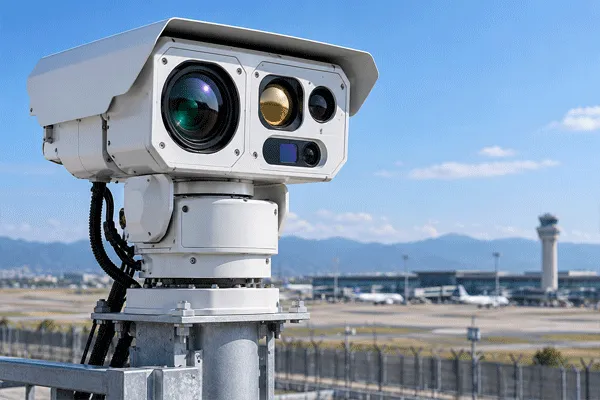
Modern security threats move fast, often from several directions at once. Traditional rotating systems may leave valuable time between scans. Four-sided AESA technology addresses this challenge by providing continuous electronic scanning around protected areas, helping operators maintain a clearer picture of their surroundings.
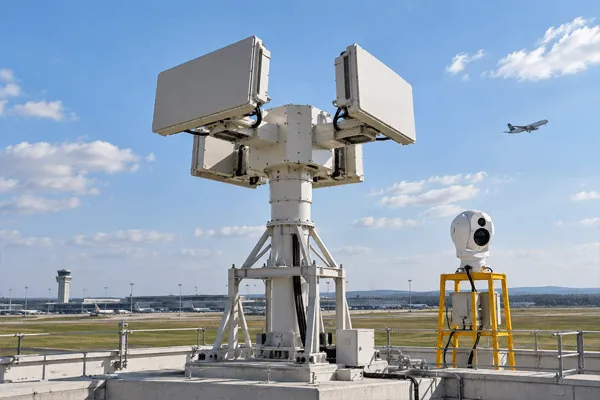
A four-sided AESA radar uses four fixed antenna faces to provide full 360-degree coverage without mechanically rotating its main antenna structure. Unlike the rotating ground-based Giraffe 4A radar, this design uses separate electronically steered panels to monitor different directions simultaneously. It is suitable for applications requiring rapid updates, continuous observation, and integration with wider security networks.
Four-Sided AESA Radar vs. Giraffe 4A Radar: Advanced Technology for 360° Surveillance
1. What Is a Four-Sided AESA Radar and How Does It Work?
A four-sided system uses four fixed antenna panels arranged to cover different directions. Together, they provide overlapping fields of view around the installation.
The core technology is known as an active electronically scanned array (AESA). Instead of relying entirely on mechanical movement, it controls the direction of an electromagnetic beam through electronic adjustments.
Each panel contains multiple transmitting and receiving elements. The system manages these elements to steer its beam, scan selected areas, and collect target information.
This arrangement offers several important characteristics:
- Full 360-degree horizontal coverage through four coordinated antenna faces.
- Electronic beam steering without rotating the main antenna assembly.
- Rapid updates across designated monitoring sectors.
- Simultaneous observation of multiple directions.
- Flexible integration with external command and monitoring platforms.
The actual coverage depends on panel geometry, elevation limits, beam steering capability, and installation conditions.
Four panels alone do not guarantee complete three-dimensional coverage. System designers must also consider vertical viewing angles, overlapping sectors, and nearby obstacles.
For buyers, this distinction matters. The number of antenna faces describes the physical configuration, while real-world performance depends on the complete system design.
2. Why Is Four-Sided Radar Technology Important for Modern Surveillance?
Traditional rotating antennas provide broad area coverage, but each target direction must be revisited as the antenna completes its rotation.
Fixed electronic scanning offers a different approach. Four independent faces can observe separate sectors without waiting for one mechanical assembly to turn toward a particular direction.
This architecture is valuable when several objects appear at different locations within a monitored area.
Consider a large airport, for example.
Security operators may need to observe activity near an approach corridor while monitoring another object close to the airport boundary. A suitable fixed-face configuration can assign scanning resources to different areas according to system design.
The main advantages include:
Continuous directional availability: Each face remains physically oriented toward its assigned coverage sector.
Flexible scanning: Electronic beam control allows the system to manage observation tasks without mechanical antenna repositioning.
Multiple-target monitoring: Appropriate processing software can maintain information about several objects within the covered area.
Reduced dependence on mechanical rotation: The main antenna structure does not need a rotating drive mechanism.
However, a fixed configuration does not automatically deliver better performance in every application. Detection distance, target update rate, processing capacity, and environmental conditions must still be evaluated.
Four-Sided AESA Radar vs. Giraffe 4A Radar: Advanced Technology for 360° Surveillance
3. How Does Four-Sided AESA Radar Compare with Giraffe 4A Radar Systems?
The Giraffe 4A radar is a well-known reference in advanced technology. Developed by Saab, it is designed for multifunctional monitoring and provides capabilities including target detection, object localization, and support for broader protection networks.
An important technical distinction is that the standard land-based Giraffe 4A uses a rotating antenna architecture with electronically steered scanning.
It can also operate in a non-rotating sector mode when greater attention must be directed toward a known area.
It should therefore not be described as a conventional four-fixed-face product.
Four Fixed Faces vs. Rotating Electronic Scanning
| Comparison |
Four-Sided AESA Architecture |
Giraffe 4A |
| Antenna Configuration |
Four fixed antenna faces |
Ăng-ten quay |
| Horizontal Coverage |
360° through coordinated panels |
360° rotating coverage |
| Beam Steering |
Điện tử |
Điện tử |
| Mechanical Antenna Rotation |
Not required |
Used in rotating mode |
| Sector Monitoring |
Available through panel configuration |
Dedicated sector mode |
| Tần suất cập nhật |
Depends on system design |
Manufacturer specifies approximately one-second revisit in rotating mode |
| Installation |
Fixed structures or suitable platforms |
Deployable land configuration |
| Main Consideration |
Continuous coverage from multiple fixed directions |
Flexible multifunctional operation |
The Giraffe family also includes a separate product called Sea Giraffe 4A Fixed Face.
It demonstrates why product specifications must be checked carefully. Systems within the same product family may use different antenna architectures.
For procurement teams, the correct question is not simply which product is more advanced. It is which architecture best matches the installation environment, required performance, and project budget.
4. What Are the Main Advantages of Four Fixed Antenna Faces?
One important advantage of a fixed-face configuration is that its antenna panels can remain available for observation in different directions.
This can be useful when system designers need to balance coverage, update frequency, and integration with other monitoring equipment.
Continuous 360° Monitoring
Four coordinated panels support observation around the protected facility without requiring a mechanically rotating antenna.
The design is particularly relevant for installations where potential risks or unusual activities may emerge from multiple directions.
Flexible Electronic Beam Control
Electronic steering enables changes in beam direction within each panel’s operating limits.
Depending on the system’s processing capacity, designers can configure different search and tracking priorities.
Reduced Mechanical Complexity
Eliminating the main rotating antenna mechanism removes one category of moving components.
However, this does not mean the complete equipment becomes maintenance-free. Cooling equipment, power modules, electronic components, and communication interfaces still require appropriate inspection.
Integration with Other Technologies
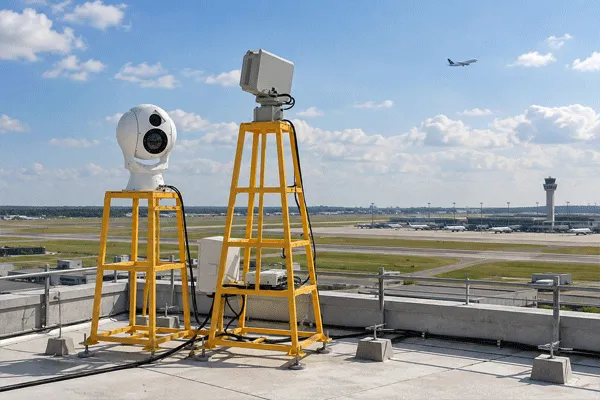
A four-sided installation can form part of a larger system that includes imaging devices, monitoring software, communications infrastructure, and centralized control.
This wider integration is particularly important for customers who require an operational solution rather than an isolated piece of hardware.
5. How Can Four-Sided Radar Support Modern Airspace Monitoring Systems?
Advanced monitoring equipment plays an important role in modern airspace monitoring systems by providing operators with information about activities within a protected area.
A fixed-face configuration can support continuous observation across different directions, helping operators maintain an updated understanding of surrounding activity.
This information may be shared with authorized command and control infrastructure, depending on interface compatibility and system requirements.
The potential applications include:
- Monitoring designated airspace around critical facilities.
- Supporting authorized security teams with situational information.
- Observing multiple airborne objects.
- Providing information to compatible monitoring platforms.
- Maintaining a wider operational picture through coordinated sensing.
In this context, airspace monitoring involves more than a single detection device.
The effectiveness of an integrated solution also depends on communication reliability, operator training, software interoperability, and operational procedures.
A radar installation should therefore be evaluated as one component of a broader architecture.
Four-Sided AESA Radar vs. Giraffe 4A Radar: Advanced Technology for 360° Surveillance
6. Where Are Ground-Based Four-Sided Radars Commonly Used?
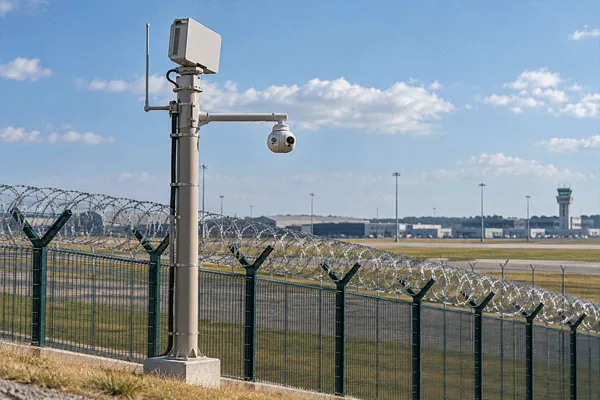
A ground-based fixed-face system is particularly relevant to permanent facilities requiring observation in multiple directions.
Unlike a mobile deployment, a fixed installation can be designed around the physical characteristics of a specific location.
These characteristics include terrain, surrounding buildings, environmental exposure, available infrastructure, and maintenance access.
Các kịch bản ứng dụng điển hình
| Ứng dụng |
Main Monitoring Requirement |
Integration Considerations |
| Airports |
Airspace awareness and monitoring around operational areas |
Aviation coordination and visual verification |
| Border Facilities |
Wide-area monitoring across designated zones |
Centralized information management |
| Coastal Facilities |
Observation of designated approaches |
Maritime and optical equipment integration |
| Power Plants |
Security awareness around critical infrastructure |
Existing facility security platforms |
| Petrochemical Complexes |
Monitoring of large protected sites |
Perimeter cameras and centralized alarms |
| Critical facilities |
Continuous observation across several directions |
Access control and incident management |
The suitable configuration varies considerably between these applications.
For example, an airport project may place greater emphasis on identifying airborne activity, while an industrial facility may prioritize integration with existing site security infrastructure.
At Midradar, we believe these differences should be addressed during project planning rather than after installation.
A successful solution begins with understanding the site, the objects that need to be monitored, and the information operators expect to receive.
7. How Do Fixed-Face Systems Handle Small and Low-Altitude Targets?
Small airborne objects create special monitoring challenges.
Their physical size, movement patterns, operating altitude, and surrounding environment can affect how reliably they appear in monitoring data.
A drone operating close to buildings or vegetation, for instance, presents a different observation problem from a larger aircraft moving through open airspace.
An advanced fixed-face architecture can support continuous sector monitoring, but its actual ability to detect particular objects depends on several technical factors.
These include:
- Operating frequency and waveform design.
- Antenna characteristics.
- Target radar cross-section.
- Signal processing capability.
- Local terrain and surrounding obstacles.
- Environmental interference.
- System configuration and installation height.
No single equipment specification can fully describe performance in every operating environment.
This is why buyers should distinguish between maximum instrumented range and practical detection performance for a specified target.
The distinction becomes especially important for low-altitude monitoring projects.
We recommend asking suppliers to provide performance information based on clearly defined target characteristics and test conditions rather than relying exclusively on headline range figures.
8. How Does Four-Sided Radar Integrate with Electro-Optical and Thermal Imaging Systems?
A detection system provides important information about the presence and movement of objects. However, operators may still need visual information to understand what they are observing.
This is where electro-optical equipment and thermal imaging become valuable.
At Midradar, we specialize in integrating advanced monitoring technologies, including surveillance equipment, electro-optical imaging, thermal cameras, intelligent pan-tilt platforms, and centralized management solutions.
Our approach focuses on helping customers combine complementary technologies into practical project configurations.
A Typical Integrated Monitoring Architecture
| Thành phần hệ thống |
Main Function |
| Four Fixed Antenna Faces |
Provide coordinated directional monitoring |
| Processing Unit |
Processes collected detection information |
| Electro-Optical Imaging |
Supports visual observation |
| Hình ảnh nhiệt |
Provides additional imagery based on thermal contrast |
| Intelligent Pan-Tilt Platform |
Directs compatible imaging equipment |
| Management Software |
Displays available information through a common interface |
| Operator Workstation |
Supports monitoring and incident assessment |
An integrated solution helps reduce the need for operators to interpret unrelated information from several independent devices.
Instead, compatible equipment can contribute information to a shared monitoring environment.
The result is a clearer operational picture and a more practical system for daily security management.
The exact level of integration depends on supported communication protocols, software functions, and the requirements of each project.
9. What Should Buyers Consider When Selecting a Multi-Function Radar?
Selecting a multi-function radar requires a careful review of technical specifications and operational requirements.
A system with impressive published performance may still be unsuitable if it does not meet the installation, environmental, or integration conditions of the intended project.
Government buyers, system integrators, and system integrators should begin by defining the intended application.
A useful procurement process should address five areas.
1. Coverage Requirements
Determine the horizontal and vertical areas that must be monitored.
For a four-sided configuration, ask the manufacturer to explain how coverage overlaps between adjacent antenna faces.
2. Detection Performance
Request clearly defined operating specifications.
These should include the relevant target characteristics, environmental conditions, and assumptions used in published performance figures.
3. Integration Compatibility
Check whether the proposed equipment can exchange information with the project’s existing monitoring infrastructure.
This may include imaging devices, command platforms, and security management software.
4. Installation and Maintenance
Review the power supply, cooling requirements, mounting structure, weather protection, and access needed for maintenance.
5. Project Support
Evaluate the supplier’s ability to provide customization, documentation, installation guidance, training, and long-term technical assistance.
The table below summarizes the most important questions.
| Mục Đánh giá |
Questions for the Supplier |
| Vùng phủ sóng |
What horizontal and elevation coverage is supported? |
| Phát hiện |
Under what conditions are performance figures measured? |
| Theo dõi |
How many targets can the system process simultaneously? |
| Giao diện |
Which communication protocols are supported? |
| Installation |
What mounting and infrastructure requirements apply? |
| Bảo Vệ Môi Trường |
What operating conditions are specified? |
| Bảo trì |
Which components require routine servicing? |
| Tùy chỉnh |
Can the configuration meet project-specific requirements? |
For procurement teams, these details are often more useful than comparing a single headline specification.
10. Why Choose Midradar for Customized Radar and Intelligent Security Solutions?
Choosing a monitoring solution involves more than selecting an antenna configuration.
Different projects require different combinations of sensing equipment, software functions, installation infrastructure, and operational support.
As a professional Chinese provider of advanced radar surveillance and intelligent security solutions, Midradar specializes in research and development, manufacturing, integration, and international project support.
Our product and solution portfolio includes:
Rather than treating every project as a standard equipment purchase, we work with customers to understand their application requirements and identify suitable system configurations.
Supporting Global Security Projects
We serve public-sector organizations, airport operators, border monitoring authorities, critical infrastructure owners, engineering contractors, system integrators, and international distributors.
Our work focuses on connecting monitoring requirements with practical equipment selection and integration.
For projects involving fixed-face architecture, we recommend confirming the required configuration, relevant specifications, and integration scope during the technical consultation stage.
This ensures that proposed equipment and system capabilities can be assessed against the actual project requirements.
From Equipment Selection to System Integration
We understand that procurement teams must consider performance, compatibility, installation conditions, and long-term support.
Our goal is to help customers make informed decisions by providing relevant technical information and project-oriented solutions.
Whether your organization is planning a new airport monitoring system, upgrading critical infrastructure security, or evaluating a wider protection network, Midradar can help you explore suitable technology options.
Liên hệ Midradar to discuss your project requirements and request a customized surveillance solution
Key Takeaways
- A four-sided AESA configuration uses four fixed antenna panels to support 360-degree monitoring without mechanical antenna rotation.
- Electronic beam steering supports flexible observation and rapid directional updates.
- The standard Giraffe 4A is a rotating multifunctional system, while Saab also provides a separate Sea Giraffe fixed-face variant.
- Actual performance depends on antenna design, processing capacity, target characteristics, and environmental conditions.
- Integrated electro-optical and thermal imaging equipment can provide valuable complementary information.
- Procurement teams should prioritize verified technical specifications, system compatibility, installation requirements, and long-term support.
- Midradar provides project-oriented security solutions for international customers requiring professional equipment integration and customization.
Planning a new surveillance project? Contact Midradar to explore a solution tailored to your operational requirements.
Câu hỏi thường gặp
What is a four-sided AESA radar?
It is a system that uses four fixed antenna faces to provide coordinated 360-degree monitoring. Electronic beam steering allows each panel to scan its assigned area without rotating the main antenna structure.
Is Giraffe 4A a four-sided fixed-face system?
No. The standard land-based Giraffe 4A uses a rotating antenna with electronic beam steering and also supports a dedicated non-rotating sector mode. Saab offers a separate fixed-face product within its Sea Giraffe family.
What is the difference between rotating and fixed-face configurations?
A rotating design moves its antenna mechanically to provide coverage around the installation. A fixed-face design uses stationary panels positioned in different directions. Both approaches can use advanced electronic scanning, but their installation and operating characteristics differ.
Can four-sided systems monitor several targets at the same time?
Yes, depending on their processing capacity and configuration. The actual number of simultaneous targets, update frequency, and classification capability must be confirmed through manufacturer specifications.
Are four-sided systems suitable for airports and critical infrastructure?
They can be suitable where continuous directional monitoring is required. Final equipment selection should consider the site's layout, surrounding obstacles, operational requirements, and applicable installation regulations.
Can Midradar provide customized integrated surveillance solutions?
Yes. Midradar provides advanced monitoring equipment and integrated security solutions, including radar-vision fusion, electro-optical imaging, thermal cameras, and related system components. Specific equipment configurations and technical requirements should be confirmed through project consultation.




 16:57