Introduction
Modern VIP protection is built around a layered security model. Route surveys identify physical chokepoints. Advance teams pre-clear venues. Monitoring teams watch for unusual movement around the route. Vehicles are reinforced and GPS-tracked. Communication is encrypted. The protection detail is trained, coordinated, and positioned.
This model addresses many common risks well: physical disruption, crowd activity, vehicle-related incidents, communication issues, and route exposure. What it often underaddresses is the external observer outside the route who is not following anyone, not transmitting anything, and not approaching the convoy — but is carefully watching it through a long-range optical instrument.
For VIP transport and motorcade protection, this optical observation layer can become a blind spot if the team has no way to detect when cameras, spotting glasses, thermal monoculars, or other optical devices are pointed toward the moving convoy.

Why Optical Observation Is a Structural Gap in VIP Transport Security
The risk of persistent optical observation against VIP transport is not new. However, it has become more practical with the commercialization of high-performance optical technology.
Equipment that once required significant investment and specialist knowledge — such as long-range telephoto photography, high-power spotting devices, and thermal imaging at extended distances — is now commercially available at a much lower cost.
More importantly, optical observation generates no electronic signature. A person using a spotting glass, long-range camera, or thermal imaging device:
Does not transmit signals that can be detected by RF monitoring tools
Does not need to approach the convoy, cross a security line, or trigger a physical barrier
Can operate from a parked vehicle, a building window, or open ground
Can repeatedly document vehicle configuration, movement timing, personnel positioning, and route habits over time
A protection team may conduct excellent physical security and route management, yet still remain visible to a patient external observer if there is no dedicated optical detection layer in place.
What External Observers May Collect
To understand why this matters, consider what a single observer with a long-range telephoto lens can document from several hundred meters away:
The VIP vehicle position within the convoy and its distinguishing characteristics
The number and positioning of security personnel
Movement patterns when the motorcade stops, slows, or changes route
The VIP’s movement behavior, such as which side they exit from and how long they remain outside the vehicle
The visible equipment and coordination patterns of the close protection team
Each observation session may only capture part of the picture. But repeated observation over days or weeks can help an external observer build a detailed understanding of the protection arrangement.
For this reason, optical observation detection is not only about identifying a single camera. It is about reducing the ability of unauthorized observers to collect repeated, long-term visual information about VIP movement patterns.
How Mobile Optical Detection Changes the Dynamic
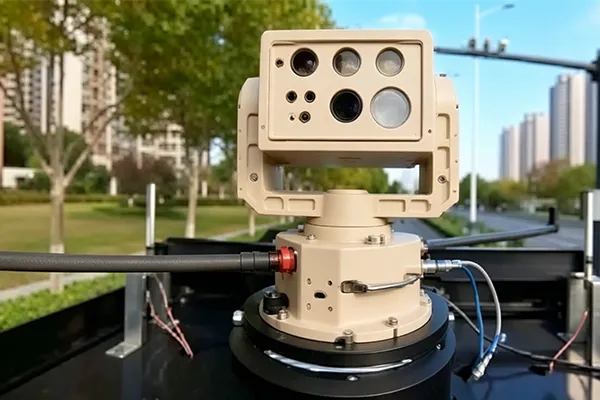
A vehicle-mounted optical detection system like the FinderPro-M operates from within the convoy itself, continuously scanning the surrounding environment during transit.
When an optical instrument is oriented toward the convoy — such as a telephoto camera, spotting glass, thermal monocular, or similar observation device — it can return a distinctive retro-reflective signature. The system detects, localizes, and reports the optical device within seconds.
The key value is not only detection. It is the change in behavior once observation becomes difficult to maintain.
An observer who does not know they have been detected may continue operating. An observer who understands that optical devices pointed toward the convoy can be detected quickly is less able to conduct persistent observation. Repositioning after each brief attempt makes long-term information collection more difficult and less reliable.
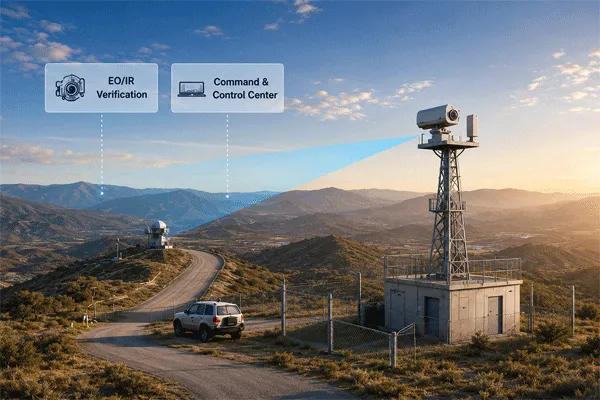
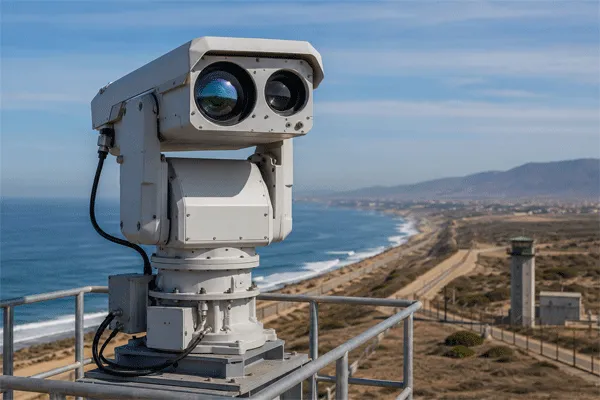
This is similar to the logic behind fixed perimeter monitoring systems. The goal is to make unauthorized optical observation consistently detectable, so that security teams can identify, locate, and respond to suspicious observation activity before it becomes a long-term exposure.
The Advance Team Dimension
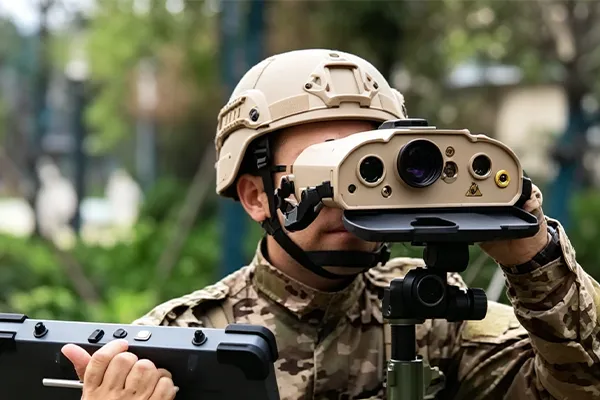
Cái FinderPro-P handheld device extends this capability to advance teams operating ahead of the convoy.
Before VIP movement begins, advance personnel can sweep buildings, elevated positions, roadside areas, and temporary stops along the planned route. This helps identify pre-positioned optical instruments or suspicious observation points before the convoy arrives.
With a lightweight design and a 1,200 m detection range, the FinderPro-P can be carried during normal advance team operations without dedicated equipment support. It can be used as part of standard venue checks, route pre-clearance, and temporary location verification.
Integrating Optical Detection into the Protection Stack
Optical detection does not replace existing VIP protection measures. It adds a dedicated detection and response layer for a specific observation risk that conventional tools may not fully address.
In a complete protection architecture, optical detection can work alongside:
Radar-based low-altitude monitoring for aerial observation platforms
EO/IR camera systems for visual confirmation of detected concerns
Acoustic warning devices for crowd and perimeter management
Physical security and close protection teams for on-site response
Command software for event logging, coordination, and response management
Each layer addresses a different part of the protection environment. The optical observation layer is specifically designed to help identify long-range visual monitoring that may otherwise remain unnoticed.
For the full integrated VIP protection solution, including system configuration options for different VIP transport scenarios, visit the VIP Motorcade & Close Protection solution page.
For a comparison of FinderPro system variants by deployment context, see the Optical Surveillance Detection Systems catalog.
Cái Giải pháp an ninh công cộng page explains how optical detection can work together with Midradar’s wider radar, EO/IR camera, command software, and intelligent security portfolio.
Kết luận
VIP transport protection is not only about the vehicle, the route, or the personnel around the principal. It is also about controlling what can be observed from outside the route.
As long-range cameras, spotting devices, and thermal imaging tools become more accessible, optical observation detection becomes an important part of modern VIP movement security.
Fixed systems can protect known venues and static areas. Vehicle-mounted systems such as FinderPro-M help maintain detection capability during transit. Handheld systems such as FinderPro-P support advance checks and temporary site verification.
Together, these tools help close the optical observation gap and give security teams a more complete view of the environment around VIP movement.



 13:43
13:43